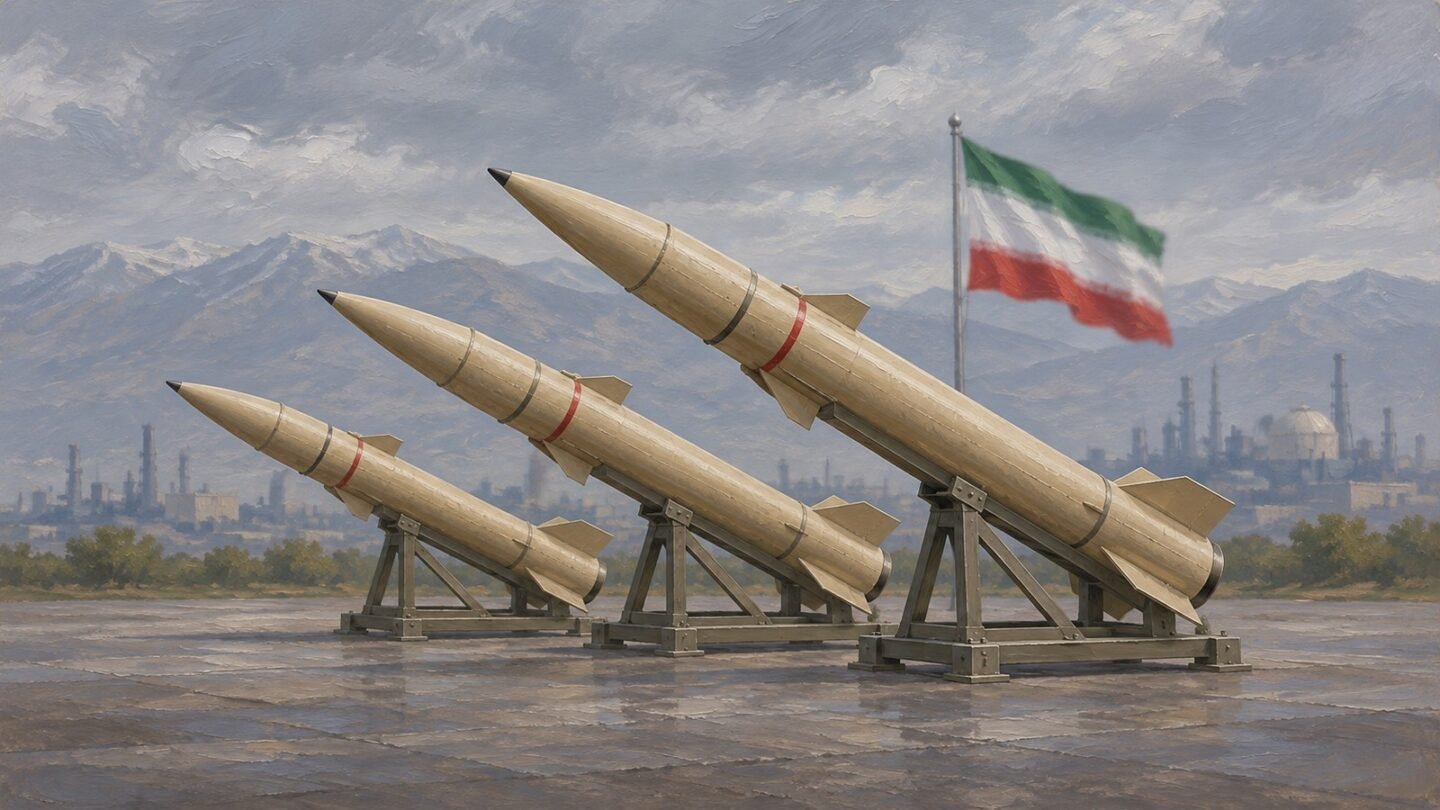
U.S. intelligence estimates put the Iran missile count at between 1,500 and 2,500, American officials told The Wall Street Journal, leaving Tehran with a substantial ability to threaten U.S. and allied targets if large-scale fighting resumes.
The officials described the figure as a low-confidence assessment because tracking missiles ready for launch and those in storage is difficult. The estimate should therefore be reported as an uncertain intelligence judgment, rather than a verified inventory.
What the Iran Missile Count Report Says
Anadolu’s November 15 account of the Journal’s reporting says Iran has continued rebuilding its arsenal despite damage from American and Israeli strikes. It describes replenishment proceeding more slowly than before the war.
Ynet, also citing the Journal, reports that Iran has relied mainly on components stored before the strikes. That distinction separates damage to manufacturing facilities from the possibility of assembling additional weapons using parts already available.
Anadolu reports that Israeli military officials separately estimate Iran holds more than 1,500 ballistic missiles, while noting that regional assessments differ. Its account also describes remaining drones and short-range missiles.
These figures should not be added together to produce a new total. The reporting does not provide a complete breakdown showing which categories overlap or how many weapons in each category are immediately usable.
Why Low Confidence Matters
The uncertainty is central to the Iran missile count. The Journal’s accessible account attributes the estimate to U.S. officials; the materials reviewed do not include the underlying intelligence assessment or a complete explanation of its methodology.
Public U.S. intelligence analytic standards distinguish confidence in the evidence supporting a judgment from the likelihood that an event will occur. They direct analysts to explain information gaps, assumptions and other sources of uncertainty.
Under those standards, confidence can depend on the quantity and quality of information, the reasoning used and analysts’ understanding of the subject. It is not simply a percentage describing the chance of an attack.
Applied to this report, the label means readers should retain the uncertainty attached to the inventory estimate. It does not establish that Iran will launch a particular operation, nor does the upper figure mean every missile is ready to fire.
The standards provide general background on interpreting intelligence language. They do not independently authenticate this reported assessment or establish the actual size of Iran’s arsenal.
How the Estimate Compares With Trump’s Claims
The reported remaining capability contrasts with President Donald Trump’s broad public description of Iran’s military. In his November 12 interview with Hugh Hewitt, Trump said: “Their military is wiped out.”
The show’s published transcript records him also claiming that Iran’s navy, air force and antiaircraft capabilities were gone. Those were the president’s assertions, rather than an independent inventory of surviving equipment.
The Iran missile count addresses one part of that broader military picture. An estimate of surviving missiles does not measure every service or establish how much damage each branch has suffered.
It does, however, challenge an interpretation that Iran has lost all meaningful capacity to retaliate. The reporting describes significant remaining weapons alongside damage to production, allowing for both military losses and a continuing threat.
What the Report Means for Further Fighting
The Journal says the rebuilding of Tehran’s missile stockpile has figured in administration discussions about whether to resume strikes. That describes a factor in decision-making, rather than an announcement of a new operation.
In the Hewitt interview, Trump expressed willingness to maintain the blockade and said he would not hesitate to use military force if circumstances required it. His comments kept both continued pressure and further action available.
Hourly Times has separately covered Trump’s Iran war victory claims and his discussion of when the conflict might end.
The unresolved questions include the precise inventory, the number of usable launch-ready weapons and the pace of replenishment. The reported range offers a warning about remaining capability, while its confidence label limits how precisely that capability can be described.