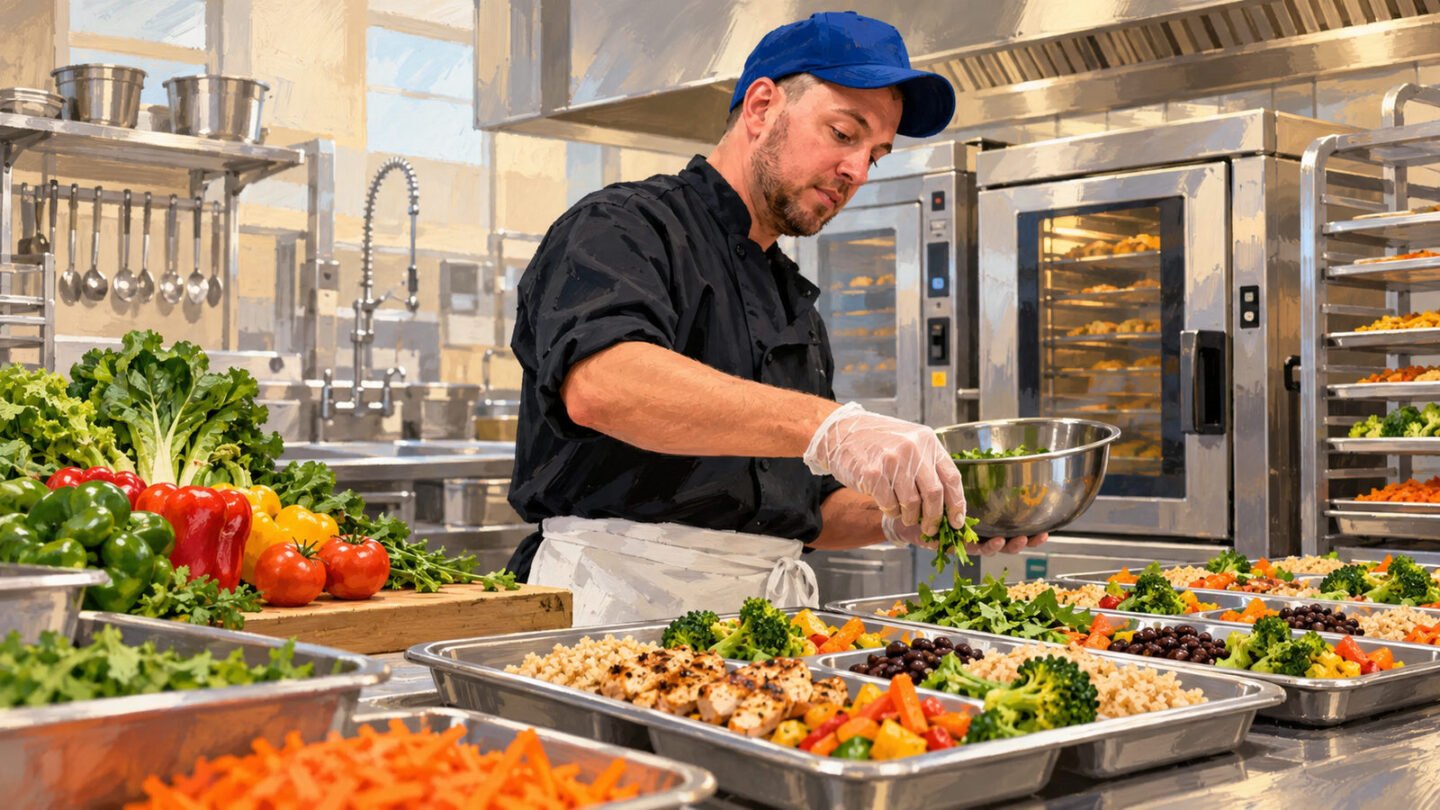
The Trump administration wants more scratch-cooked school meals and fewer heavily processed options in cafeterias. School districts generally support serving nutritious food, but a recent survey of district leaders shows why changing how lunches are made can be difficult: many kitchens lack the staff, space and money needed to cook more food on site.
The effort is part of the administration’s “real food” agenda. Health and Human Services Secretary Robert F. Kennedy Jr. and Agriculture Secretary Brooke Rollins announced new school nutrition initiatives in August 2026. Their announcements describe grants, research, local purchasing and a voluntary pledge. They do not, by themselves, mean every school must immediately prepare every meal from scratch.
What districts say about scratch-cooked school meals
A survey released on September 21 by AASA, The School Superintendents Association, collected responses from 429 school district leaders in 43 states. Among respondents, 64% named staffing as a barrier to expanding scratch cooking, while 61% named funding. Only 44% said every school in their district had a full kitchen equipped for that work.
Those percentages describe the surveyed leaders, not every district in the country. Still, the results help explain why a menu change can require much more than a new recipe. A school may need working ovens, cold storage, preparation space and enough trained employees to produce large numbers of meals within a short service period.
Earlier federal research points to similar problems. In a USDA study of school meal operations during the 2022–23 school year, the leading barriers to scratch cooking included too few staff, labor costs, insufficient time, limited culinary training and a lack of space. The age of those observations matters: they describe conditions in that school year, not a fresh count of conditions in September 2026.
What the administration has announced
The Agriculture and Health and Human Services departments announced an initiative called Harvest to Hallways on August 24. It includes up to $70 million for school cafeteria infrastructure: a new $50 million investment building on $20 million in previously announced equipment assistance grants. The departments also announced up to $25 million in additional farm-to-school grants for fiscal 2026.
The equipment money is meant to help qualifying schools buy items such as stoves and cold storage, improve food safety and expand breakfast programs. A separate HHS initiative announced two days later set out $32.5 million to test practical ways to replace highly processed foods with more nutritious meals. HHS said the first funding awards were expected in October.
These are program announcements and planned investments. They should not be confused with proof that all districts have already received money or that every cafeteria has the capacity to change its menu. The agencies say they want to identify approaches that can work across different school settings rather than prescribe one model for all.
The cost beyond new equipment
Equipment is only one part of the task. A school can purchase a new oven and still struggle to hire cooks, train staff, buy ingredients reliably and give employees enough paid preparation time. Fresh food also needs safe storage and handling. Those recurring needs can outlast a one-time equipment grant.
The Food Research & Action Center surveyed 96 large districts about school meal operations in October 2025. In its May 2026 report, 81 districts reported high food costs and 78 reported increased labor costs. That survey covers large districts and a different time period from the AASA survey; its findings should not be treated as national totals.
A peer-reviewed study published in September 2026 examined school food service directors in California’s San Joaquin Valley. It also identified staffing, labor funding and kitchen space as obstacles. Because that study covered a limited region and a small group of directors, it provides context rather than a national estimate.
What happens next
The federal government can encourage scratch-cooked school meals through grants, guidance and research, but local implementation will depend on each district’s facilities, workforce, budget and suppliers. The new programs may help schools test solutions. Their results, and the number of districts able to adopt them, still need to be measured.
The key distinction is between the administration’s goal and schools’ present capacity. Healthier meals are the stated aim; staffing and infrastructure determine how quickly a particular district can move toward it. For families, the useful question is what their own district can cook now, what upgrades it needs and how it will pay for the people and equipment required.