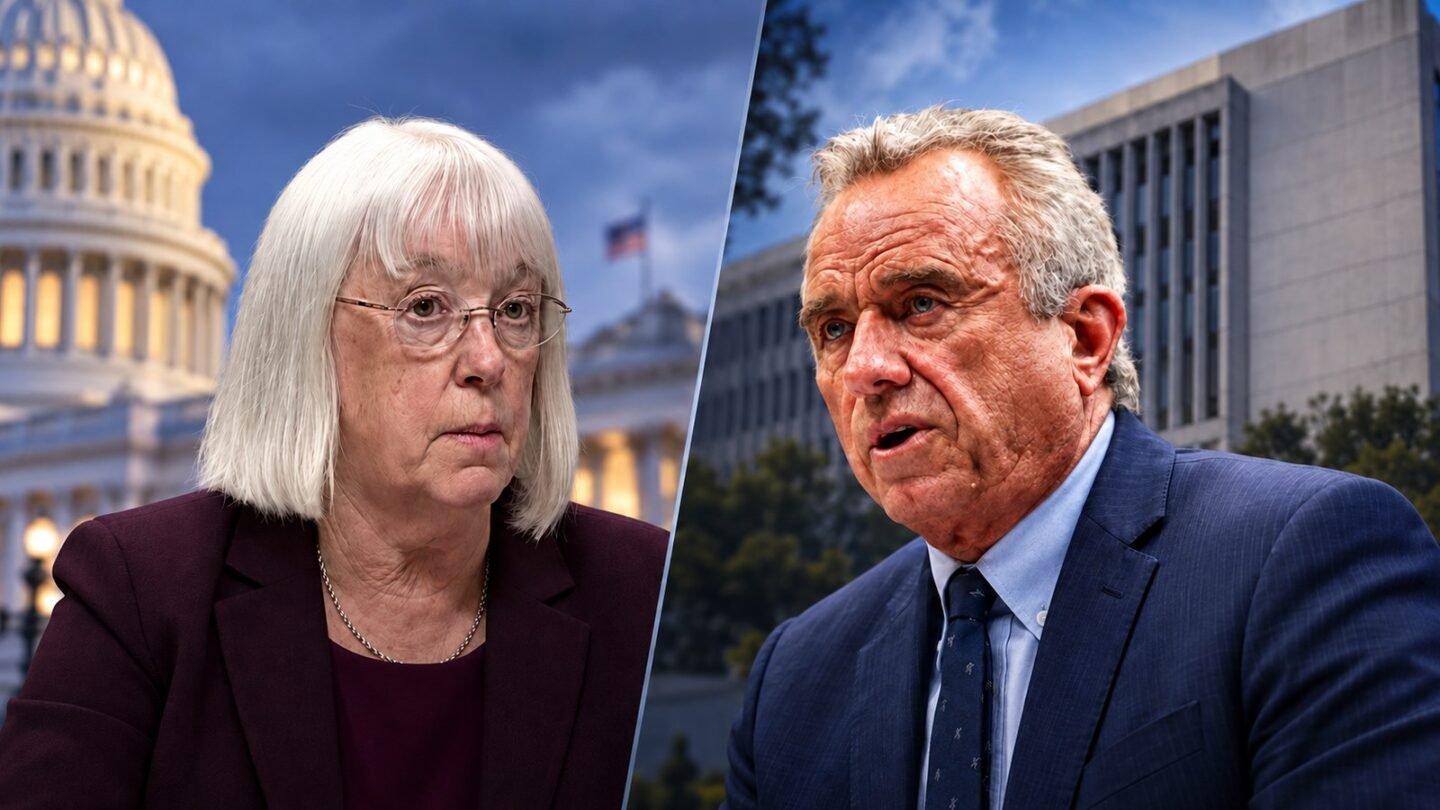
Patty Murray urged President Donald Trump to fire Health and Human Services Secretary Robert F. Kennedy Jr. in August 2025, then repeated the demand in a September Senate speech. Her criticism continued in 2026 through questions about research funding and warnings about the government’s ability to respond to disease outbreaks.
The Washington Democrat’s call is documented in official statements, but its timing matters: the firing demand dates to 2025. It should not be presented as a newly announced October 2026 development. Her later interventions show a continuing dispute over the direction of federal health agencies.
What Patty Murray Said About Kennedy
Patty Murray issued her initial public statement on August 27, 2025, amid the removal of Centers for Disease Control and Prevention Director Susan Monarez and the departure of senior CDC officials. She praised Monarez for defending scientific standards and argued that Kennedy, rather than the CDC director, should lose his position.
In a September 4 Senate floor speech, Murray accused Kennedy of endangering medical research, pandemic preparedness and food safety. She tied her demand to his leadership of HHS and disputes over vaccine policy.
“Fire RFK Jr. This man is burning down our public health system from the inside.”
That language expresses Murray’s assessment of Kennedy’s leadership. Her statement establishes what she argued; it does not turn every allegation or prediction in the speech into an independently established finding.
CDC Departures Brought Competing Accounts
Reuters reported in August 2025 that Monarez had resisted vaccine-policy changes she believed conflicted with scientific evidence. Former acting CDC director Richard Besser described a conversation with Monarez about those concerns. Several departing senior officials also criticized the agency’s direction.
The White House offered a different explanation. Spokesperson Karoline Leavitt said Monarez was not aligned with the president’s Make America Healthy Again agenda and that Trump fired her after she declined to resign.
Kennedy declined to discuss specific personnel matters in a television interview cited by Reuters. He said the CDC needed repairs and defended the possibility that some employees should no longer work there. The accounts reflected a dispute over both leadership and scientific decision-making.
The Budget Dispute Continued in April 2026
At an April 21, 2026, Senate appropriations hearing, Patty Murray questioned Secretary Kennedy about the administration’s fiscal year 2027 budget request. She challenged proposed reductions affecting the National Institutes of Health and other programs, arguing that federal medical research and patients would suffer.
Kennedy defended the administration’s spending priorities and characterized some research spending as wasteful. According to the exchange published by Murray’s office, he also said Congress would decide funding levels and that he would spend money lawmakers appropriated.
The exchange concerned a proposed budget. It should not be read as proof that every requested reduction had already become law or been implemented. Murray and Kennedy disagreed about which investments were necessary and whether the proposed savings were justified.
Senators Raised Outbreak-Preparedness Concerns
In a June 9, 2026, letter to Kennedy, Patty Murray and several other senators warned that staffing reductions, funding cuts and leadership vacancies could undermine responses to infectious-disease emergencies. They requested information about agency capacity and the administration’s response to emerging threats.
The letter described concerns about the CDC, FDA, NIH and emergency-preparedness leadership. Those details represent the senators’ account at the time of writing; they should not be treated as a current inventory of every vacancy.
HHS has defended its restructuring as an effort to reduce duplication, improve efficiency and focus on chronic disease. Its March 2025 announcement said essential services would remain intact. Murray’s criticism challenges that assurance.
The policy dispute remains active. On October 8, 2026, Reuters reported that HHS launched an effort to study health problems reported after vaccination, including an NIH clinic and changes to adverse-event reporting. Kennedy remained health secretary in that reporting. Murray’s demand for his removal should therefore be distinguished from any actual announcement that he has left office.