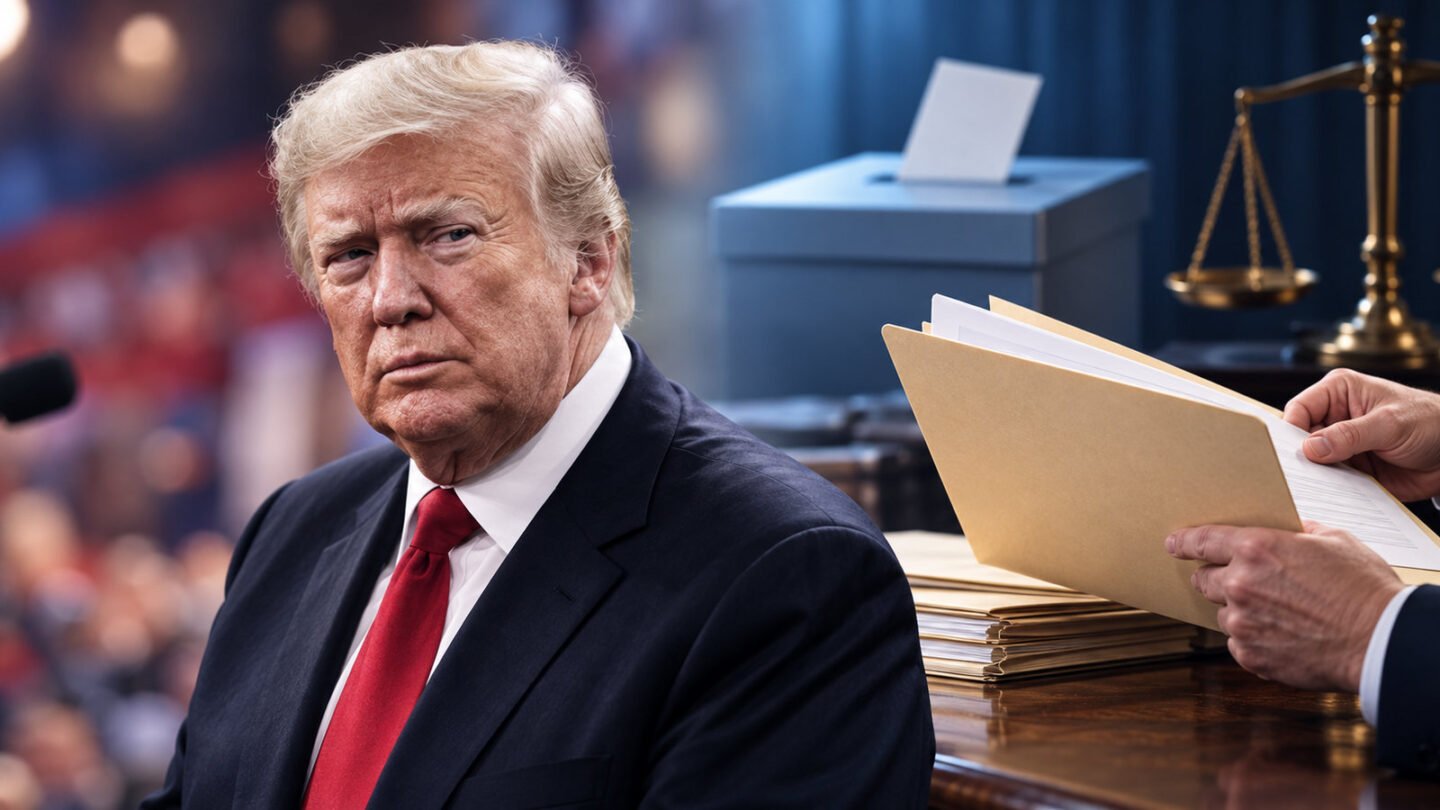
Free Speech For People has asked state attorneys general to examine whether President Donald Trump’s remarks at a Republican convention could violate laws against soliciting voter fraud. The September 25 request followed a September 10 speech in Dallas in which Trump led a crowd in a pledge about voting in the November midterm elections.
The group sent a letter to Connecticut Attorney General William Tong, who is president of the National Association of Attorneys General. It urged attorneys general to assess the remarks under their own states’ laws and consider prosecution if the facts and law support it. The letter is a request for an investigation. It is not a criminal charge or a finding that Trump broke the law.
What Trump said in Dallas
At the closing night of the Republican midterm convention, Trump asked audience members to raise their right hands and repeat a pledge. In the course of that pledge, he said, “I don’t care if I’m registered or not, I’m gonna try and cheat like hell like they do.” He then spoke about bringing friends and family members to vote on November 3 or before.
The wording appears in a transcript of the speech, and contemporaneous coverage also reported it. The surrounding passage was a call for his supporters to turn out for the election. Trump also accused his political opponents of cheating, but that accusation does not establish that the opponents committed voter fraud.
The letter treats the pledge as an invitation to unlawful voting. Whether Trump meant to encourage a crime, and whether any particular state law covers the statement, are separate questions that would require examination of the full speech and the applicable law.
Why the group wants a voter fraud investigation
Free Speech For People argues that the remarks could amount to solicitation of voter fraud. Its letter discusses state rules on solicitation, attempted crimes and conspiracy, and says prosecutors should consider whether the pledge crossed a legal line even if no fraudulent ballot was cast.
Those are the organization’s legal arguments, not conclusions reached by a court. The group also argues that a partisan convention speech would not be protected as an official presidential act for purposes of state prosecution. That immunity question, too, would depend on the circumstances and any legal challenge if authorities pursued a case.
The letter was addressed to Tong in his role at the national attorneys general association and copied to state attorneys general. It asks them to investigate the statement and any related acts, then bring charges where appropriate. It does not itself start a state prosecution or direct an attorney general to file charges.
The association confirmed Tong’s selection as its 2026 president in December 2025. Being the association’s president does not mean Tong can decide for every state whether to open an investigation. Each office would need to evaluate its own authority, evidence and state law.
What has happened since the letter
The speech occurred on September 10. Free Speech For People published its request and dated its letter September 25. The time between those events matters: the new development is the advocacy group’s appeal to state officials, not a newly discovered speech or a newly announced criminal case.
As of September 29, Hourly Times could not independently confirm that Tong or another state attorney general had opened a criminal investigation in response to this specific letter. It also could not confirm that any charge had been filed over the convention pledge. An office could review a request without publicly announcing it, so the absence of an announcement should not be treated as proof that no review is taking place.
The group’s letter sharply criticizes federal law enforcement and predicts federal agencies will not investigate. Those statements are the group’s opinions and predictions. They should not be mistaken for an official finding about what federal officials have done or will do.
What an investigation would need to address
If a state office decides to look into the remarks, it would first have to identify a law that applies to the conduct alleged. Investigators would then examine the complete speech, the meaning of the pledge, whether anyone acted on it, and any evidence relevant to intent. Different state statutes may set different requirements.
A public statement can be controversial without satisfying every element of a criminal offense. The wording of Trump’s pledge is documented, but the legal conclusion urged by Free Speech For People remains untested in any confirmed case arising from this letter. Trump and his representatives should have an opportunity to respond to any formal allegation if one is brought.
For voters, the practical distinction is clear: the organization is asking officials to investigate a statement about voting. It has not shown that fraudulent votes were cast because of that statement, and its request does not establish criminal guilt. Any decision to investigate, charge or decline a case belongs to the relevant authorities under their laws.