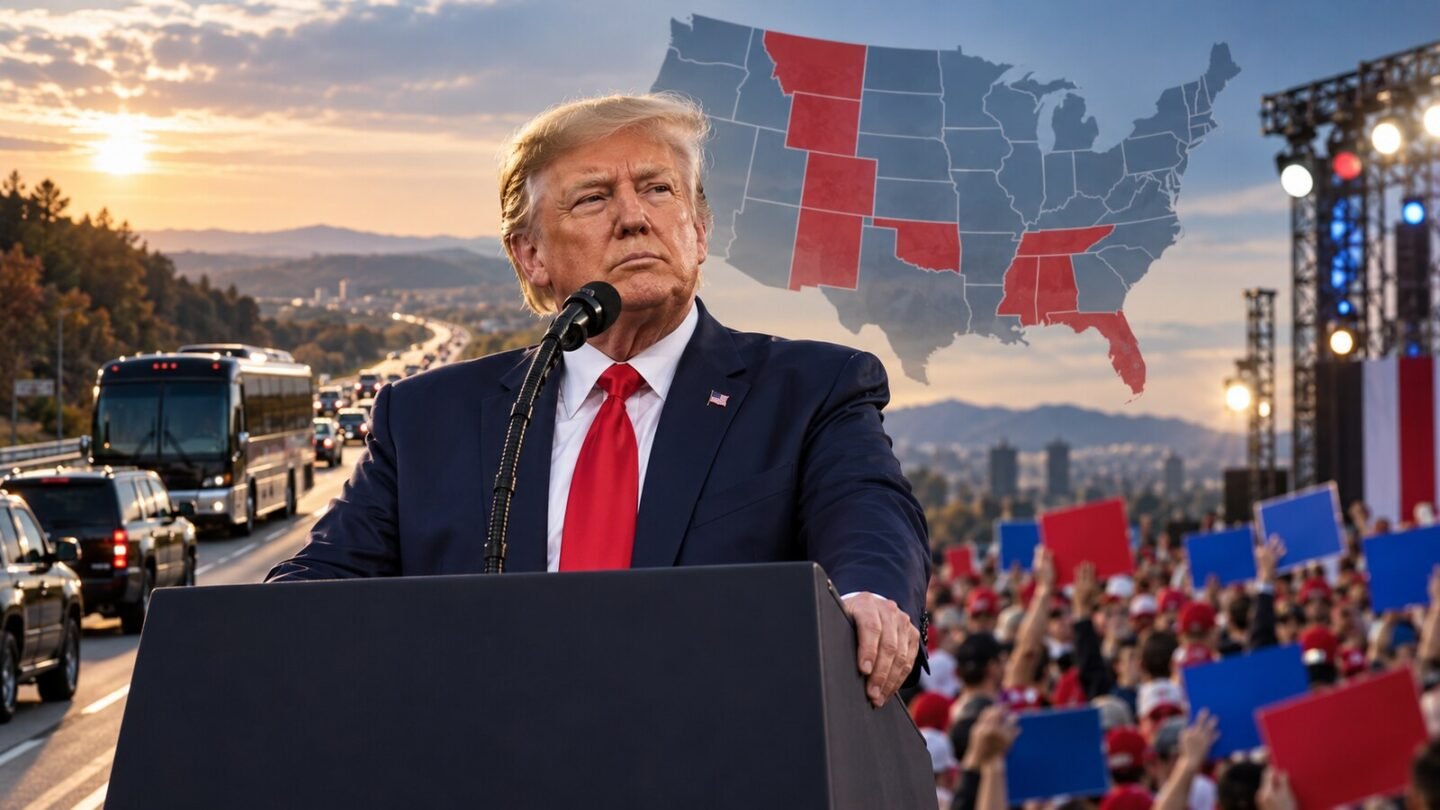
President Donald Trump is preparing an October campaign swing through several traditionally Republican states as the GOP enters the final weeks of the 2026 midterm elections facing unexpectedly competitive races.
Politico reported that Trump plans appearances in Iowa, Florida, Texas and Alaska, citing two people familiar with his schedule. Those stops would come in addition to an announced appearance in Oklahoma and a visit to Alabama.
The travel plan is notable because much of it focuses on territory that Republicans would normally expect to hold comfortably. Party officials are trying to protect narrow congressional majorities while voters continue to express concern about the cost of living and other national issues.
Why Trump is focusing on red states
The planned appearances suggest Republican leaders see value in using Trump to energize the party’s base even in states that are not usually treated as traditional battlegrounds.
According to Politico, Trump has indicated that he wants to campaign for Republican Senate candidates Ken Paxton in Texas and Dan Sullivan in Alaska. His Iowa and Florida visits would also put him in states where Republicans are monitoring races that have become more competitive than expected.
Reuters previously reported that Trump promised to campaign aggressively for Republican candidates and referred to roughly 35 important congressional races. At a White House dinner for Republican lawmakers, he said he would support the party through Election Day.
The midterm elections are scheduled for November 3, 2026. Control of both the House and Senate is at stake.
Oklahoma and Alabama come first
Trump’s latest travel swing is expected to begin with stops in Oklahoma and Alabama. The Alabama appearance could help Republican Rep. Rhett Marques, who is running against Democratic Rep. Shomari Figures in the state’s 2nd Congressional District.
That contest has attracted attention despite Alabama’s broader Republican lean, illustrating why both parties are investing beyond the small group of districts normally considered the most competitive.
Vice President JD Vance is also expected to increase his campaign travel. Politico reported that Trump and Vance are expected to make stops in Ohio to support Republican Sen. Jon Husted, who is facing Democratic former Sen. Sherrod Brown.
Economic concerns shape the midterm environment
The campaign push comes as voters remain focused on household costs. Republican candidates in several states have faced pressure over fuel prices, inflation and the economic effects of the administration’s policies.
Those concerns do not mean every deep-red state has become a toss-up. Candidate quality, fundraising, turnout and local issues differ from one race to another. But the decision to send a sitting president into reliably Republican territory shows that party strategists are not taking those contests for granted.
In Iowa, Republican Senate nominee Ashley Hinson has publicly differed with Trump over the Iran war. Some Republican House members from the state have also raised concerns about the conflict and its economic consequences.
What the campaign blitz could accomplish
Presidential visits can attract local media coverage, raise money and motivate reliable voters. They can also nationalize a race and place greater attention on the president’s own approval ratings and record.
Republicans argue that Trump’s appearances will help protect and potentially expand their congressional majorities. Democrats see the increased attention to conservative states as evidence that the electoral map has become less predictable.
The effectiveness of the October blitz will depend on whether the events increase Republican turnout without energizing opposition voters. With Election Day approaching, the remaining campaign calendar leaves little time for either party to change public opinion.
What to watch next
The final locations, dates and candidates appearing with Trump have not all been publicly announced. Campaign schedules can also change.
The most important signals will be whether Republican spending and presidential travel continue moving into traditionally safe states, and whether polling in Iowa, Texas, Alaska and Alabama remains competitive as early voting and Election Day approach.