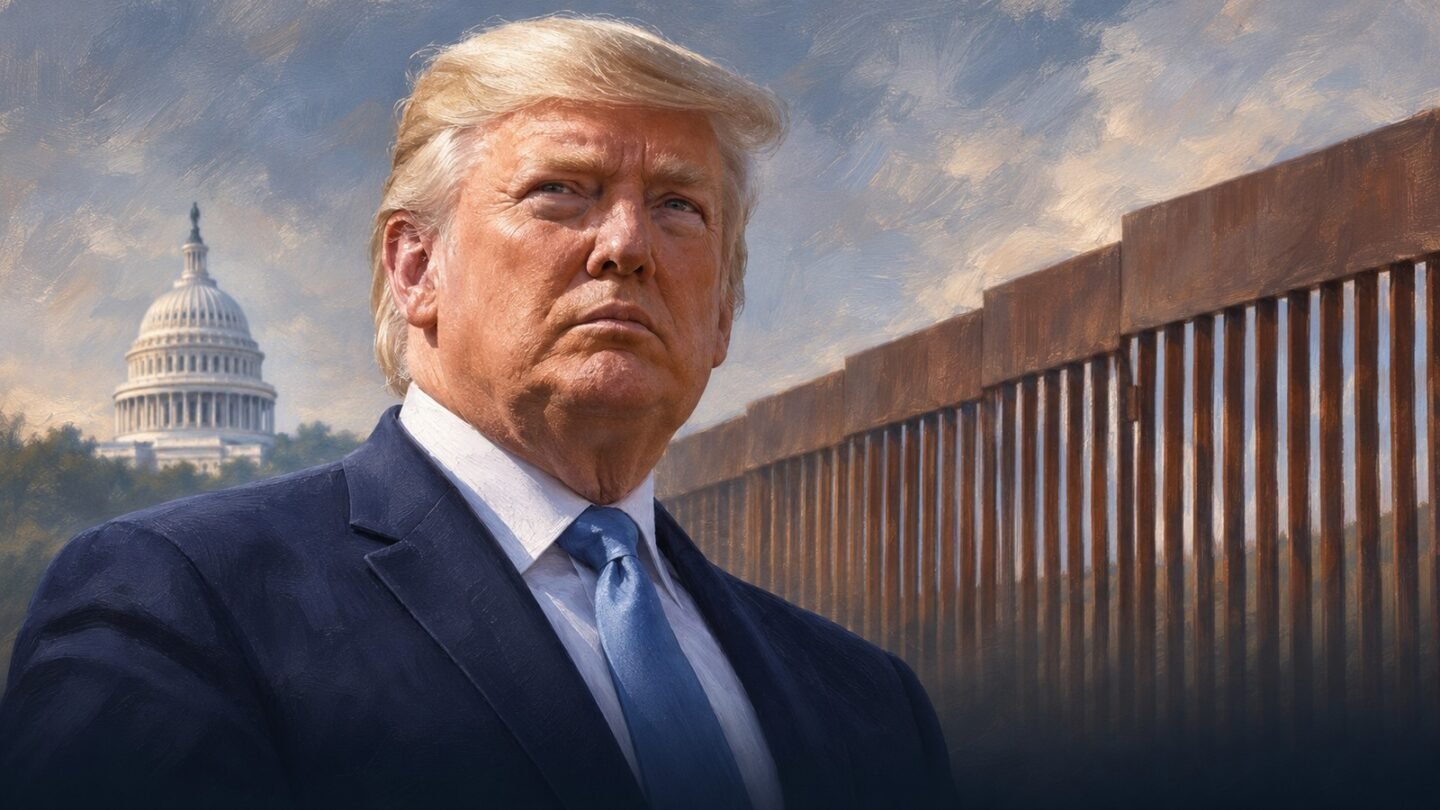
The Trump border proposal described as the “No Invasion of Our Country Act” is a verified presidential pledge, but the records reviewed do not establish that legislation under that name has been introduced. President Donald Trump promoted the idea at the Republican National Committee’s September 9 midterm convention in Dallas.
Trump said he wanted to prevent a future president from reversing his approach to the border. A separate measure sponsored by Republican Rep. Chip Roy, the Permanent Trump Secure Border Act, has an official bill number and a documented congressional history.
Those distinctions matter when assessing a circulating graphic that describes Trump as pushing a bill that would make future policy reversals legally impossible. A speech, an introduced bill and an enacted law are different stages, with different legal effects.
What the Trump border proposal says
The official government transcript of Trump’s Dallas remarks records his promise to make it legally impossible for future presidents to open the border again. He then pledged to pass an act using the “no invasion of our country” wording.
The transcript confirms that the name originated in an actual statement by the president. It does not supply legislative text, a bill number, enforcement procedures or a detailed explanation of how the proposed restriction would operate.
The Trump border proposal expresses his intended policy outcome. It should not be presented as a legal finding that a future administration has already lost authority, or as confirmation that Congress has passed the proposal.
Roy’s Separate Bill Has a Documented Record
Government Publishing Office records identify H.R. 9773 as the Permanent Trump Secure Border Act, introduced by Roy on July 20, 2026. It was referred to the House Judiciary and Foreign Affairs committees.
The House’s official committee repository records a July 21 Judiciary Committee markup. It says the measure was reported favorably to the House, as amended, by a 16–14 vote.
That was committee action, rather than passage by the full House or enactment into law. The reviewed committee record cannot, by itself, establish every later step in the bill’s history.
The introduced text addresses asylum eligibility, credible-fear interviews, inspection of applicants for admission and provisions concerning unaccompanied children. Those subjects describe a detailed immigration measure, rather than simply a declaration that a later president could never change policy.
There is also an earlier Roy bill bearing the same title, H.R. 9199, introduced June 8. The July introduction date therefore identifies H.R. 9773 specifically; the title alone does not distinguish the two measures.
Why a Federal Law Would Not Be Irreversible
Writing a policy into federal law can constrain executive action while that law remains in force. A president cannot simply amend or repeal a statute by announcing a different preference.
But Congress retains the power to change federal statutes through the constitutional lawmaking process. A Congressional Research Service report on repeal legislation explains that repeal must follow the same constitutional procedures required for enacting legislation.
The Supreme Court’s decision in Clinton v. City of New York likewise explains that presidents do not possess a general power to enact, amend or repeal statutes themselves. That principle distinguishes presidential discretion from Congress’s authority to legislate.
Consequently, limiting a successor’s unilateral actions would be different from making immigration law permanently unchangeable. The Trump border proposal cannot be evaluated in detail without a verified legislative text specifying which powers and policies it would restrict.
What Readers Should Watch Next
Hourly Times’ coverage of Trump’s veto warning and potential cooperation with Democrats explains the separate roles of Congress and the president in passing legislation.
For this proposal, the next verifiable developments would be publication of bill text, assignment of a bill number or a documented congressional action. Until then, the confirmed development is Trump’s pledge, alongside the separate Roy measures already in the record.