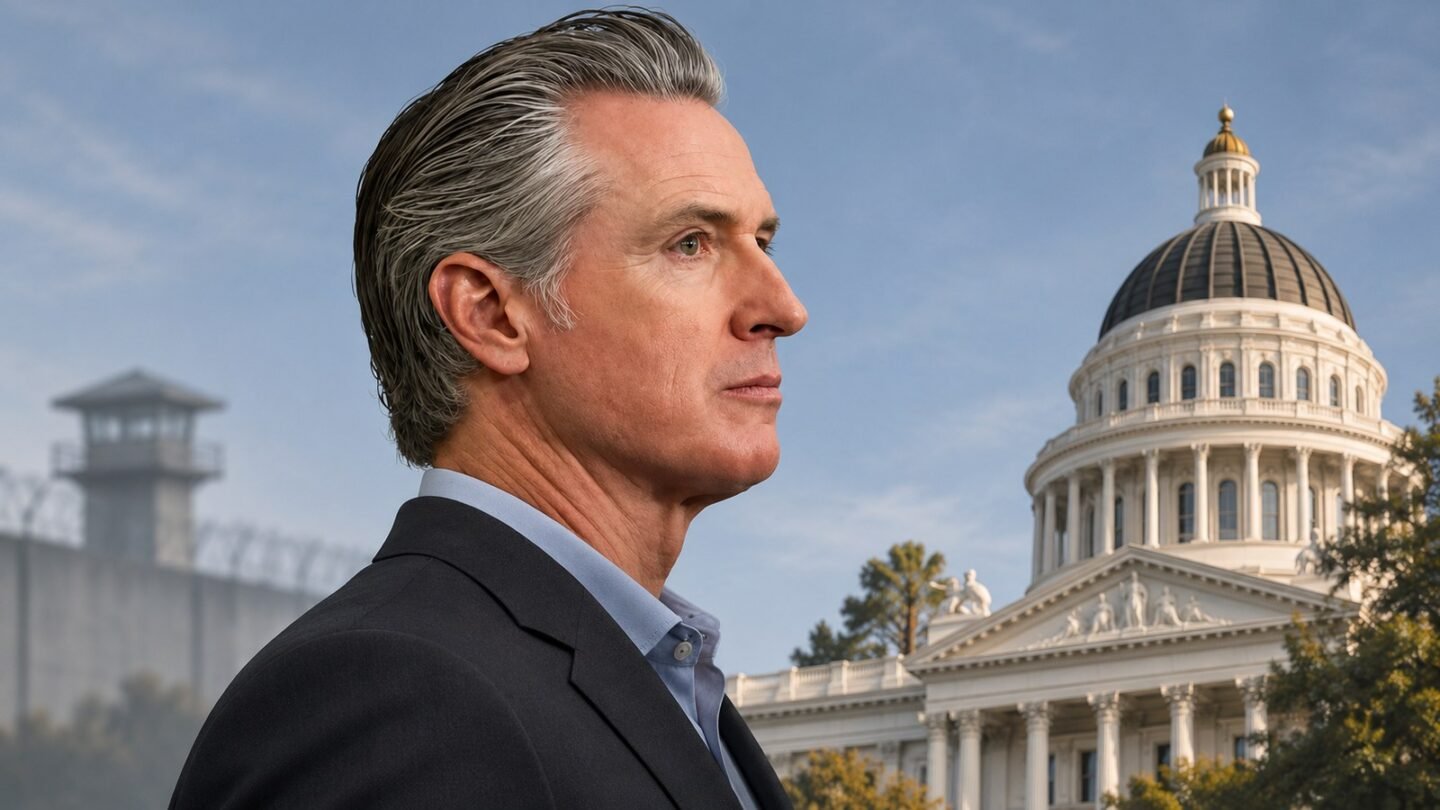
The Newsom clemency plan would replace all 548 California death sentences with life in prison without the possibility of parole. Gov. Gavin Newsom announced the decision in Sacramento on November 5, 2026, but his office says the changes will take effect only after the necessary legal steps are completed.
The announcement covers 529 men and 19 women, according to figures from the governor’s office reported by The Associated Press. It would change their punishment while keeping them imprisoned without parole.
A central part of the process remains unresolved: California Supreme Court approval is required for people convicted of more than one felony. Newsom’s office told AP that this requirement applies to 382 people, approximately 70% of those covered by the announcement.
What the Newsom clemency plan would change
Newsom’s decision concerns people already sentenced to death. The governor’s official clemency information states that they would remain in prison and would not become eligible for release.
The distinction matters because the announcement does not mean that all 548 sentences have already changed. The same official page says the commutations will not take effect until the required legal steps are finished.
A commutation reduces a sentence. It is different from a pardon, and this action does not erase the underlying convictions. In these cases, the intended replacement sentence is imprisonment for the remainder of each person’s life without parole.
Why court approval remains necessary
California’s clemency rules limit the governor’s ability to act alone when someone has multiple felony convictions. In those cases, the governor must obtain the state Supreme Court’s approval before granting a commutation.
The 382 cases identified by Newsom’s office represent about seven in every 10 intended recipients. Announcing the same intended punishment for everyone does not remove that constitutional requirement.
For that reason, the Newsom clemency plan should be described as an announced action with legal steps pending. Neither the announcement nor the governor’s stated intentions establish that the court has approved every case.
A decision following years without executions
Newsom imposed a moratorium on executions in 2019, shortly after becoming governor. California last carried out an execution in 2006, long before his administration began.
In explaining the new decision, Newsom said he believes “state-sanctioned killing is incompatible with California’s values,” according to AP. He also acknowledged that the announcement could bring back painful memories for victims’ families.
The action would not repeal California’s death penalty law. The Marshall Project reported that prosecutors can continue seeking death sentences while capital punishment remains legally available.
California voters rejected proposals to abolish the death penalty in 2012 and 2016, according to the Death Penalty Information Center. In 2016, they also approved a separate measure intended to speed up the capital punishment process.
The Marshall Project also reported that California had transferred people sentenced to death into general prison populations. That change in where people are housed is separate from changing their sentences. The new clemency announcement addresses the punishment itself, while the existing moratorium concerns whether the state carries out executions.
Supporters and critics differ over justice
The ACLU welcomed the announcement, citing concerns about racial bias and errors in capital punishment. AP reported that the organization is also involved in a legal challenge alleging that California’s death penalty statute is discriminatory and unconstitutional.
Victims’ relatives do not share a single position. The Marshall Project reported that Marc Klaas, whose daughter Polly was murdered in 1993, opposed the move, while Polly’s sister, Jess Nichol, supported it.
The Death Penalty Information Center described the announced action as the largest mass clemency involving death sentences in U.S. history. The Marshall Project reported that its full implementation could reduce the national population sentenced to death by nearly one-third.
The next step for the Newsom clemency plan is completion of the required legal process, including Supreme Court consideration where necessary. The governor’s office says registered victims will receive notification when the commutations take effect.