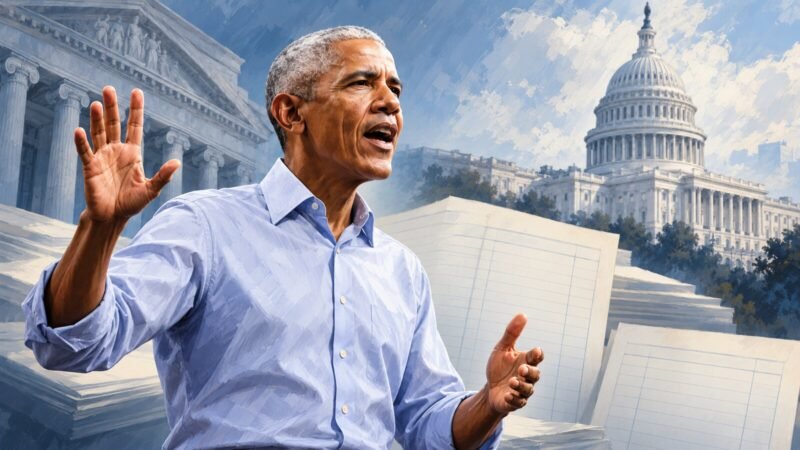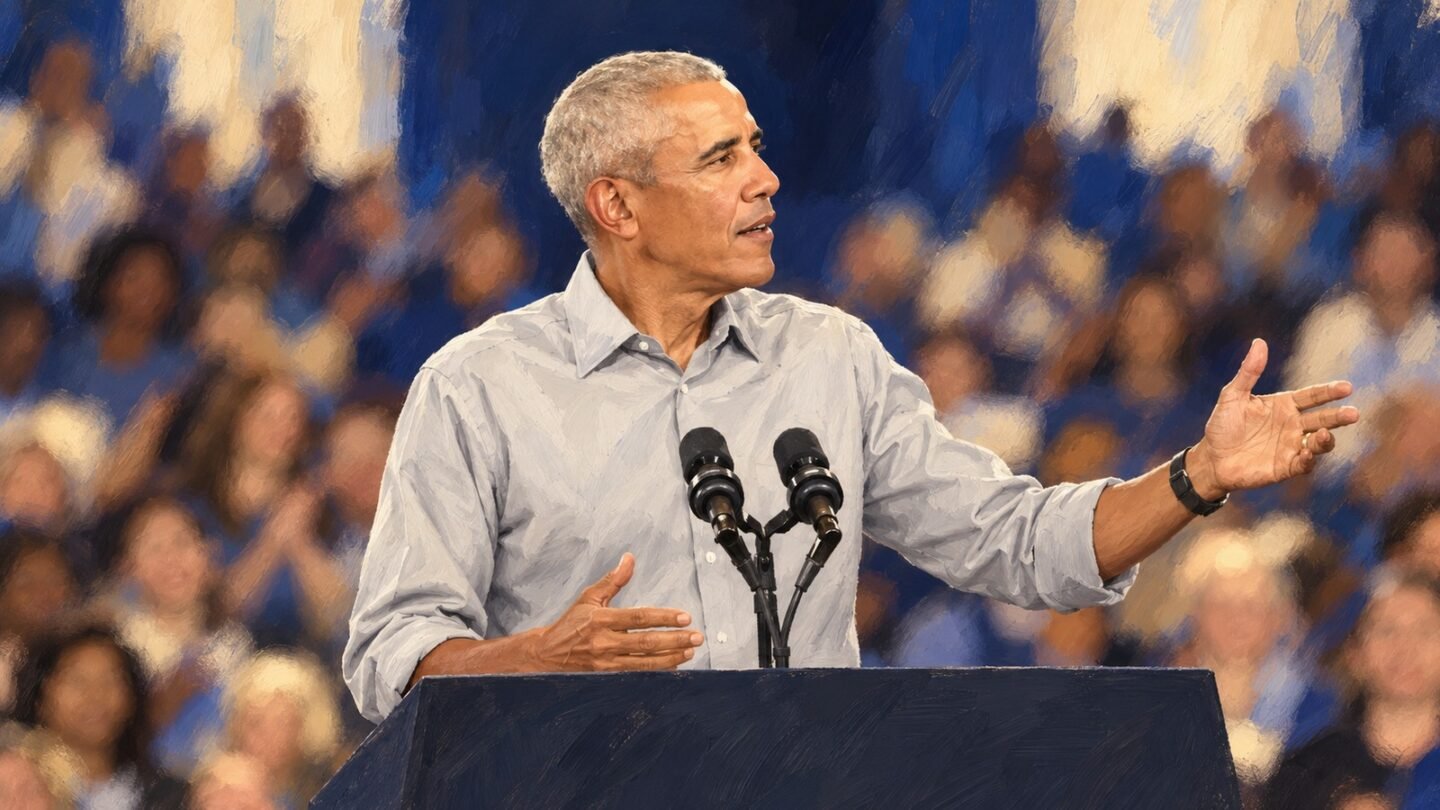
The Obama job growth claim in a quotation graphic reflects an argument Barack Obama made during the 2024 presidential campaign. His statement about handing Donald Trump an economy with 75 consecutive months of job gains has support in the historical record, but the graphic shortens his remarks and combines statistics with political judgment.
A close match appears in Obama’s speech supporting Kamala Harris in Tucson, Arizona, on October 18, 2024. His account published the transcript the following day. These are historical campaign remarks, rather than a newly verified statement about Trump’s second presidency.
Where the Obama job growth remarks came from
In his published Tucson transcript, Obama argued that Trump inherited an economy strengthened during his administration. He cited the employment streak and criticized Trump’s tax cuts and their effect on the deficit.
Obama also argued that Trump wanted to repeat that approach. At the time, he was campaigning for Harris ahead of the November 2024 election. Arizona Public Media independently reported the Tucson rally and Obama’s appeals for voters to support Harris and other Democrats.
The supplied graphic uses shorter, rewritten wording. It should therefore be described as a condensed version of his argument, rather than reproduced as a fully verified, word-for-word quotation. I cannot independently confirm the graphic’s complete wording as one exact quotation.
What the 75-month employment figure measures
The Obama job growth figure matches the account published by the White House Council of Economic Advisers on January 6, 2017. That report said total nonfarm employment had increased for 75 consecutive months, beginning in October 2010 and continuing through December 2016.
The count covers three months in 2010, followed by six full years: 3 plus 72 equals 75. It describes a run of monthly increases in payroll employment. It does not mean employment grew throughout all eight years of Obama’s presidency.
The distinction between total employment and private-sector employment also matters. The same White House report discussed a private-sector recovery beginning earlier in 2010. Those are different measures, so their starting dates and streak lengths should not be used interchangeably.
This evidence supports Obama’s narrower point that an employment expansion was underway before Trump took office. It does not, by itself, measure how much of that recovery resulted from any particular president’s decisions.
Job gains continued during Trump’s first year
The Bureau of Labor Statistics later reported that total nonfarm payroll employment increased by 2.2 million in 2017. Its review described a continuing expansion, although annual employment growth slowed compared with 2016.
That record adds context to Obama’s suggestion that Trump did little beyond cutting taxes. The economy continued adding jobs after the transition. The employment figures document that result; they do not settle which administration deserves credit for each increase.
For more background, Hourly Times’ review of presidential recession timelines explains why dates alone cannot establish responsibility for economic downturns or recoveries. The Obama job growth debate involves the same distinction between describing a trend and proving its causes.
Tax cuts and deficits need separate context
The graphic’s claim about tax cuts for people who did not need them is a political assessment. IRS guidance on the 2017 tax law describes changes affecting individual taxpayers, including a nearly doubled standard deduction for 2018 and an increased maximum child tax credit. The law’s provisions were not limited to wealthy taxpayers.
The deficit criticism has a basis in contemporary budget analysis. In its April 2018 outlook, the Congressional Budget Office said the 2017 tax act was expected to reduce individual and corporate income-tax collections. It also identified separate spending laws as contributors to larger projected deficits.
CBO additionally projected that the tax legislation would raise economic output. Those estimates were forecasts made in 2018, rather than a final measurement of every later outcome. Using them accurately requires keeping their date, assumptions and scope clear.
The available evidence supports the historical 75-month figure and establishes a close source for Obama’s argument. It does not authenticate every word on the graphic or turn his broader criticism into a complete economic assessment. No new announcement or forthcoming decision is established by this historical quotation.