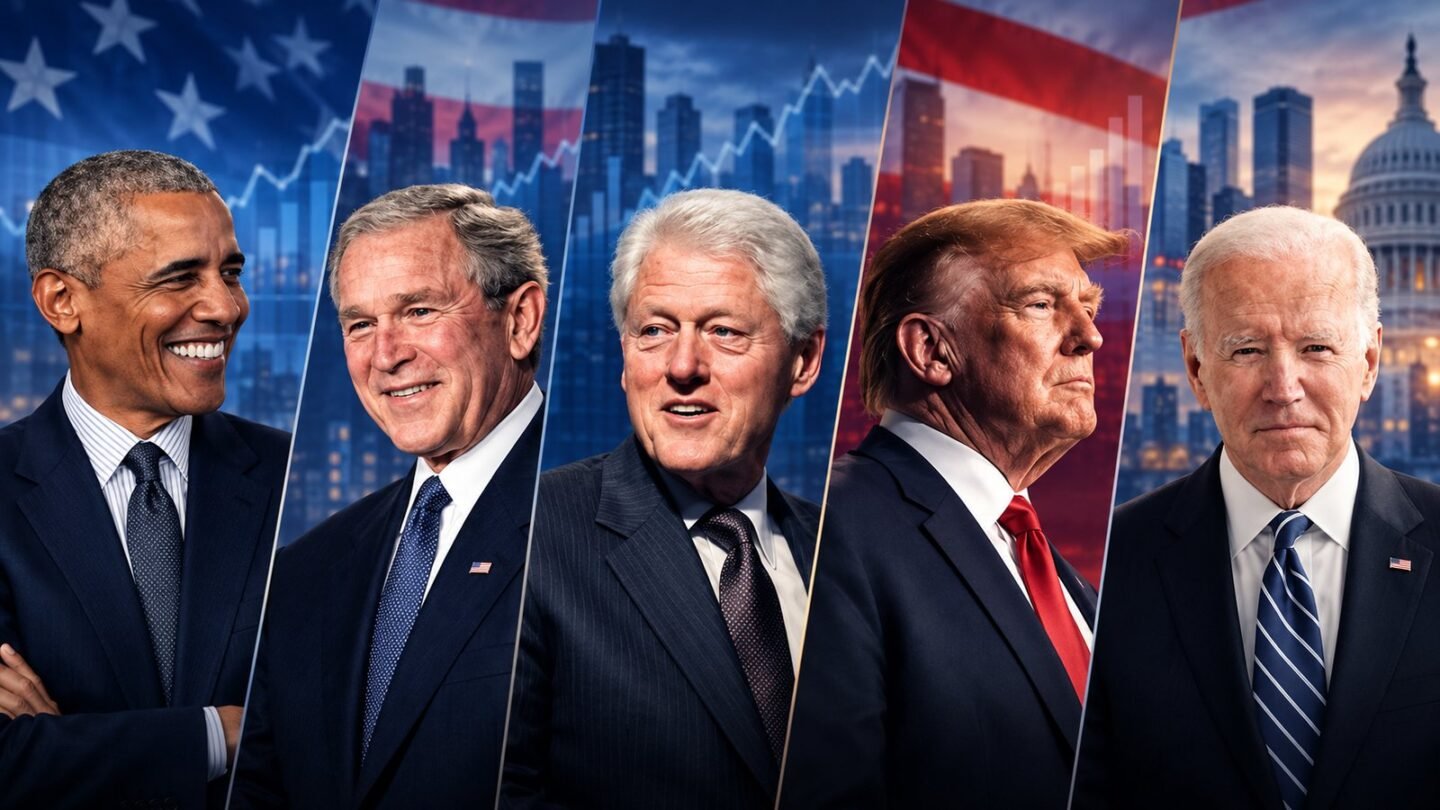
The claim that every Democratic president over the past 35 years had to rescue the U.S. economy from a Republican recession is only partly supported by the timeline. Bill Clinton and Joe Biden entered office after the recessions often linked to their Republican predecessors had officially ended. Barack Obama, however, took office while the Great Recession was still underway.
That distinction matters. A recession’s official dates can show when an economic contraction happened. They do not, by themselves, prove which party caused it or how much responsibility belongs to a president. The National Bureau of Economic Research (NBER), which maintains the U.S. business-cycle chronology, dates recessions using broad measures of economic activity.
Clinton Took Office After the 1990–91 Recession
The 1990–91 recession began in July 1990 and ended in March 1991, during President George H.W. Bush’s administration. Clinton was inaugurated on January 20, 1993, nearly two years after the NBER-dated end of the recession.
That does not mean the economy’s difficulties disappeared in March 1991. The NBER says unemployment continued to rise for 15 months after that recession’s trough. People could still be facing job losses and financial strain after the official downturn ended.
Clinton’s first inaugural address also described an economy weakened by business failures and stagnant wages. That statement shows the economic concerns his administration highlighted at the time. It does not change the NBER’s recession dates: the contraction itself had already ended.
Obama Entered Office During the Great Recession
Obama’s case is different. The Great Recession began in December 2007, while George W. Bush was president. Obama took office on January 20, 2009, while the downturn was still in progress. The NBER later set the recession’s end in June 2009.
The recession officially lasted 18 months. Its impact continued beyond the date marking the end of the contraction. The NBER noted in 2010 that economic activity remained below its previous peak at that time.
So the record supports saying Obama entered office during a recession that began under a Republican president. The timeline alone does not settle every question about the recession’s causes or how much any administration’s policies contributed to the recovery.
The COVID-19 Recession Had Ended Before Biden Took Office
The COVID-19 recession began in February 2020 and ended in April 2020, during Trump’s presidency. Biden was inaugurated on January 20, 2021, months after the NBER-dated end of the recession.
The downturn was brief by the NBER’s measure, lasting two months, but the organization described it as unusually severe and widespread. The NBER also recognized that the pandemic and the public-health response gave the downturn different characteristics from earlier recessions.
The official end date does not mean all the pandemic’s economic effects had vanished by April 2020. It means the economy had reached the low point used in the NBER’s business-cycle chronology and began an expansion afterward. Biden inherited an economy still dealing with pandemic-related disruption, but he did not take office during the official recession.
What the Record Can—and Cannot—Show
The history gives a mixed answer to the claim. Obama clearly entered office during a recession that began under a Republican president. Clinton and Biden entered office after the relevant recessions had officially ended, though economic hardship and recovery concerns remained.
The recession dates do not establish that every Republican administration caused the downturns or that every Democratic administration alone rescued the economy. They also do not measure how well either party’s policies served ordinary Americans. Those broader comparisons require other evidence, such as employment, wages, inflation, growth and household costs.
The source material provided for this story does not identify a polling organization or report survey results. The question below is suitable as a reader poll, but its responses should not be presented as representative of U.S. public opinion.