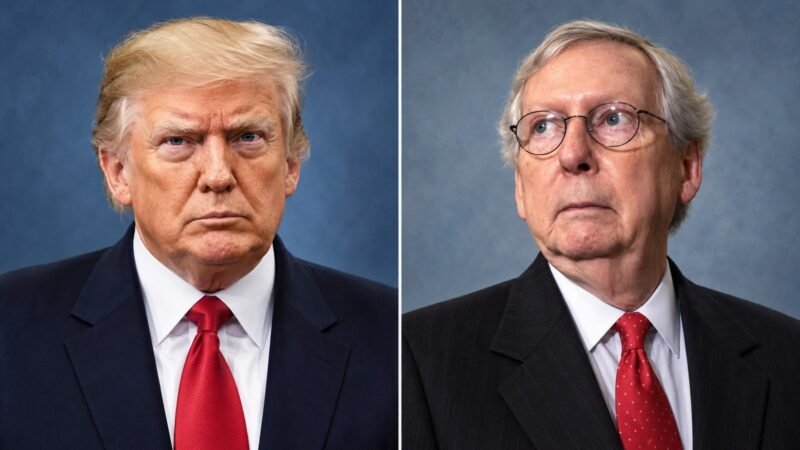
Medicaid cuts were part of the 2025 tax-and-spending law supported by nearly every Republican in Congress. Official final-passage records show 218 House Republicans and 50 Republican senators voted for the legislation, which also extended tax cuts and changed food-assistance rules.
That supports the central claim about Republican support. However, the accompanying graphic mixes projected future effects with completed losses, matches an outdated food-assistance estimate and omits important context from its claim about taxes rising for 95% of Americans.
President Donald Trump signed the legislation, widely called the One Big Beautiful Bill Act, on July 4, 2025. Saying lawmakers acted specifically to reward billionaire donors goes beyond what the vote records and budget estimates establish.
How Republicans Voted on the Final Bill
The House’s July 3 roll call records 218 Republican votes in favor and two against. All 212 voting Democrats opposed the measure, which passed 218-214.
Republican Reps. Thomas Massie of Kentucky and Brian Fitzpatrick of Pennsylvania voted no. Republican support was therefore 218 of 220 members, approximately 99.1%.
The Senate passed the legislation on July 1 after senators split 50-50 and Vice President JD Vance broke the tie. Republicans Susan Collins of Maine, Rand Paul of Kentucky and Thom Tillis of North Carolina opposed it.
Across the two chambers, 268 of 273 Republican lawmakers supported the final legislation, approximately 98.2%. That calculation excludes Vance because he was voting as vice president rather than as a senator.
What CBO Projects From the Medicaid Cuts
The Congressional Budget Office’s October 2025 estimate projected that the law’s Medicaid chapter would increase the number of uninsured people by 7.5 million in 2034. That is a forecast relative to what would otherwise happen, not a count of people already stripped of coverage.
CBO’s February 2026 outlook projected a $1.2 trillion net reduction in Medicaid outlays over 2026-2035 and 13.1 million fewer Medicaid enrollees in 2035. Enrollment reductions and increases in uninsured people are different measures and should not be used interchangeably.
The graphic’s eight-million healthcare claim therefore needs a source, scope and future date. The reviewed CBO estimates do not establish eight million completed coverage losses by October 2026.
Hourly Times has separately examined rural healthcare funding and Medicaid reductions, including why funding programs covering different periods cannot be compared as equivalent annual amounts.
The Food-Assistance Figure Matches an Earlier Proposal
A June 13, 2025, Center on Budget and Policy Priorities analysis estimated that 2.5 million children lived in households at risk of losing some food assistance under an earlier Senate work-requirement proposal.
The organization published a revised analysis on June 27 after the proposal changed. That version estimated about 800,000 children lived in households at risk under the revised provision.
Neither figure was a verified count of children already removed from food assistance. Household benefit reductions also differ from children individually losing eligibility. The graphic’s wording removes those distinctions.
The 95% Tax Claim Combines Several Policies
An April 2026 Institute on Taxation and Economic Policy report projected average tax increases for income groups covering the lower-income 95% of the population. Its analysis combined tariffs, the reconciliation law and other tax-policy decisions.
It did not establish that the bill alone raised taxes for every person in that group. Group averages do not describe every household’s individual result.
CBO’s separate distributional analysis projected that the lowest-income tenth of households would lose resources on average, while the highest-income tenth would gain. That measure includes taxes, benefits and other government activity, rather than tax bills alone.
Donor Motives and the Next Implementation Deadline
The legislation combined Medicaid cuts with tax reductions benefiting wealthy households and others. Those policy effects do not independently prove that each supporting lawmaker acted to reward particular donors.
The administration defends its approach differently. In June, the Centers for Medicare & Medicaid Services described work requirements as promoting employment, independence and program accountability.
CMS says applicable states must implement the requirement for certain adults no later than January 1, 2027, with exemptions and some earlier implementation. That deadline is the next major nationwide milestone for this part of the Medicaid cuts.