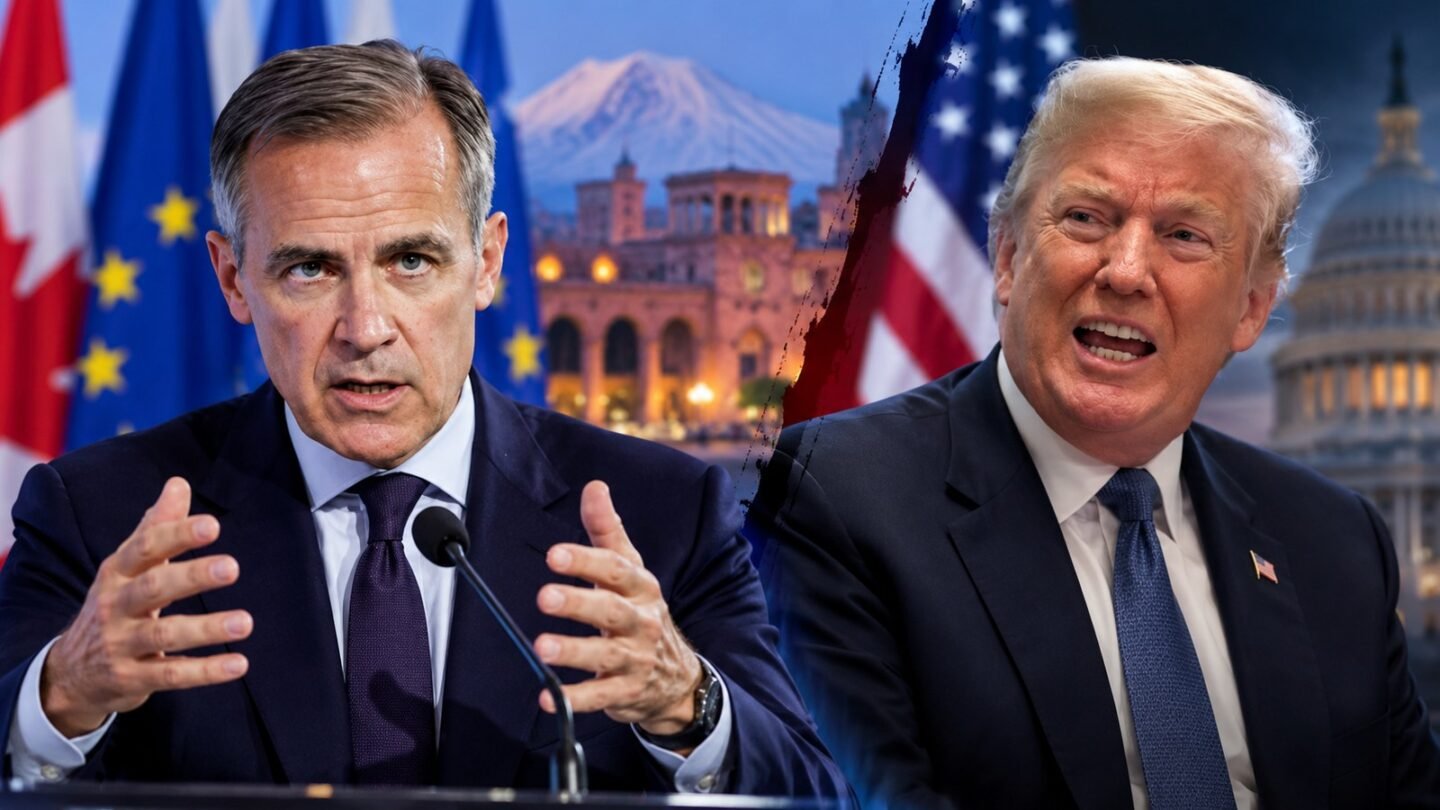
The Carney global order remarks delivered in Yerevan on May 4, 2026, put Europe at the center of a debate over who will shape the next phase of international cooperation. Canadian Prime Minister Mark Carney told leaders at the European Political Community summit that the existing system was undergoing a major rupture and said he believed the international order would eventually be rebuilt “out of Europe.”
Carney did not explicitly say that President Donald Trump had ended America’s status as “leader of the free world.” That wording is an interpretation of his remarks, not a verified direct quote. His speech did, however, come during sharp tensions between Washington and European allies over trade, defense commitments and the direction of U.S. foreign policy.
What the Carney Global Order Remarks Actually Said
Carney described the world as facing disruption across technology, energy, commerce and geopolitics. He said countries had to deal with the world as it exists rather than rely on nostalgia for an earlier international system.
He also argued that Canada and Europe should deepen cooperation in areas such as defense, critical minerals, energy, digital technology and supply chains. At the summit, he said Canada did not have to submit to a more transactional and insular world and described Europe as central to rebuilding a rules-based international system.
The European Political Community meeting in Yerevan brought together leaders from across Europe. Carney was the first non-European leader invited to participate in the forum, according to the European Council and the Canadian prime minister’s office.
Why Trump Was Part of the Wider Context
The Carney global order message arrived as the Trump administration was taking steps that unsettled several European governments.
Days before the summit, Trump announced plans to raise tariffs on cars and trucks imported from the European Union to 25 percent from 15 percent, arguing that the EU had not fulfilled parts of a trade agreement. European officials disputed that characterization and warned that the move could damage transatlantic economic relations.
At roughly the same time, the Pentagon announced plans to withdraw about 5,000 U.S. troops from Germany over a six-to-12-month period. The decision raised questions in Europe and in Washington about the future size and posture of American forces on the continent.
Those moves formed part of the political backdrop to Carney’s speech. They do not prove that the United States has stopped being a global leader, but they help explain why European governments and Canada were discussing greater strategic autonomy and stronger cooperation outside a U.S.-centered framework.
Europe’s Growing Strategic Role
Carney’s argument was not that Europe could simply replace the United States in every area of global leadership. His emphasis was on Europe’s institutions, alliances and economic capacity as building blocks for a future international system.
The Carney global order view also fits Canada’s broader effort to reduce its economic dependence on the United States. Since taking office, Carney has promoted deeper trade, defense and investment ties with Europe while continuing to describe the U.S. relationship as important.
That distinction matters. Canada has not announced an end to its alliance with Washington, and Carney has continued to pursue cooperation with the United States even while criticizing aspects of the changing global system.
What Trump Supporters and Critics Argue
Trump supporters argue that his “America First” approach is designed to make allies contribute more to their own defense, protect U.S. industries and reduce what they see as unfair trade arrangements. From that perspective, pressure on Europe does not necessarily mean the United States is abandoning leadership; it can be seen as an attempt to redefine the terms of that leadership.
Critics argue that tariffs, troop reductions and confrontational diplomacy risk weakening trust among longtime allies. They say that if allied governments begin building alternative trade, defense and diplomatic structures, Washington could lose influence even if the United States remains the world’s largest military and one of its largest economies.
The available evidence supports saying that transatlantic relations were under serious strain when Carney spoke. It does not support presenting the claim that Trump definitively ended U.S. leadership of the free world as an established fact.
What Happens Next
The central question raised by the Carney global order speech is whether Europe and countries such as Canada will continue building institutions and partnerships that reduce their reliance on the United States.
Carney’s later diplomacy suggests that diversification remains a major Canadian priority. His government has continued seeking stronger trade and security relationships outside the United States while also maintaining channels with Washington.
That leaves the debate open. Carney’s verified position is that the international order is changing and that Europe will play a major role in rebuilding it. Whether that shift amounts to the end of American leadership is a political and strategic judgment, not a fact established by the speech itself.