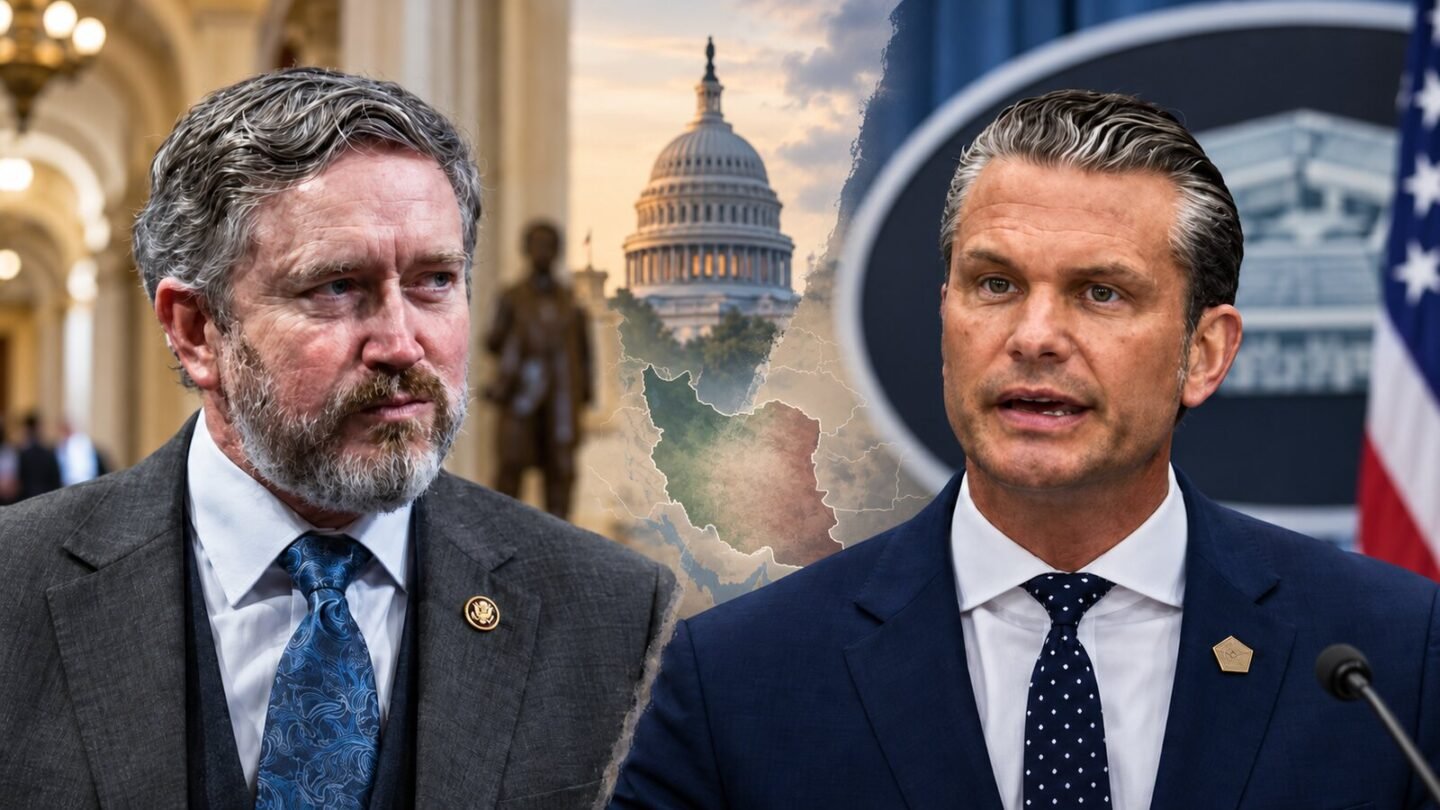
The Hegseth impeachment effort launched by Republican Rep. Thomas Massie has opened a new fight over congressional war powers and accountability inside the Trump administration. Massie introduced eight articles against Defense Secretary Pete Hegseth on September 15, but the charges remain allegations and the House has not voted to impeach him.
What Massie filed against Hegseth
Massie, a Kentucky Republican, presented the impeachment resolution as privileged legislation, a procedure designed to require prompt House consideration while the chamber is in session. He accused Hegseth of committing “high crimes and misdemeanors” through his leadership of the Defense Department.
The resolution contains eight articles. The first three allege violations of separate provisions of the War Powers Resolution of 1973. Massie argues that Hegseth helped conduct hostilities against Iran without a declaration of war, specific statutory authorization, an attack on the United States or an imminent threat.
He also alleges that Hegseth continued the conflict after congressional action directing the removal of U.S. forces and beyond the War Powers Resolution’s termination periods.
The remaining five articles go beyond the Iran conflict. They accuse Hegseth of ignoring laws intended to reduce civilian casualties, directing unlawful lethal operations against suspected drug traffickers, suppressing protected speech involving Sen. Mark Kelly, participating in the seizure of Venezuelan leader Nicolás Maduro and conducting an unauthorized war in Yemen.
Those claims have not been established by an impeachment vote, trial or court judgment. They are Massie’s formal allegations and should be reported as such.
Hegseth impeachment effort tests Republican unity
The Hegseth impeachment effort is unusual because it was initiated by a Republican against a Cabinet secretary serving under a Republican president. Massie has repeatedly broken with President Donald Trump and congressional Republican leaders over military action in Iran.
Massie’s central argument is that the Constitution gives Congress the authority to decide whether the country enters a prolonged war. The administration and its supporters maintain that the president has broad commander-in-chief authority to protect American national-security interests and direct military operations.
The Pentagon rejected the criticism of Hegseth. Pentagon press secretary Kingsley Wilson described him as a transformative leader and said the department remained united behind his vision. That response did not address every allegation individually, but it made clear that the department continued to support him.
House recess stopped an immediate vote
The House did not decide whether to impeach Hegseth. Speaker Mike Johnson sent members home early on September 16 for the pre-election recess, preventing the expected immediate consideration of Massie’s privileged resolution.
Johnson dismissed the push as a publicity stunt, while Massie accused Republican leaders of avoiding unfinished business. The early recess left the resolution unresolved until lawmakers return after the November elections.
This distinction matters. Hegseth has not been impeached, convicted or removed. Massie introduced articles and attempted to force a vote, but the House departed without taking that vote.
Senate vote deepened the war-powers dispute
The wider argument continued after the House left Washington. On September 24, the Senate rejected another Iran war-powers resolution by a 50–49 vote. Forty-nine senators supported the resolution, 50 opposed it and one did not vote.
Republican Sens. Susan Collins, Rand Paul, Thom Tillis and Lisa Murkowski joined most Democrats in supporting the measure. Democratic Sen. John Fetterman voted against it.
That resolution was separate from the Hegseth impeachment effort. It focused on directing Trump to end the conflict or obtain congressional authorization, rather than determining whether Hegseth should be removed from office.
The close vote nevertheless demonstrated that questions about the Iran war do not divide Congress entirely along party lines. They also provide the political setting for Massie’s decision to target a senior official from his own party.
What must happen for Hegseth to be removed
The Constitution gives the House the sole power to impeach federal civil officers. Approval of one or more articles would require a House majority. The Senate would then conduct a trial, and conviction and removal would require support from two-thirds of senators present.
The Hegseth impeachment effort had not completed the first step as of October 2. Its future depends on whether the House returns to the resolution and whether enough representatives support any of Massie’s eight allegations.
Supporters of Massie’s action can argue that Congress must enforce its constitutional authority over war and investigate alleged abuses by defense officials. Opponents can argue that impeachment is an excessive or politically motivated response to disputed questions of executive power and military policy.
For now, the verified conclusion is limited: Massie introduced eight articles, the Pentagon defended Hegseth, and Republican leaders recessed the House without a vote. Whether the effort advances after the election remains unresolved.