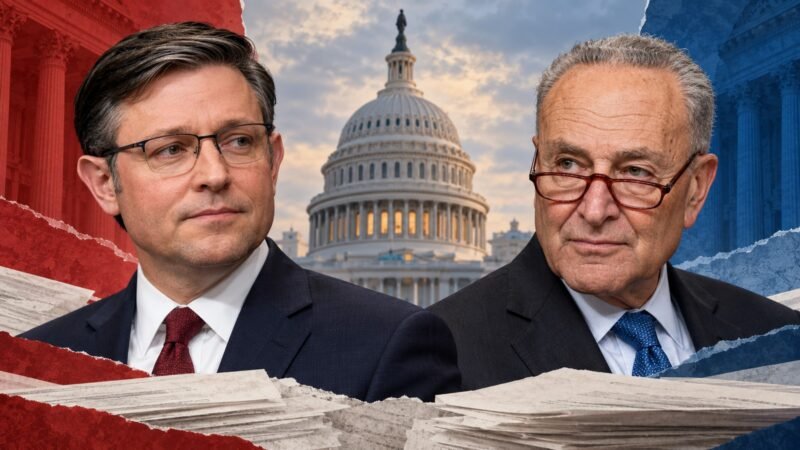
The Mike Johnson campaign tour now has a confirmed California stop: the House speaker campaigned with Republican Rep. David Valadao in Bakersfield on September 30. For the Midterm Elections 2026, the visit illustrates a central challenge for Republicans: protecting vulnerable incumbents while pursuing Democratic-held seats.
Bloomberg Government reported that Johnson’s spokesperson confirmed travel across 22 states. Axios first reported the plans on September 28. The state list establishes the breadth of the effort, but it is not a complete district-by-district itinerary.
Three identified contests offer a useful starting point: California’s 22nd and 13th districts, and Arizona’s 6th. Their different incumbents, ratings and event records show why a speaker’s campaign schedule should be read carefully rather than treated as a prediction.
What the tour reveals about Midterm Elections 2026
The Cook Political Report’s September 25 overview placed 17 Republican-held seats and five Democratic-held seats in its Toss Up category. It favored Democrats in 208 races and Republicans in 205. Those ratings describe competitiveness and expectations; they are not election results.
That creates two tasks for Democrats. They need opportunities to gain seats, but they also need to protect incumbents facing Republican challengers. A Johnson appearance alongside a Republican incumbent signals support for keeping a seat. An appearance for a challenger points to an attempted pickup.
Neither tells readers how many voters will change their minds. A visit may provide publicity, fundraising opportunities or encouragement for volunteers. The records reviewed here do not establish how much any particular appearance changes a candidate’s chances.
The same caution applies to missing stops. A district’s absence from the currently available records does not prove Republicans have abandoned it. Public events, private fundraising and scheduling changes can make a published itinerary incomplete.
California’s 22nd: a Republican seat Democrats can contest
Johnson’s Bakersfield appearance with Valadao is supported by reporting from KBAK/KBFX and ABC30. This was a completed campaign event, not merely an advance announcement. Cook’s public race directory lists the Republican-held district as Toss Up.
Democratic challenger Randy Villegas is therefore competing in a district an established forecaster considers genuinely competitive. That is a stronger basis for describing a Democratic opportunity than the presence of a national Republican leader alone.
The local reporting also identifies an issue contrast. ABC30 reported Villegas’s criticism of the Iran war and its effect on fuel costs. Valadao argued that California policy also bears responsibility, while Johnson expressed confidence that the administration would improve the situation.
These are competing campaign explanations. The report does not independently establish how much of a household’s fuel bill is attributable to each factor, and the candidates’ expectations about the conflict’s duration are not settled facts.
For voters, the useful comparison is between proposed responses to those costs. Johnson’s visit gives Valadao national support, but it also invites scrutiny of what the Republican majority has done and what it would do next.
California’s 13th: a Democratic seat requiring defense
The neighboring example has a different political purpose. C-SPAN’s event listing identified a September 30 Johnson rally with Republican congressional candidate Kevin Lincoln in Chowchilla. Federal Election Commission records identify Lincoln and Democratic Rep. Adam Gray as candidates in California’s 13th District.
The reviewed C-SPAN listing establishes the announced event; this analysis does not treat it as an independently verified transcript or attendance record. Cook’s public directory rates Gray’s seat Lean Democratic, rather than Toss Up.
That makes the contest a Republican pickup effort in a district where Democrats are favored. It does not make Gray’s reelection guaranteed. A competitive race can remain important even when a forecaster gives one party an advantage.
It also changes the accountability comparison. Gray has a congressional voting record; Lincoln is challenging him. Lincoln should be evaluated through his own proposals and statements, rather than assigned votes cast by Republican members of Congress.
For Democrats, the district demonstrates why a national environment that appears favorable cannot substitute for defending existing seats. The party’s path to a majority depends on both gains and retention.
Arizona’s 6th: an announced event and a documented record
Ciscomani’s campaign advertised an October 1 Tucson rally with Johnson in a September 28 email preserved by the Archive of Political Emails. Tucson Agenda separately reported the planned event. These sources confirm the invitation and schedule; they do not independently establish that the appearance took place.
Cook lists Republican Rep. Juan Ciscomani’s district as Toss Up. Democratic challenger JoAnna Mendoza is seeking the seat. The district therefore belongs in the opportunity discussion, while the event’s completion remains a separate verification question.
Johnson’s broader message can be checked against legislation. His campaign website’s September 28 interview summary emphasized tax relief and business investment. The official July 3, 2025, House roll call shows Johnson, Valadao and Ciscomani voting for the Senate-amended H.R. 1. Gray voted against it.
The law’s Medicaid provisions supply a concrete policy test. The Congressional Budget Office estimated that their combined effects would increase the number of people without health insurance by 7.5 million in 2034. This is a national projection relative to the baseline, not a count of people who have already lost coverage in these districts.
Democratic criticism can reasonably examine that projected coverage loss. Republican claims about tax benefits should be examined alongside it. A defense of the law needs to explain the tradeoffs; a criticism needs to preserve the distinction between projected effects and observed local outcomes.
A campaign map is evidence, not an election forecast
Johnson’s appearances and announced events identify places receiving national Republican attention. They do not provide a complete ranking of vulnerable seats, establish a candidate’s motives or measure the effectiveness of the tour.
A possible Blue Wave remains a conditional campaign scenario. In Democratic organizing, Vote Blue No Matter Who is a slogan, not evidence that voters in these districts will support every Democratic nominee.
As the Midterm Elections 2026 approach, the next useful updates are completed-event reports, any changes to race ratings and candidates’ specific answers about legislation. The clearest lesson from the available record is narrower than a national prediction: Johnson is supporting both Republican incumbents and a challenger to a Democratic seat, and each contest deserves its own policy and electoral assessment.