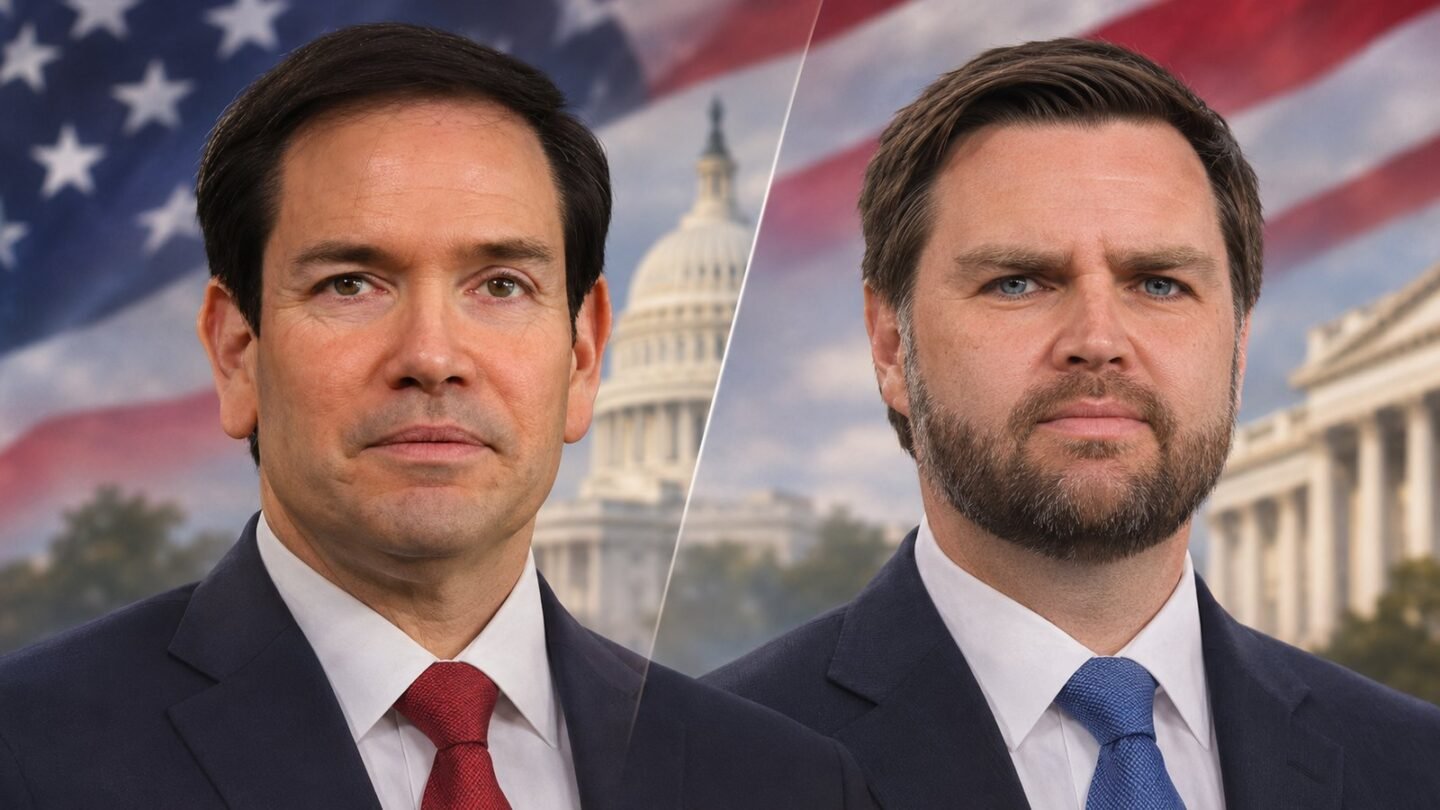
A new 2028 GOP poll from Emerson College places Secretary of State Marco Rubio ahead of Vice President JD Vance in a hypothetical Republican presidential primary. Rubio received 44% support to Vance’s 24% when respondents were shown a list of potential candidates.
The national survey was conducted November 14-16, 2026. Its findings describe an early preference among respondents who said they would participate in a Republican primary or caucus, rather than a forecast of the eventual nomination.
Emerson’s release and linked results workbook gives the more precise figures as 43.6% for Rubio and 24.0% for Vance. The difference is 19.6 percentage points, which rounds to the 20-point gap shown by the release’s whole-number percentages.
What the 2028 GOP poll found
In the candidate-list question, Ron DeSantis followed the two leaders at 9.4%, with Donald Trump Jr. at 6.0%, Tucker Carlson at 5.0% and Ted Cruz at 3.7%.
Nikki Haley received 2.9%, Robert F. Kennedy Jr. 1.2% and Glenn Youngkin 1.1%. Another 0.2% selected someone else, while 3.0% were undecided. The published percentages are rounded and should not be expected to sum perfectly.
The workbook lists 418 responses for this question. That is the relevant Republican-primary table, not the full survey of 1,000 voters.
Rubio also led when respondents first answered without seeing candidate names. Emerson’s release summarized that open-ended result as 36% for Rubio and 20% for Vance.
Why the two question formats matter
An open-ended question asks people to supply a name themselves. A closed-ended question asks them to choose from options supplied by the pollster. These are different ways of measuring preferences, even when they concern the same election.
Pew Research Center’s guidance on survey questions explains that offering answer choices can affect responses. Question wording, the available options and their order can all influence what people select.
Emerson asked the open-ended presidential preference question before presenting the candidate list. Rubio led under both formats, but the percentages from one format should not be combined with those from the other.
Pew also advises researchers to keep question wording and context consistent when measuring change over time. A larger share in one version of a question does not, by itself, show that individual voters changed their minds.
The 2028 GOP poll therefore supports a specific finding: Rubio led this survey’s hypothetical Republican field. It does not establish that every national survey puts him ahead.
How Emerson conducted the survey
Emerson College conducted and funded the study. Its methodology reports a national sample of 1,000 U.S. voters and a full-sample credibility interval of plus or minus 3 percentage points.
The release describes text-to-web recruitment through a probability-based voter panel from Consensus Strategies, supplemented by PureSpectrum panel interviews. Panel responses were matched to a voter file using names and ZIP codes.
Researchers weighted the data by gender, education, race, age, party and region. Emerson’s directly reviewed methodology says the survey was administered in English using QuestionPro.
The full-sample interval should not be attached to the smaller Republican group. Emerson warns that smaller subsets have greater uncertainty; a specific Republican-primary credibility interval was not identified in the release reviewed.
The eligibility question concerned which party’s primary or caucus respondents would enter. The results should therefore be labeled as Republican-primary preferences, rather than described as the views of all Americans or the entire national electorate.
One survey does not settle the Republican race
Other recent polling has produced different rankings. RealClearPolling’s published listings show an Echelon Insights survey with Vance at 40% and Rubio at 26%. Differences in sampling, timing and questionnaires need to be considered before treating separate results as a single trend.
Hourly Times previously examined early 2028 candidate ratings and respondent definitions. Ratings of whether someone would make a strong candidate are different from choosing one preferred nominee.
The 2028 GOP poll is an early snapshot, not an election result. Further comparable surveys and formal campaign decisions will provide additional evidence about the field as the nomination contest develops.