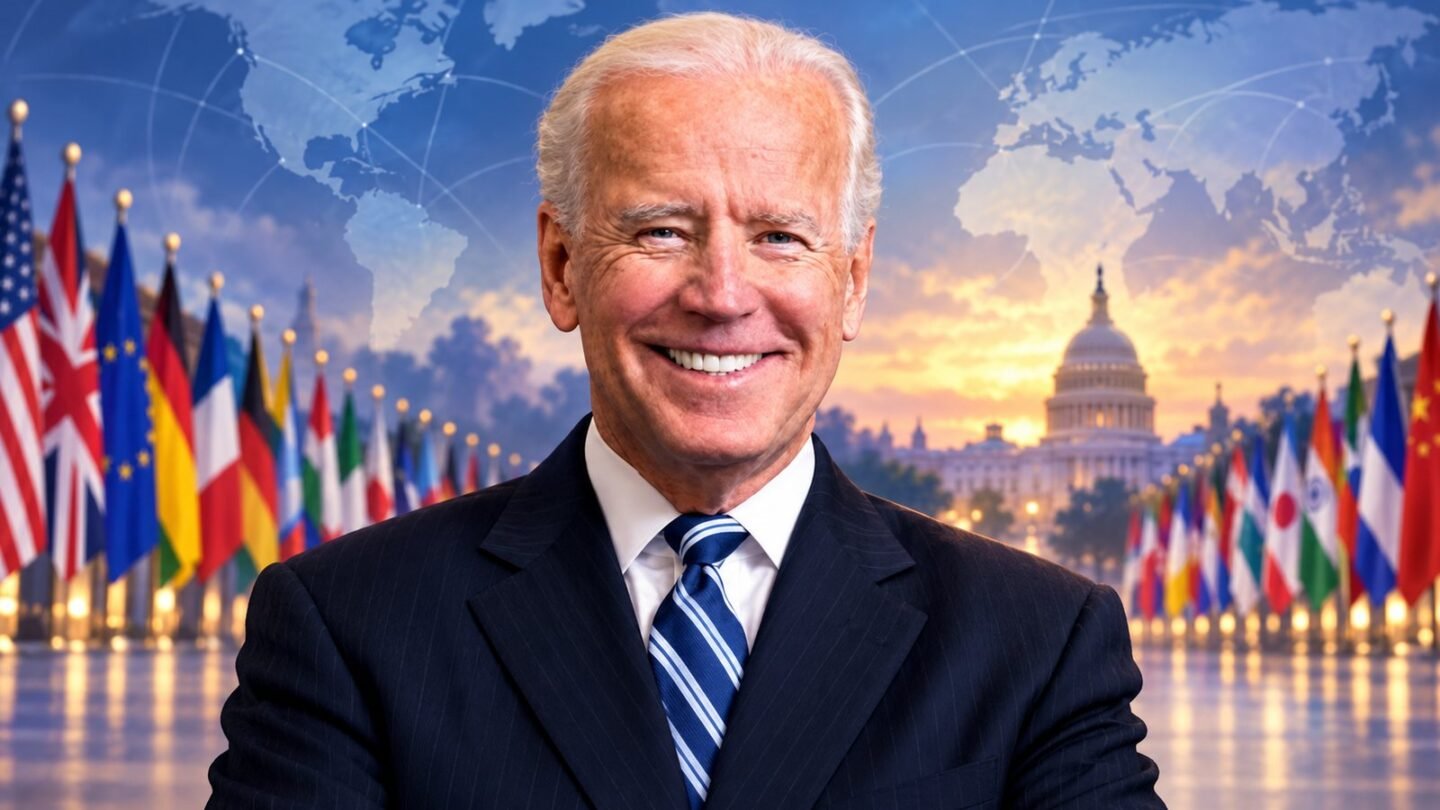
Joe Biden left the presidency in January 2025. Supporters say he rebuilt relationships with traditional U.S. allies and led international efforts to support Ukraine after Russia’s 2022 invasion. Critics point to the chaotic U.S. withdrawal from Afghanistan and widespread disagreement over his administration’s support for Israel during the Gaza war.
International polling offers useful context, but it cannot prove that America was always treated with dignity or never faced humiliation. Those are judgments about the country’s image and conduct—not questions the survey directly asked.
What the 2024 Pew survey found
Pew Research Center surveyed people in 34 countries from January 5 to May 21, 2024. The survey did not include the United States. Across the countries surveyed, a median of 54% had a favorable view of the U.S., while a median of 31% had an unfavorable view.
The same survey found more mixed views of Biden personally. A median of 43% said they had confidence in him to do the right thing in world affairs; 46% said they lacked confidence. For Donald Trump, 28% expressed confidence.
These figures show that the surveyed publics viewed the United States more favorably than unfavorably in 2024, while views of Biden’s leadership were divided. They do not show that every country respected the United States, or that the U.S. received more respect than during every other presidency.
Biden also faced criticism abroad
The survey found particularly low approval of Biden’s handling of the Israel-Hamas war: a median of 31% approved, while 57% disapproved across the 34 countries. This is an important part of the same polling picture. It shows that favorable views of the U.S. overall did not mean broad approval of every Biden administration policy.
The 2021 Afghanistan withdrawal also drew serious criticism. The evacuation at Kabul airport was chaotic, and U.S. allies questioned the process and the effect on American credibility. Biden defended the decision to end the war, while accepting responsibility for the final withdrawal. The agreement negotiated by the prior Trump administration shaped the timeline, but Biden made the final decision to complete the pullout.
What “respect” and “humiliation” mean
Pew asked people about their view of the United States and whether they trusted Biden or Trump to handle world affairs. It did not ask whether America had been humiliated, whether Biden represented the country with “dignity, respect and kindness,” or whether the world treated the U.S. with more respect under one president than another.
Those ideas can mean different things to different people. One person may define respect through favorable public opinion or close work with allies. Another may focus on diplomatic disputes, military decisions, or how other governments respond to U.S. policy. A poll about favorability can inform that debate, but it cannot answer every part of it.
The 2024 results are also a snapshot from the final year of Biden’s presidency, not a full measure of global opinion across all four years. Polling in 2022, for example, also found positive views of the U.S. in the countries then surveyed. Results vary by year, country and question.
A mixed record, not a simple verdict
The evidence supports a careful conclusion: in Pew’s 2024 survey, views of the U.S. were more favorable than unfavorable across the countries surveyed, and Biden received greater confidence than Trump on world affairs. But Biden’s own rating was divided, and his administration’s handling of the Israel-Hamas war drew low approval. The Afghanistan withdrawal also prompted public and allied criticism.
That record gives people reasons to praise parts of Biden’s diplomacy and criticize other decisions. It does not prove that America “never faced global humiliation” under him or that the country was always treated with greater respect. Those remain political judgments.
Readers can decide how they define America’s standing abroad and which evidence matters most: public opinion, relationships with allies, policy outcomes, or the conduct of the president.
Reader Poll
This is an informal Hourly Times reader poll. Its results are not a scientific measurement of U.S. public opinion.