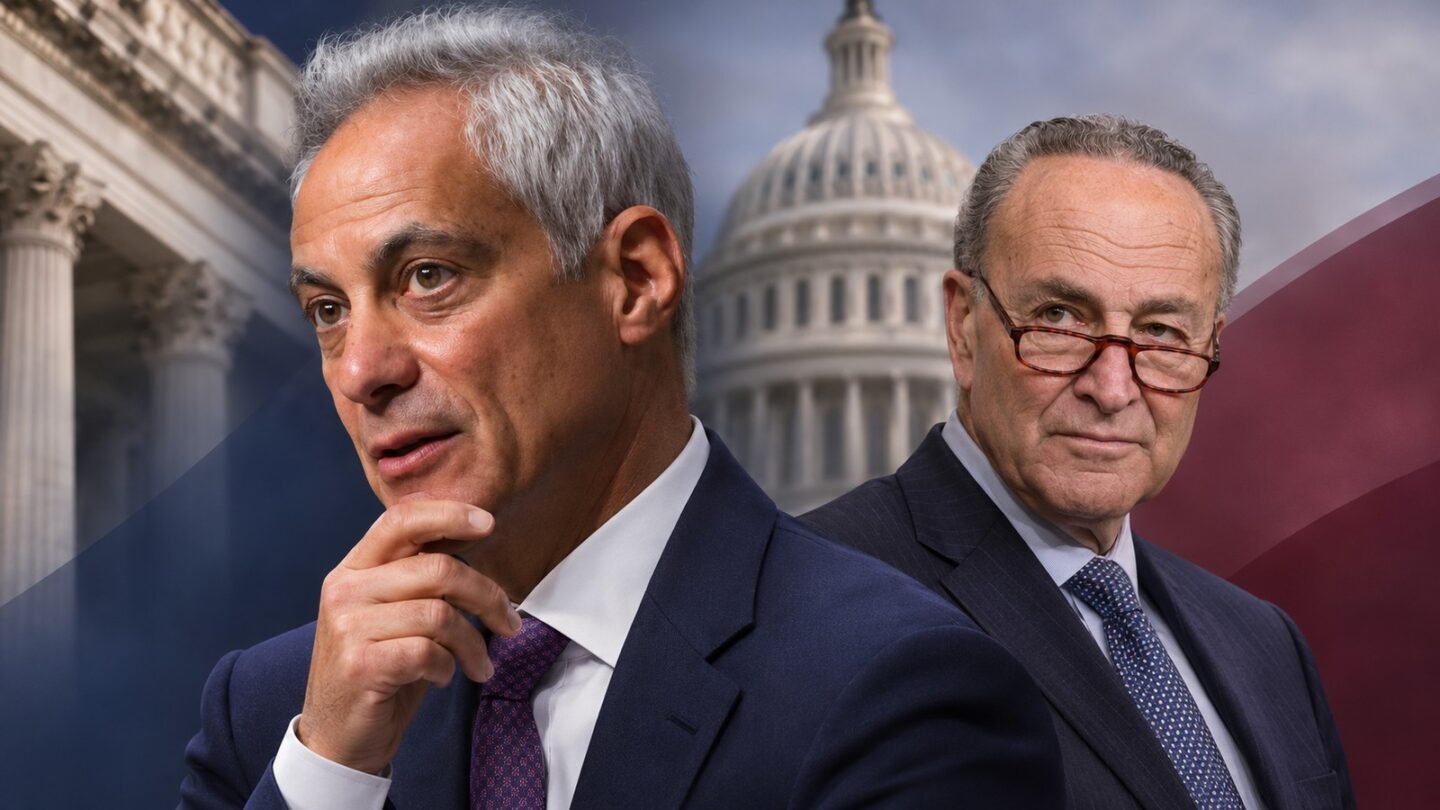
Rahm Emanuel said on November 22 that Chuck Schumer should commit to leaving Senate Democratic leadership after the next Congress, proposing a two-year transition as the party prepares to take control of the chamber. The former Chicago mayor made the recommendation during an interview on ABC’s “This Week.”
Emanuel’s proposal would allow Schumer to lead the incoming majority while making room for a successor afterward. Democrats and the independents who caucus with them are set to hold a 56-seat majority when the next Congress begins in January 2027.
The remarks came ahead of a December 1 leadership election in which Maryland Sen. Chris Van Hollen is challenging Schumer. Emanuel’s recommendation does not establish that Schumer has agreed to leave or that either candidate has won that contest.
Rahm Emanuel proposes two more years for Schumer
Rahm Emanuel suggested Schumer should promise to preserve the majority, decline to seek the leadership position in the following cycle and help younger party figures develop.
“I am not going to run for majority leader next cycle,” Emanuel said, describing the commitment he wanted Schumer to make.
When ABC co-anchor Jonathan Karl asked whether Schumer should serve as majority leader for the next two years, Emanuel agreed. His answer placed the proposed departure after the incoming Congress rather than before it.
Emanuel described both Schumer and Van Hollen as friends and argued that Democrats should concentrate on improving voters’ lives. His comments concerned the leadership position, rather than an announcement that Schumer would resign his New York Senate seat.
Schumer maintains that he will win
Schumer has projected confidence about the leadership election. Reuters reported that he told reporters he expected to be elected majority leader and said his focus was delivering results in 2027.
Van Hollen has argued for greater influence for new members and a change in how the Democratic caucus operates. Schumer’s critics have also pressed for generational change despite the party’s election gains, according to Reuters.
Those competing positions leave the decision with Democratic senators. Neither Emanuel’s recommendation nor public endorsements determine how members will vote in the private leadership contest.
A larger majority brings competing expectations
The Associated Press reported that Democrats flipped nine Senate seats in the midterms, producing an incoming 56-44 majority. The result gives the party control of the chamber after two years in the minority.
That success has not ended disagreements over leadership. AP has reported that incoming senators face pressure to choose between Schumer’s experience and relationships and Van Hollen’s promise of a more confrontational approach toward President Donald Trump.
Ohio Sen.-elect Sherrod Brown supports Schumer, while progressive organizations including MoveOn and Indivisible have endorsed Van Hollen, according to AP. These endorsements describe individual and organizational positions, rather than a completed caucus vote.
Hourly Times previously covered Abdul El-Sayed’s earlier decision to leave his leadership choice open. That November 8 position provides background to the debate and should not be treated as his current endorsement.
How Senate Democrats choose their leader
The Senate’s official explanation of party leadership says each party conference elects its leader for a new Congress. The party holding power supplies the majority leader; the other supplies the minority leader.
The majority leader coordinates legislative strategy and schedules floor business in cooperation with committee leaders. The role therefore concerns the daily management of the chamber as well as the party’s public message.
Under the Democratic Conference’s published rules, contested leadership elections use secret ballots. Balloting continues until a candidate receives a majority of conference members present and voting.
The rules also say that neither the leadership nor the conference can bind members to a particular vote in the conference, a committee or the Senate. Leadership selection and subsequent legislative votes remain separate decisions.
Rahm Emanuel’s proposed transition remains advice to the caucus and its current leader. The next scheduled decision is the December 1 vote to select who will lead Senate Democrats into the new Congress.