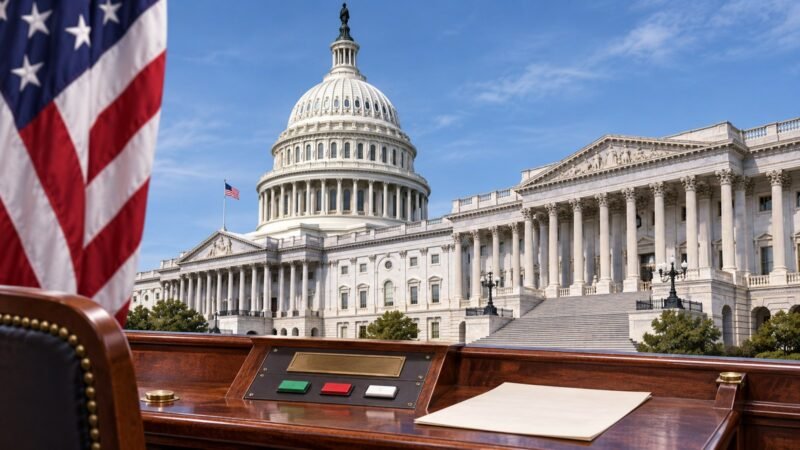
House proxy voting could not establish the quorum needed to pass a $1.7 trillion spending package during Joe Biden’s presidency, the Fifth U.S. Circuit Court of Appeals ruled on November 20, 2026.
The full court’s 9–8 decision upheld an injunction preventing federal enforcement of the Pregnant Workers Fairness Act against Texas. Although its reasoning concerns passage of the larger legislation, the court did not issue a nationwide injunction blocking the entire spending package.
What the House proxy voting ruling decided
Judge Cory Wilson wrote the majority opinion in the case involving the Consolidated Appropriations Act of 2023. The majority concluded that absent representatives could not be counted as present through another member for purposes of establishing a constitutional quorum.
The court’s published opinion expressly limits the relief it affirmed to the district court’s injunction concerning enforcement of the pregnancy accommodation provision against Texas.
That separates two questions: whether the House used a constitutional procedure to pass the bill, and what remedy the court could award in this lawsuit. The majority’s answer to the first was broad, while the order it upheld was limited.
How lawmakers voted on the spending package
The House clerk’s official record shows that the measure passed on December 23, 2022, with 225 votes in favor, 201 against, one member voting present and four not voting.
Support included 216 Democrats and nine Republicans. One Democrat and 200 Republicans voted against the measure. The party totals record lawmakers’ positions; they do not establish how many representatives were physically inside the chamber.
The appeals court said 226 members recorded their participation by proxy. The constitutional dispute therefore concerned the attendance requirement for conducting business, rather than whether the recorded supporters outnumbered opponents.
Article I, Section 5 of the Constitution requires a majority of each chamber for a quorum. It separately authorizes each chamber to set its procedural rules and permits measures to compel absent members to attend.
Why the judges disagreed about physical presence
The majority held that Congress’s authority to write its rules could not remove the Constitution’s attendance requirement. Judge James Graves dissented, arguing that the majority read a physical-presence condition into the constitutional text.
The House proxy voting dispute had previously produced the opposite result. A three-judge Fifth Circuit panel ruled in August 2025 that the Quorum Clause did not require physical presence and reversed the district court’s judgment. That panel opinion was later vacated for rehearing by the full court.
The earlier opinion described procedures adopted in May 2020 under House Resolution 965. During designated pandemic periods, an absent member could submit a signed letter naming another representative to cast a vote or record that member’s presence.
Republicans ended the pandemic-era proxy system after taking control of the House following the 2022 elections, Reuters reported.
The pregnancy protections at the center of the case
The Equal Employment Opportunity Commission’s explanation says the Pregnant Workers Fairness Act generally requires covered employers to accommodate known limitations connected to pregnancy, childbirth or related medical conditions, unless doing so creates an undue hardship.
The law took effect on June 27, 2023. It generally applies to private employers and state or local government employers with at least 15 employees, as well as federal agencies, Congress and certain other employment organizations.
Possible accommodations include additional breaks, schedule adjustments, a stool for work normally performed standing, and leave for medical appointments. Whether an accommodation is required depends on the circumstances; the agency defines undue hardship as significant difficulty or expense.
The EEOC also distinguishes accommodation rights from other protections against pregnancy discrimination. The law does not replace federal, state or local protections that provide stronger safeguards.
What the decision means for other legislation
The House proxy voting ruling could provide an argument for additional challenges to laws passed under the pandemic procedures. CNN reported that legal experts had raised concerns about those wider consequences.
However, potential future lawsuits are separate from the relief already ordered. The decision affirmed an injunction against enforcing one provision against Texas; it did not itself block every provision of the spending package throughout the country.