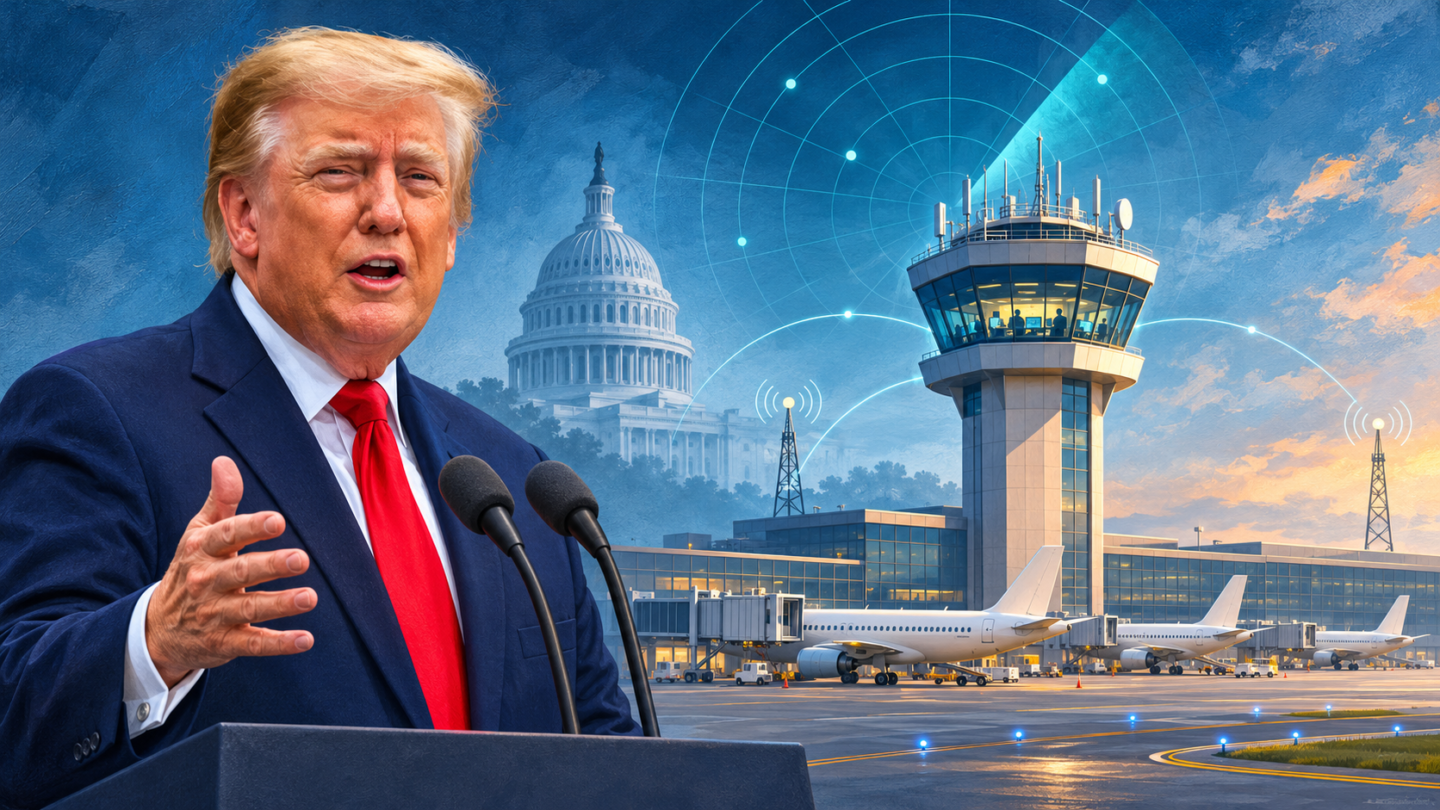
President Donald Trump is pressing Congress for more air traffic funding after the November 13 nationwide departure halt, backing an overhaul of aging aviation systems. His public appeal came Sunday, November 15, as Transportation Secretary Sean Duffy sought up to $50 billion for air traffic control and airport improvements.
The call is a request for additional money, rather than an announcement that Congress has approved a new package. Duffy has described the $12.5 billion previously provided for modernization as a down payment and says further funding is needed to complete the work.
What the air traffic funding request covers
The administration initially sought $30.1 billion for aviation improvements before increasing its request to $50 billion after Friday’s disruption, Reuters reported. The earlier proposal included air traffic control technology, control towers and airport projects, so the broader package extends beyond replacing communications equipment.
Trump urged lawmakers to finance the work as a comprehensive project instead of dividing it into smaller stages. UPI reported that he argued a fully funded rebuild could move quickly, while criticizing the previous administration’s handling of the system.
Duffy’s explanation for seeking more money centers on what the existing allocation can buy. In a November 15 summary of his television interviews, the Transportation Department said the approved funds were designated for specific equipment, including radar, radios and electronic flight strips.
The secretary said those resources were accounted for and could not simply be redirected to every remaining need. He identified a replacement telecommunications network and new software for managing aircraft separation as areas requiring additional funding.
Congress weighs spending and accountability
House Speaker Mike Johnson said lawmakers would consider the expanded request in year-end legislation, according to Roll Call. His comments indicated an intention to take up the proposal, rather than a completed agreement on its size or terms.
Senior Democrats questioned the administration’s spending progress and asked for more detail before supporting the larger package. Roll Call reported that House appropriators Rosa DeLauro and James Clyburn challenged why previously approved aviation money remained unspent and questioned restrictions on its availability.
Those objections form part of the air traffic funding debate. Duffy maintains that the existing money has specific purposes and that the remaining network work needs further resources. The competing accounts leave lawmakers weighing both the request and management of earlier appropriations.
What investigators know about Friday’s disruption
The FAA’s official questions and answers describes excessive data flooding its telecommunications network, creating instability in communications and radar feeds. Investigators identified possible sources at a radar site in Amarillo, Texas, and a radio communications site in El Dorado, Arkansas.
Contractor L3Harris had been deploying a new router at the Arkansas location. The agency said blocking the two sites stabilized the network, while the FAA and the company continued investigating the underlying cause.
Air traffic resumed at 8:15 p.m. Eastern on November 13. Some communications and radar feeds remained available throughout the disruption, and approximately 3,500 aircraft already airborne landed safely, according to the FAA. The departure halt did not stop every aviation operation.
Hourly Times’ earlier coverage of Trump’s response explains the Cabinet briefings and congressional scrutiny that followed the disruption.
Modernization concerns predate the outage
The Government Accountability Office documented the wider problem in a September 2024 report. Drawing on an FAA assessment, it said 51 of 138 air traffic control systems were unsustainable, citing issues including outdated functions and difficulty obtaining spare parts.
That report also identified slow modernization and weaknesses in investment oversight. Its findings describe longstanding infrastructure and management concerns; they do not establish the cause of the November 2026 disruption.
The watchdog recommended clearer reporting to Congress on risks involving critical systems and stronger oversight of modernization investments. Those recommendations concern how projects are planned and managed, alongside the separate question of how much funding Congress should provide.
The FAA’s modernization program includes replacing older communications links, improving surveillance equipment and introducing electronic flight strips. The air traffic funding decision now before Congress concerns how much more to provide and under what conditions, while the separate technical investigation continues.