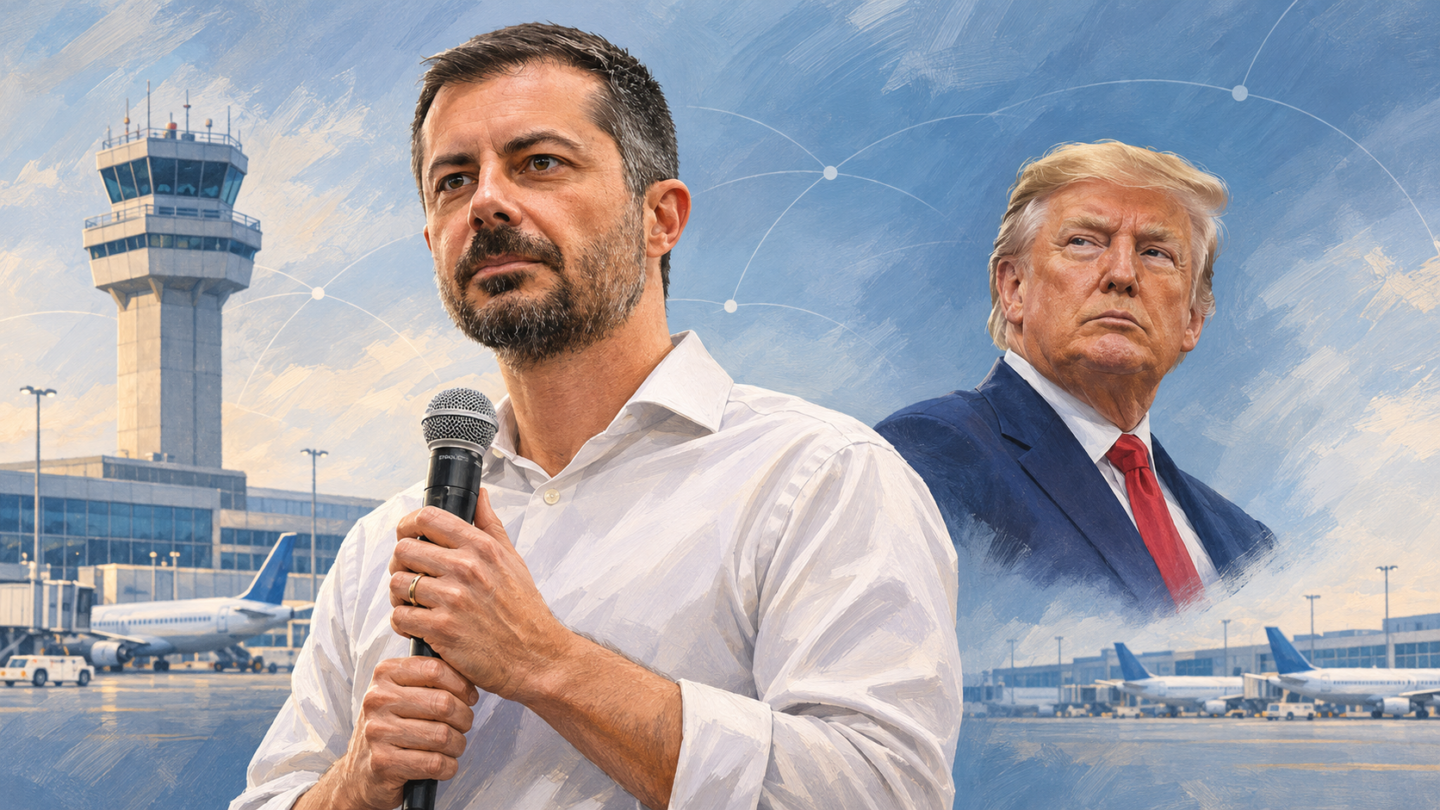
The FAA blame dispute escalated on November 16 when former Transportation Secretary Pete Buttigieg rejected President Donald Trump’s claim that he was responsible for Friday’s nationwide ground stop. Buttigieg defended his record and demanded answers about the breakdown, while federal officials continued investigating the network failure.
Buttigieg said his department had started moving the Federal Aviation Administration’s communications away from copper wiring toward a modern network. He welcomed continued work under the Trump administration but questioned why the recent maintenance operation had produced such widespread disruption, according to CNN’s reporting on his social-media statement.
Trump had told reporters that Buttigieg “ruined the system.” He also rejected personal responsibility for the outage, describing aging equipment as the problem. Those remarks assigned political blame; they did not present a completed technical investigation establishing responsibility for the failure.
FAA blame dispute follows a communications breakdown
The FAA’s official explanation of the ground stop says the disruption began on November 13 at approximately 3:30 p.m. Eastern. Air traffic resumed at 8:15 p.m., after officials stabilized the system and waited to confirm it was safe to lift the restrictions.
The agency said excessive connection attempts flooded its telecommunications network, destabilizing communications with aircraft and radar information. Its initial investigation identified potential sources at a radar facility in Amarillo, Texas, and a radio communications site in El Dorado, Arkansas.
Transportation Secretary Sean Duffy said contractor L3Harris had been carrying out routine work in Arkansas when equipment there was activated and problems also appeared at the Texas site. In a November 15 update, the Transportation Department said engineers were examining both the equipment and the installation process.
The FAA said some radio frequencies and radar feeds remained available during the disruption and aircraft landed safely. The ground stop restricted departures as a safety precaution; it did not mean that every communications channel or every aviation operation across the country had stopped.
Buttigieg seeks answers about spending and execution
Buttigieg’s response focused on how the work was carried out and how modernization money had been used. He said he supported additional FAA funding while asking the administration to explain the failure and the measures it would take to prevent another one.
The White House’s rapid-response account rejected his defense and attacked his performance as transportation secretary, CNN reported. The FAA blame dispute therefore includes competing political accounts of the system’s condition, alongside an investigation into a specific maintenance-related incident.
Duffy has defended the administration’s handling of upgrades. The Transportation Department said the $12.5 billion Congress provided for modernization was allocated to projects including radar, radios and electronic flight strips. Duffy argued that further funding was needed for other work, including a replacement network and air-traffic software.
Aging systems were documented before the outage
Concerns about the FAA’s technology predate the current dispute. In a September 2024 report, the Government Accountability Office described an FAA assessment that classified 51 of its 138 air-traffic systems as unsustainable and another 54 as potentially unsustainable.
The watchdog also identified weaknesses in modernization planning and oversight. Some projects addressing especially concerning systems were expected to take years to complete. Those findings document existing vulnerabilities, but they are not a finding about which equipment or decision caused the November 2026 breakdown.
Neither Trump’s accusation nor Buttigieg’s defense settles that technical question. The FAA’s published explanation says the agency and L3Harris are continuing to investigate the root cause. Its preliminary account should be distinguished from a final determination of individual or institutional responsibility.
Congressional review and equipment testing continue
House Transportation and Infrastructure Committee Chairman Sam Graves, a Missouri Republican, and ranking member Rick Larsen, a Washington Democrat, said in a joint November 13 statement that the committee would examine the issues behind the ground stop. They also thanked controllers and the FAA for protecting travelers.
Hourly Times’ earlier coverage of Trump’s response and congressional demands for answers explains the initial oversight and funding debate. The new exchange adds Buttigieg’s defense of his tenure to that continuing argument.
The FAA blame dispute continues while engineers examine the routers and the installation process. The official updates reviewed did not give a publication date for a final root-cause report.