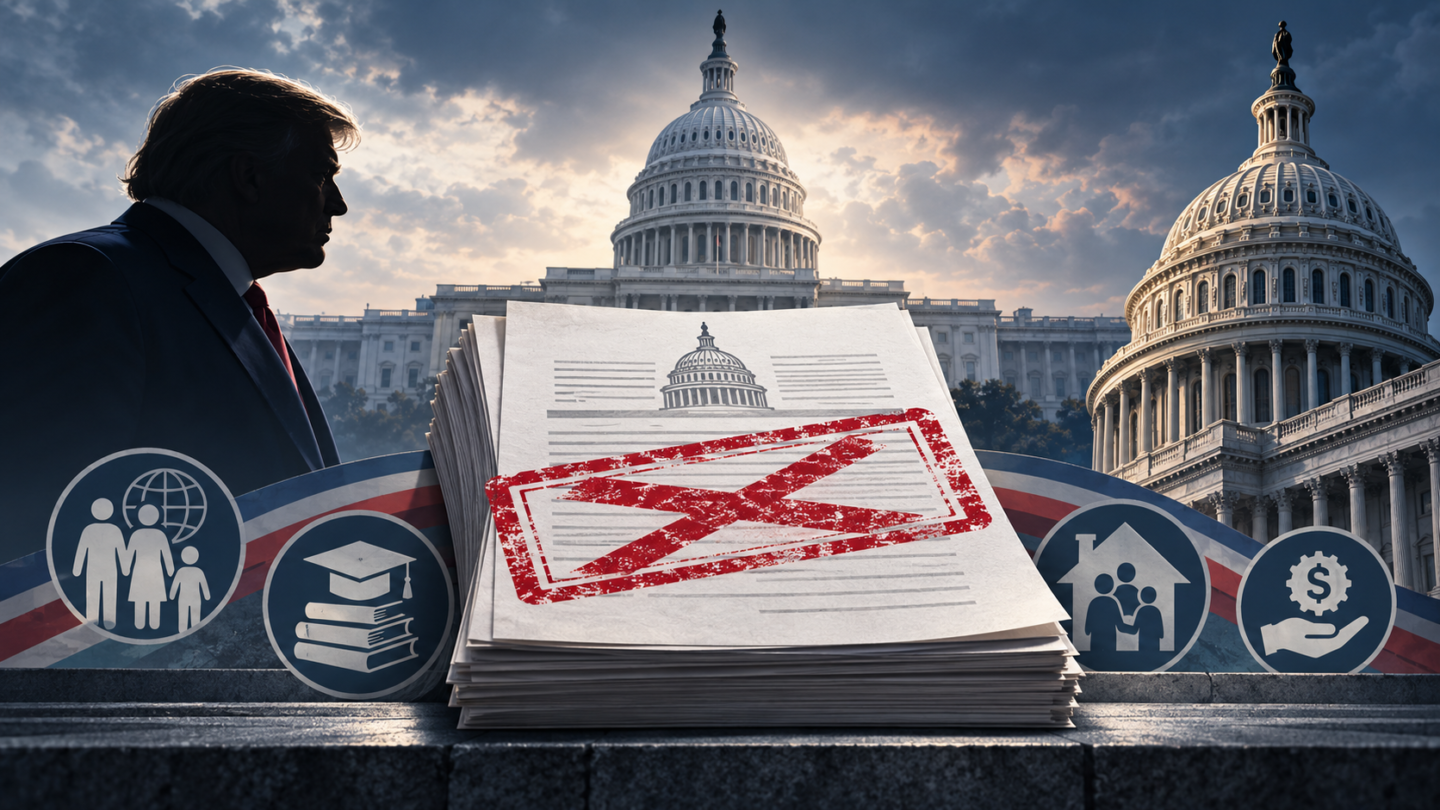
The Trump administration announced Friday that it plans to cancel nearly $1 billion in federal spending that Congress had previously approved. The move targets programs connected to immigrant services, education, housing counseling, minority-business assistance and selected health-research grants.
The White House described the action as a way to eliminate what it considers wasteful or harmful spending. The administration is using a rarely deployed budget procedure known as a “pocket rescission,” which allows the president to propose the cancellation of appropriated funds close to the end of the fiscal year.
The announcement has renewed a long-running dispute over whether the president can effectively prevent Congress-approved money from being spent without receiving a new approval vote from lawmakers.
What Funds Are Being Targeted?
According to a White House fact sheet, the largest listed portion involves approximately $567 million in Health and Human Services funding connected to services for noncitizens. The administration argues that changing immigration conditions have left some of the money unnecessary.
The White House also identified funding for several other areas, including:
- $15 million in Department of Homeland Security programs
- $25 million in Education Department programs for migrant students
- $15 million for the Justice Department’s Community Relations Service
- $10 million for Minority Business Development Agency programs
- $70 million in international education programs
- $28 million in selected HHS research programs
- $56 million in housing-counseling support for nonprofit organizations
The administration says some of the programs promote policies it opposes or duplicate other federal activities. Those descriptions reflect the White House’s position and do not establish that the programs violated federal law.
The Associated Press reported that the cuts focus on immigrant services and diversity-related initiatives and that the total amount is nearly $1 billion.
Why Is the Procedure Controversial?
The procedure is connected to the Impoundment Control Act of 1974. Under the normal rescission process, the president sends Congress a formal request to cancel specific funding. The administration may temporarily withhold the money while Congress considers the request.
The Government Accountability Office says Congress generally has 45 days of continuous session to act on a rescission proposal. If Congress does not approve the cancellation, the funds are generally required to become available for obligation.
A “pocket rescission” is controversial because the request may be made so close to the end of the fiscal year that the money could expire before Congress completes its review. Critics argue that this could allow the executive branch to achieve a cancellation without receiving the approval required by the law.
GAO has previously stated that the Impoundment Control Act does not permit the administration to withhold funds until they expire simply because a rescission request was submitted near the end of the fiscal year.
A Continuing Fight Over the Power of the Purse
The dispute centers on the Constitution’s division of federal spending authority. Congress approves funding through legislation, while the executive branch administers those programs.
The Trump administration maintains that its action is authorized under existing law and is designed to prevent taxpayer money from being spent on programs it considers unnecessary or harmful. The White House has also used similar rescission strategies in earlier funding disputes.
Opponents argue that the approach weakens Congress’s constitutional control over federal spending. The legal debate is likely to continue if lawmakers, affected organizations or states challenge the cancellations in court.
The issue also follows the administration’s earlier effort to use a similar procedure for foreign-aid funding. That earlier dispute produced major legal and political challenges over how much control a president has over funds appropriated by Congress.
What Happens Next?
Congress may review the rescission request, approve some or all of the cancellations, reject them or take no immediate action. Courts could also be asked to decide whether the administration’s interpretation of the law is valid.
The most important questions are whether the funds have already been legally obligated, whether Congress remains in session long enough to complete its review and whether affected programs can continue operating while the dispute is pending.
The White House has not announced a final court ruling or congressional vote on the new package. The legality and practical effect of the cancellations therefore remain unresolved.