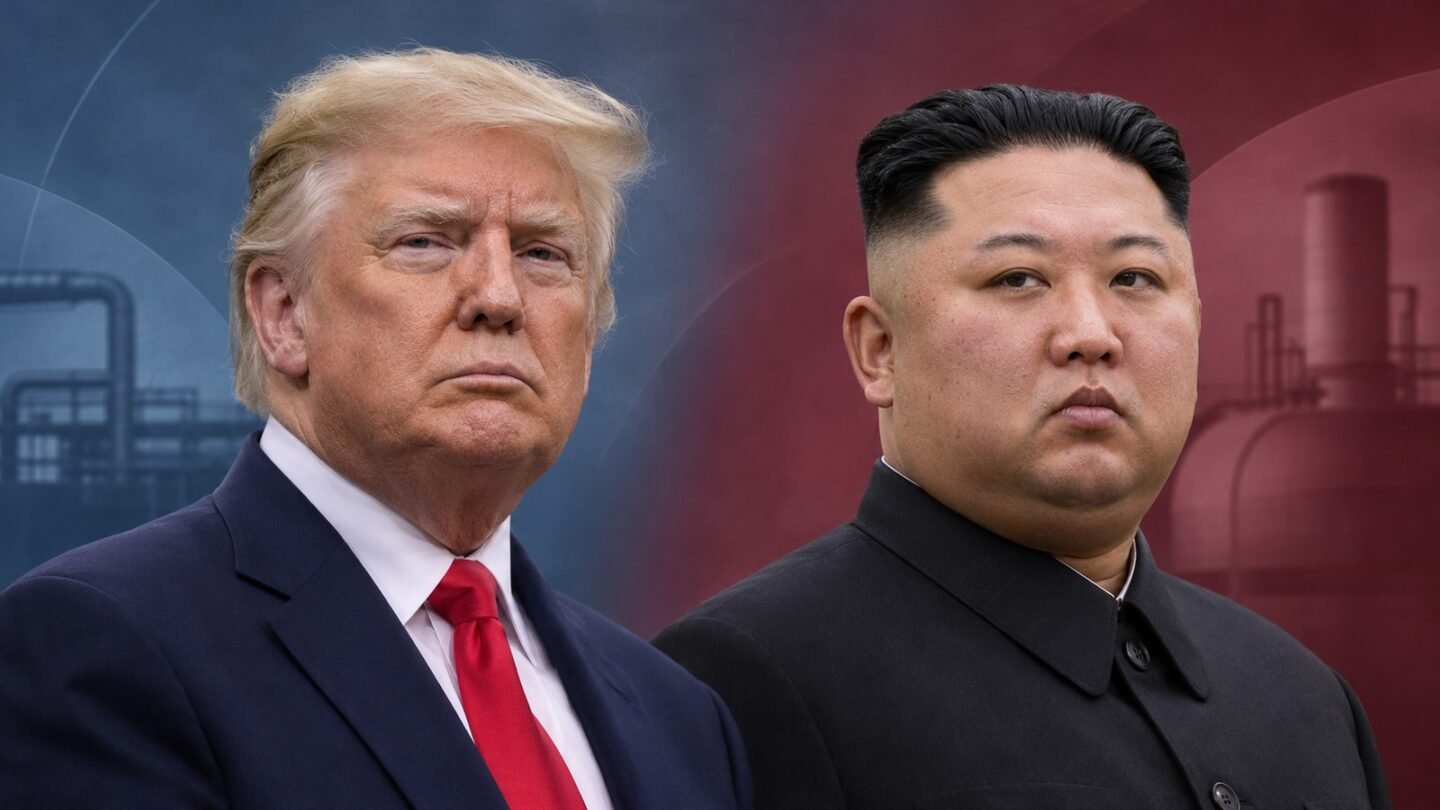
Trump-Kim talks failed to materialize during President Donald Trump’s latest Asia trip, which ended in Shenzhen, China, on November 19. The missed encounter came as the International Atomic Energy Agency reported further expansion of North Korea’s uranium-enrichment facilities, underscoring the continuing nuclear dispute between Washington and Pyongyang.
Trump had publicly raised the possibility of meeting North Korean leader Kim Jong-un during the visit. No meeting took place, and the two governments have announced no date for another summit.
Separate reporting about unanswered calls and a returned letter adds to questions about their relationship. Those accounts rely on unnamed sources and should be distinguished from the publicly documented outcome of the trip.
Trump-Kim talks end without a meeting
Before departing Washington on November 16, Trump suggested Kim might travel to China. He raised the possibility again during his stop in Manila, according to Yonhap News Agency.
Secretary of State Marco Rubio subsequently said Trump was serious about engaging Kim, while acknowledging that a meeting might not happen. Rubio argued that direct engagement was necessary to address problems involving North Korea.
Trump ultimately departed Shenzhen after attending the Asia-Pacific Economic Cooperation summit and meeting Chinese President Xi Jinping and Russian President Vladimir Putin.
According to Yonhap, the three leaders’ joint declaration supported dialogue on reducing nuclear risks and preventing proliferation but did not mention North Korea or denuclearization of the Korean Peninsula.
Outreach reports face an administration denial
The Wall Street Journal reported that Trump’s attempts to contact Kim in 2025 went unanswered and that a letter delivered to a North Korean diplomat was later returned unopened. Its account relied on people familiar with the matter.
An administration official disputed efforts to arrange a meeting, and the White House said its denuclearization position remained unchanged, according to subsequent reporting. The Journal said North Korea’s United Nations mission could not be reached for comment.
These reports do not establish that every communication channel has been permanently closed.
Trump offered a different public explanation for the missed encounter, telling NBC News that his schedule had been too crowded, according to the Korea JoongAng Daily. He continued to suggest that a future meeting remained possible.
IAEA reports expansion at Yongbyon
The clearest recent evidence about North Korea’s nuclear activities comes from IAEA Director General Rafael Grossi’s November 18 statement to the agency’s Board of Governors.
Grossi said construction of a further extension to the original uranium-enrichment facility at Yongbyon began in mid-September. Its exterior appeared complete by late October.
He also described continuing enrichment operations at Kangson and Yongbyon and construction of an additional enrichment facility at Yongbyon. The agency expressed serious concern about the expanding program.
The IAEA observed indications that Yongbyon’s five-megawatt reactor likely continued operating. Grossi also said the site’s light-water reactor had been operating since late April following a shutdown.
These observations concern facilities and activity. They do not provide a verified count of newly assembled nuclear weapons or establish when individual warheads entered the arsenal.
Warhead estimates carry significant uncertainty
The Federation of American Scientists estimates that North Korea may possess approximately 60 assembled nuclear warheads. Its 2026 assessment of global nuclear forces cautions that national stockpile figures carry substantial uncertainty.
That estimate should not be presented as an audited inventory. FAS explains that publicly available information, historical records and other evidence support its assessments, while the amount of information available differs considerably between countries.
The distinction matters: estimates of assembled weapons are different from estimates of how many weapons a country could potentially produce. Neither should be treated as a precise, publicly verified total.
The uncertainty surrounding Trump-Kim talks leaves two separate questions: whether the leaders will resume direct engagement and whether any future discussions would produce limits on nuclear activity.
For now, Trump-Kim talks have no publicly announced restart date. South Korea’s Foreign Ministry told the Korea JoongAng Daily on November 22 that Seoul and Washington remained open to dialogue and continued coordinating their North Korea policies.