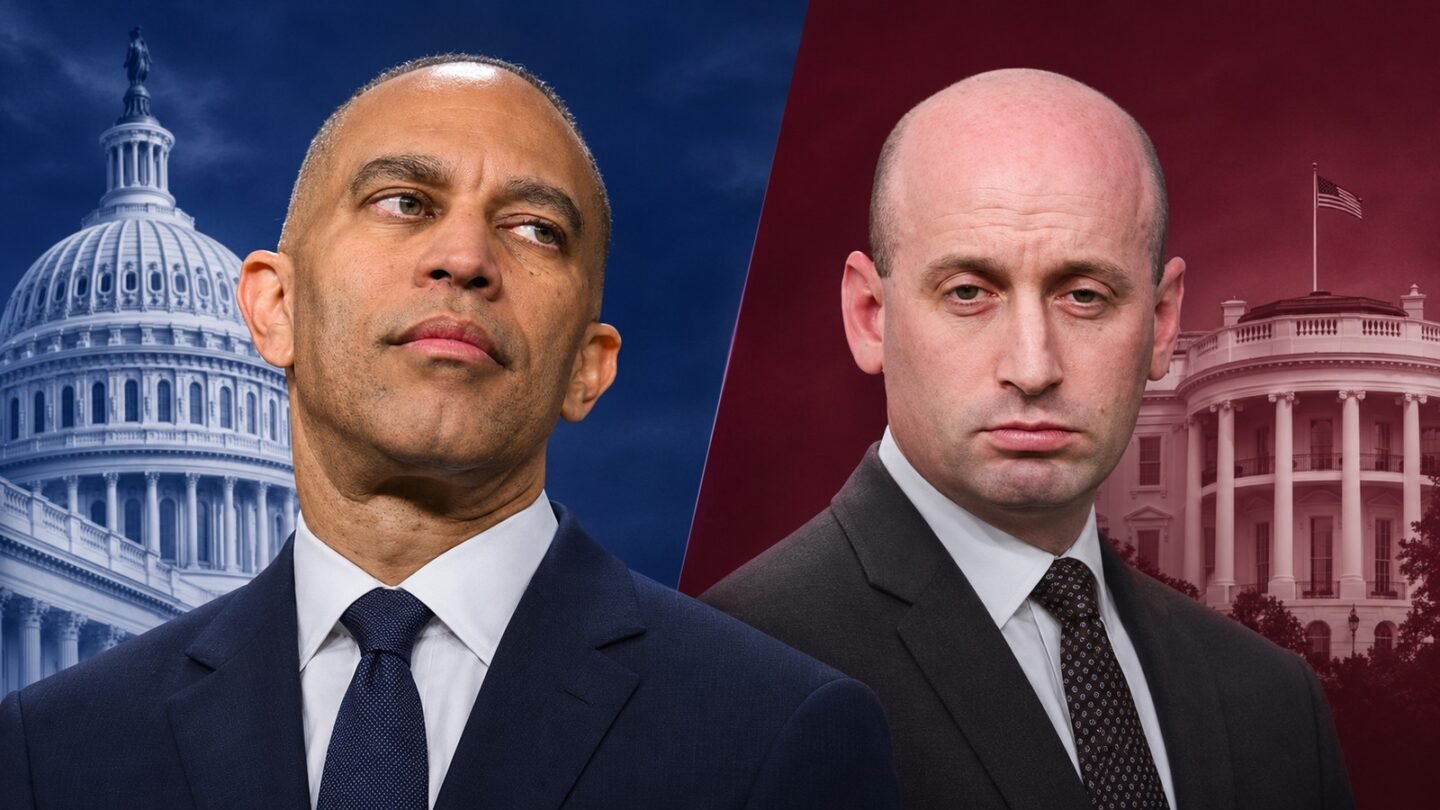
Hakeem Jeffries has ruled out meeting with White House chief of staff Stephen Miller while leaving open direct communication with President Donald Trump and Vice President JD Vance. In a New York Times interview released November 21, the House Democratic leader linked his refusal to Miller’s role in the administration’s immigration policies.
The White House rejected Jeffries’s criticism, defending Miller’s record on public safety, drug pricing and other issues. The exchange comes as Democrats prepare to take control of Congress in January.
Jeffries is his party’s nominee for speaker, but the full House must still elect the chamber’s presiding officer. His stated approach to White House negotiations therefore comes before that formal vote.
Hakeem Jeffries rejects Miller as a negotiating partner
Asked whether he could envision sitting down with Miller, Jeffries said no, according to published accounts of the interview. He called the chief of staff a “stone-cold racist” and criticized his involvement in Trump’s deportation policies.
Jeffries associated those policies with cruelty, disorder and deaths. Those descriptions were his criticisms of the administration, rather than findings announced by a court or congressional investigation.
His refusal was directed at Miller personally. Jeffries said he could communicate with Trump directly or through Vance, and pointed to Cabinet officials and vice presidents as other channels used in earlier administrations.
Hakeem Jeffries’s position leaves room for White House discussions without accepting Miller as his counterpart. It does not announce a scheduled meeting, a policy agreement or a commitment by Trump or Vance to a particular negotiating arrangement.
The Hill reported that Jeffries had briefly spoken with incoming Republican House leader Jim Jordan and expected a later discussion about opportunities to work together. That conversation concerned congressional relations, separately from his refusal to engage Miller.
White House defends Miller’s record
White House spokeswoman Taylor Rogers disputed the criticism and said Miller had helped advance bipartisan work on public safety reform, drug pricing transparency and nuclear energy.
She also credited him with efforts to improve safety in Washington, D.C., and Memphis. Her response presented the administration’s defense of Miller and its policy record.
Trump separately defended his chief of staff during a November 21 appearance on Fox News’ “Saturday in America,” emphasizing Miller’s approach to border security, according to the New York Post.
The president also praised Jeffries and suggested negotiations with Democrats remained possible. That response did not resolve the disagreement over Miller, but it left the prospect of communication between the two elected leaders open.
The refusal follows earlier public criticism
Hakeem Jeffries had already rejected working with Miller before the latest interview. A November 8 transcript published by his congressional office records him saying cooperation with the new chief of staff would not happen.
During that ABC interview, he contrasted Miller with predecessor Susie Wiles, with whom he had communicated. He again connected his opposition to the administration’s immigration enforcement.
Hourly Times previously covered Trump’s decision to replace Wiles with Miller. The appointment moved an existing senior aide into the administration’s top staff position.
Jeffries’s November 8 remarks also identified areas where Democrats wanted legislative action, including credit card relief and healthcare costs. He said the party intended to pursue affordability measures alongside oversight of the administration.
A separate House vote still lies ahead
Democrats selected Jeffries as their speaker nominee on November 18. As Hourly Times explained in its coverage of the speaker nomination and remaining floor vote, that party decision did not immediately install him in office.
The House’s official leadership guide states that the speaker is elected by the whole chamber. The office combines responsibility for presiding over House proceedings, administering the institution and leading the majority party.
The dispute with Miller concerns whom Jeffries is willing to engage as Democrats prepare for those responsibilities. His willingness to consider other administration contacts remains separate from whether negotiations produce legislation.
The next scheduled institutional milestone is the speaker election when the new Congress convenes on January 3, 2027.