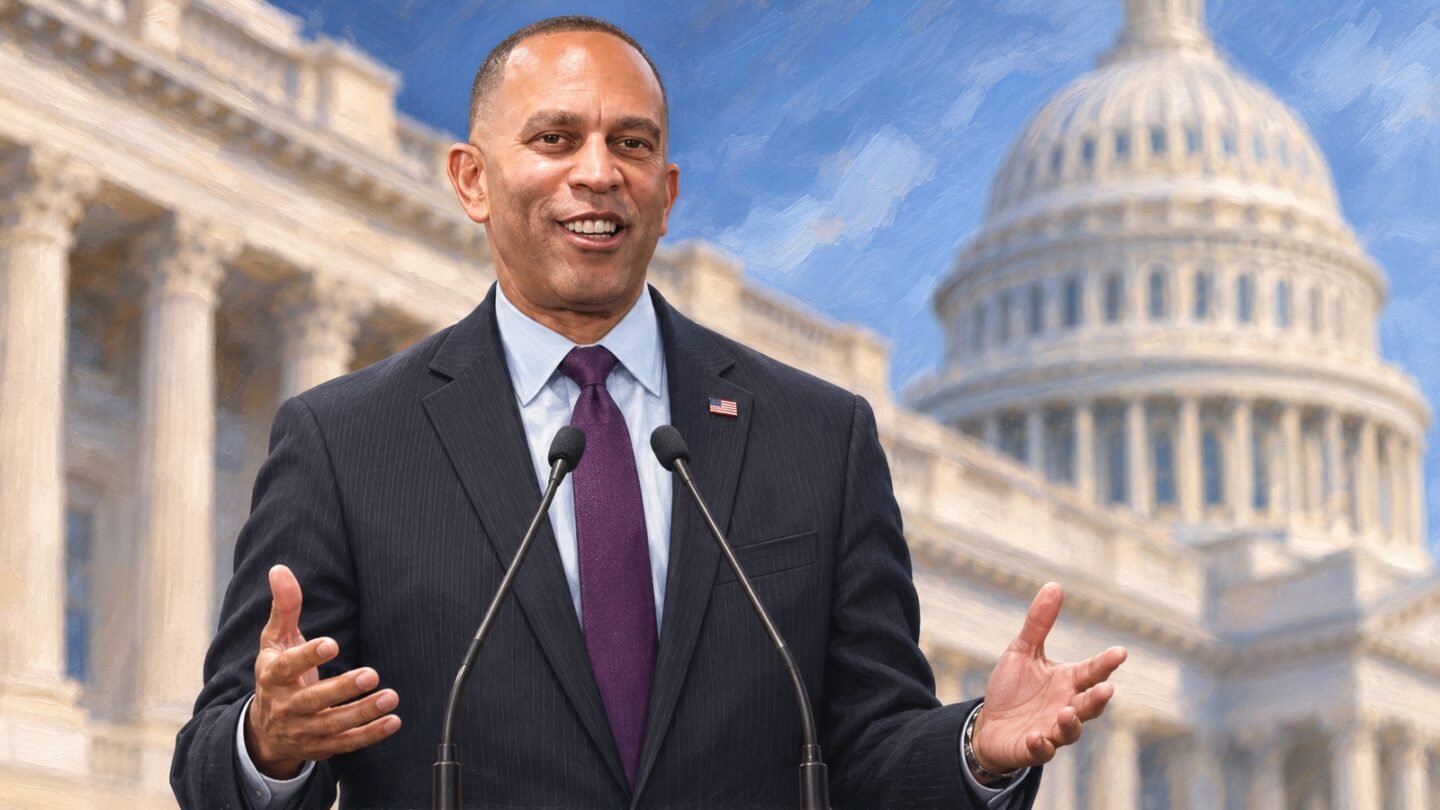
Hakeem Jeffries launched his House speaker bid on November 4, 2026, following Democrats’ midterm victories. Axios reported that he requested colleagues’ support in a letter.
The New York Democrat is seeking to lead the House when the new Congress begins in January. His party’s victories in both chambers create the prospect of a Democratic-controlled Congress confronting President Donald Trump during the final two years of his term.
Jeffries has not yet been elected speaker. Democrats must select their nominee, and the full House must then choose its presiding officer. The election result gives him a path to the gavel but does not complete either leadership vote.
Hakeem Jeffries Seeks the Speaker’s Gavel
The candidacy announcement moves the House Democratic leader from campaigning for a congressional majority to seeking colleagues’ backing for the chamber’s top job. The Guardian also reported his formal announcement Wednesday.
If elected, Jeffries would become the first Black speaker of the House. Reuters reported that he would face the challenge of opposing Trump’s agenda while maintaining cooperation between Democratic moderates and progressives.
Jeffries represents New York’s 8th Congressional District. His official biography says colleagues unanimously elected him Democratic leader in 2022 and again in 2024. Before taking that role, he chaired the House Democratic Caucus and served as whip of the Congressional Black Caucus. He previously co-chaired the Democratic Policy and Communications Committee.
The size of the incoming Democratic majority was still unsettled as votes were counted. A projection of party control is distinct from the final seat total, which will affect how much room a speaker has to lose members’ support on closely contested votes.
How the House Chooses Its Speaker
The House’s official leadership guide explains that members of each party meet separately to choose their leaders. Those internal meetings are different from the election of the speaker by the whole House.
A Congressional Research Service report explains that each party normally selects a nominee before the floor vote. Members then state the name of their preferred candidate during a roll call.
The winning candidate needs a majority of votes cast for a person by name, with a quorum present. That threshold is not always 218 because absences and members answering present can change the number of votes needed.
If no candidate receives the required majority, voting continues. Members are not restricted to the major parties’ nominees, and a candidate is not automatically eliminated for receiving fewer votes on an earlier ballot.
Affordability and Oversight Shape the Agenda
Reuters reported that Hakeem Jeffries has emphasized helping poor and middle-class households cope with living costs while investigating the administration’s dealings with corporate executives.
Roll Call identified several Democratic priorities, including reversing Medicaid cuts, extending Affordable Care Act tax credits and challenging Trump’s broad use of tariffs. It also reported that Jeffries had discussed expanding the Child Tax Credit and Earned Income Tax Credit.
Those are policy priorities, rather than enacted changes. Control of the House would allow Democrats to advance legislation and redirect oversight, but it would not automatically turn campaign promises into law.
Under the Constitution, legislation must pass both chambers and be presented to the president. Trump retains veto authority, while Congress can override a veto with two-thirds support in each chamber.
Republicans Face Their Own Leadership Transition
On the Republican side, Speaker Mike Johnson will not seek the minority leader role. Hourly Times’ report on Johnson’s leadership decision explains that the announcement concerns his party’s next leader, rather than an immediate transfer of the speakership.
The House describes the speaker as its presiding officer and administrative head, as well as the majority party’s leader. The office is second in the presidential line of succession, after the vice president.
Hakeem Jeffries must secure support through the nomination and floor-vote process before assuming those responsibilities. New congressional terms begin January 3, 2027, under the 20th Amendment, with the speaker election expected when the new House convenes.