Trump renaming efforts have changed federal terminology for military leadership, geographic features and artificial intelligence, but the legal effects differ from one action to another. Executive orders and a Kennedy Center court ruling show why a new label should not be confused with a change to every underlying law or institution.
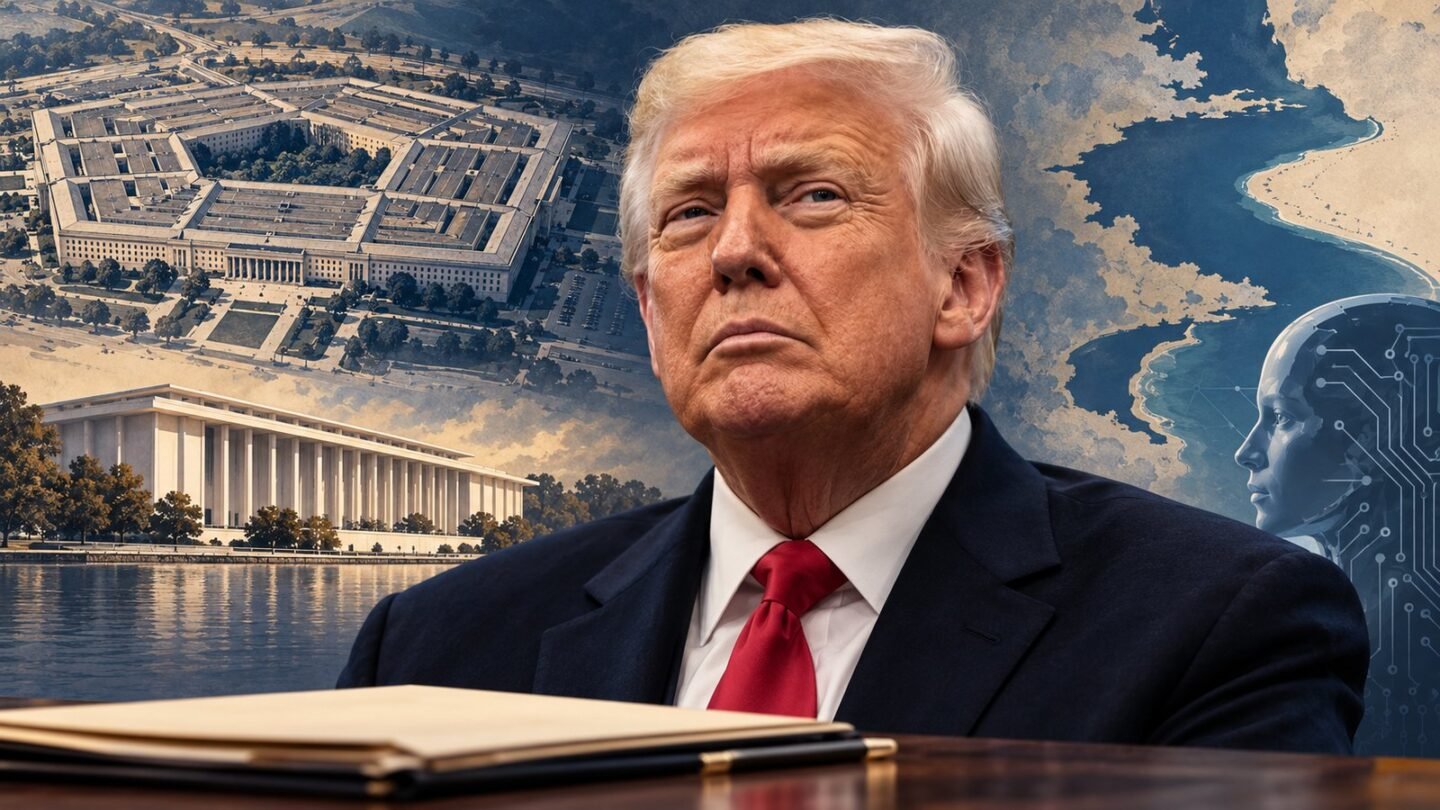
The examples in a supplied political graphic span different dates and legal processes. They include presidential directives, a contested decision by a cultural institution’s board and a criminal judgment that exists independently of those naming disputes.
The central distinction is between changing official usage and changing legal authority. Some directives require agencies to update communications or databases. Others expressly preserve statutory language, while a court has blocked particular efforts to add Trump’s name to the Kennedy Center.
Trump renaming efforts gave Defense a secondary title
Trump’s September 5, 2025, Department of War executive order authorized that name as a secondary title for the Department of Defense. It also permitted corresponding titles for the secretary and other officials in specified executive-branch settings.
The order covers official correspondence, public communications, ceremonies and non-statutory documents. Crucially, it says statutory references to the Department of Defense and its officials remain controlling until changed by law.
Describing the action simply as a complete legal replacement of the department’s name leaves out that qualification. The order itself distinguishes its immediate communications policy from a permanent statutory change.
The administration defended the terminology as a way to communicate military strength and readiness. That stated rationale does not establish whether the label produces measurable improvements in defense performance.
Geographic orders govern federal naming practices
The January 20, 2025, naming order directed use of Gulf of America for the specified U.S. continental shelf area bordering Texas, Louisiana, Mississippi, Alabama and Florida. It instructed officials to update the Geographic Names Information System and federal references.
A separate order dated August 27, 2026, directed federal authorities to adopt Lake America for Lake Ontario and update government maps, documents and communications. It required action through the Interior Department and Board on Geographic Names, consistent with applicable law.
Canada did not accept that terminology. Reuters reported on August 27 that Prime Minister Mark Carney said the lake would continue to be called Lake Ontario. The U.S. directive therefore should not be described as an internationally agreed renaming.
These Trump renaming efforts establish instructions for federal usage. They do not demonstrate that every government, publisher or member of the public has adopted the same language.
The Kennedy Center dispute produced court orders
Judge Christopher Cooper’s September 15, 2026, opinion and order in the Kennedy Center case explains that an earlier ruling rejected the board’s attempt to rename the institution for Trump.
Cooper wrote that Congress had designated the center for John F. Kennedy alone and restricted additional memorials. The earlier injunction required removal of Trump’s name from physical and digital signage and official materials.
The September decision blocked a proposed Trump renovation inscription and the proposed naming of the campus as President Donald J. Trump Plaza. It granted the emergency motion in part and denied it in part, with separate notice requirements concerning a possible future endowment acknowledgment.
This was a judicial restriction, rather than merely a judge expressing disagreement with the board’s branding.
The AI order changes terminology within stated limits
Trump’s September 29, 2026, Super Intelligence executive order directs agencies to substitute that term and SI for artificial intelligence and AI in specified communications and non-statutory documents, to the maximum extent permitted by law.
For implementation, the order initially ties the new terms to the existing statutory definition of artificial intelligence. It does not require alteration of previously issued regulations, presidential actions, contracts, grants or historical documents.
The directive therefore changes executive-branch terminology without itself proving that the underlying technologies have acquired different capabilities.
The criminal judgment is a separate legal matter
Reuters reported on August 28, 2026, that Trump’s 34-count New York felony conviction remained on the record after a judge rejected his federal-transfer request. His January 10, 2025, unconditional discharge imposed no jail time or fine.
Trump denied wrongdoing and continued challenging the conviction. That report does not establish the outcome of any later appeal, and a naming directive is not an order reversing a criminal judgment.
For Trump renaming efforts, one confirmed next step concerns the AI order: it requires proposed legislative language for a federal definition within 60 days of September 29. Any resulting proposal should be distinguished from legislation actually enacted.