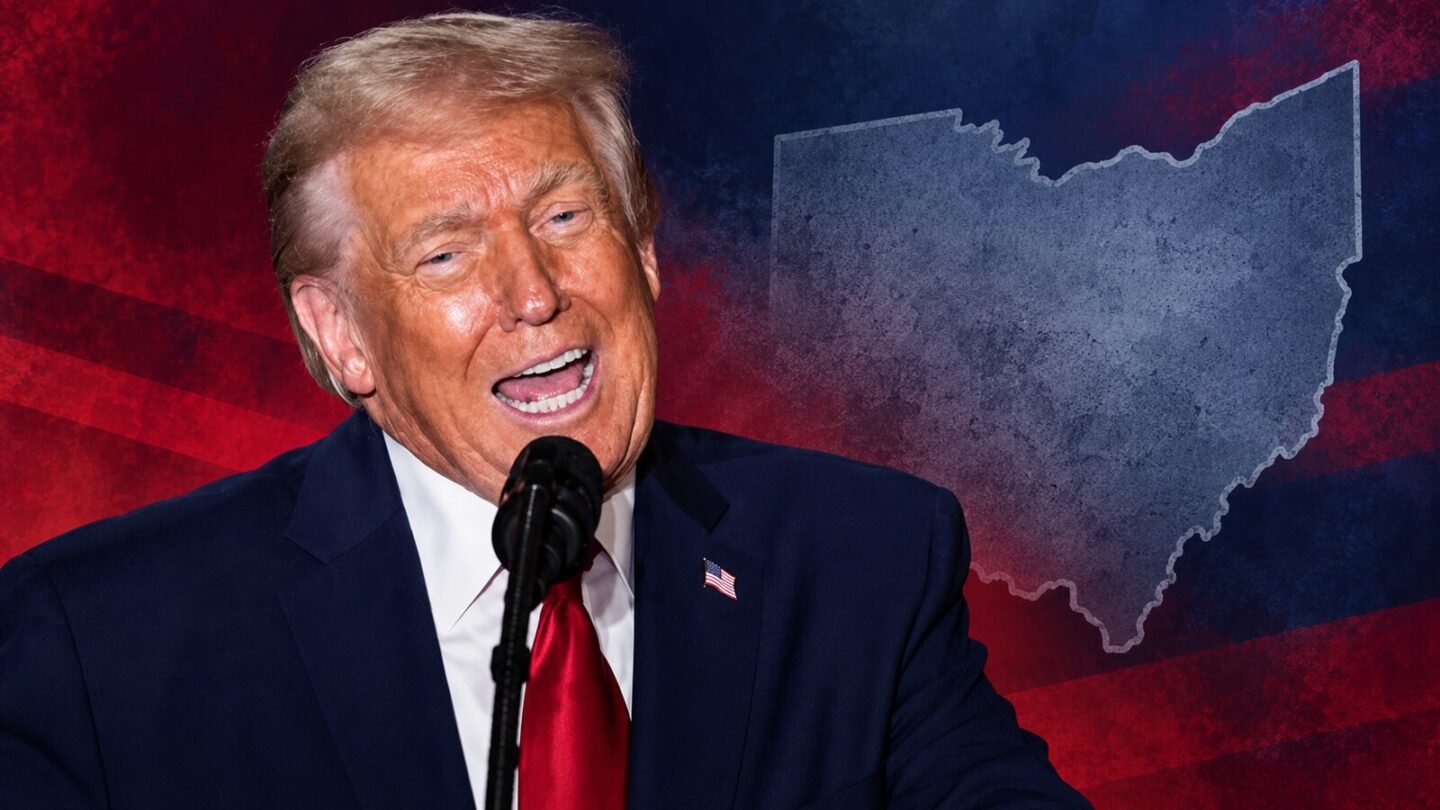
An Ohio funding warning from President Donald Trump linked his willingness to help the state to Republican victories in November. Speaking in Vandalia on October 3, 2026, Trump suggested he would work differently with Democratic leaders while campaigning for Republican Senate and gubernatorial candidates.
Reuters reported that Trump portrayed Republican officials’ relationships with his administration as an advantage when seeking federal assistance. His comments concerned Democratic gubernatorial candidate Amy Acton, who is running against Republican Vivek Ramaswamy, and came during a rally supporting Sen. Jon Husted.
The remarks support reporting a warning about reduced cooperation. They do not, by themselves, establish that Trump issued an order canceling all federal funding to Ohio or prove that fear of impeachment motivated the warning.
What Trump’s Ohio funding warning said
In the archived rally transcript, Trump described Republican Ohio officials calling him to request money. He contrasted those relationships with the possibility of Acton becoming governor, saying cooperation would probably change.
“But I’m not gonna help her probably.”
The transcript places that sentence at approximately one hour and 18 minutes into the speech. Trump presented personal relationships as a reason for his willingness to work with state leaders, describing the difference as human nature.
That wording contains a qualification: “probably.” It is therefore more precise to describe the Ohio funding warning as a threat of less help or cooperation than as a completed decision to terminate every federal payment.
The quoted passage does not specify which program would lose funding, how much money would be affected or when a restriction would begin. Those details would be necessary to assess any actual funding action.
The competitive races behind the remarks
Husted faces former Democratic Sen. Sherrod Brown, while Ramaswamy faces Acton in the governor’s race. Trump urged supporters to turn out and expressed confidence that Republicans would outperform expectations.
Reuters’ October 1 analysis reported competitive Democratic campaigns in 10 states Trump won by double-digit margins in 2024. That assessment describes an expanded campaign battlefield; it is not a prediction that Democrats will win every race.
The Ohio funding warning also comes against an unfavorable national approval reading for Trump. A Reuters/Ipsos survey conducted September 30 through October 5 recorded 32% approval and 65% disapproval among U.S. adults.
Among registered voters, 44% selected the Democratic candidate and 37% the Republican candidate when asked about a hypothetical congressional election. Those results concern national congressional preferences, not the outcome of Ohio’s Senate or governor’s race.
What the approval poll measures
Ipsos’ survey methodology and published results describe a probability-based KnowledgePanel survey of 4,506 adults. The margin of sampling error was plus or minus 1.5 percentage points for all adults and 1.7 points for registered voters.
The approval question asked respondents to assess Trump’s handling of his job as president. It did not ask whether he feared impeachment. Polls estimate attitudes during their fieldwork period and cannot establish a politician’s private motives.
Impeachment requires separate congressional action
Rep. Steve Cohen’s introduction of 26 impeachment articles is documented in reporting by WMC and in his office’s announcement. The proposal alleges abuses of power and other misconduct; its introduction is not a finding that those allegations have been proved.
Hourly Times’ earlier coverage explains Cohen’s impeachment articles and the congressional steps involved. A Democratic House majority could change which allegations receive attention, but an election victory would not automatically impeach Trump.
The Senate’s explanation of impeachment distinguishes a House majority vote approving articles from a Senate trial. Conviction requires two-thirds of senators present and results in removal from office.
Neither the rally remarks nor the approval poll establishes a connection between Trump’s warning and the impeachment proposal. Describing his presidency as the “worst” is also a political judgment, rather than a conclusion established by these sources.
Ohio voters will choose between the competing candidates on November 3. Any subsequent funding restriction or congressional impeachment action would require separate verification beyond the president’s campaign remarks.