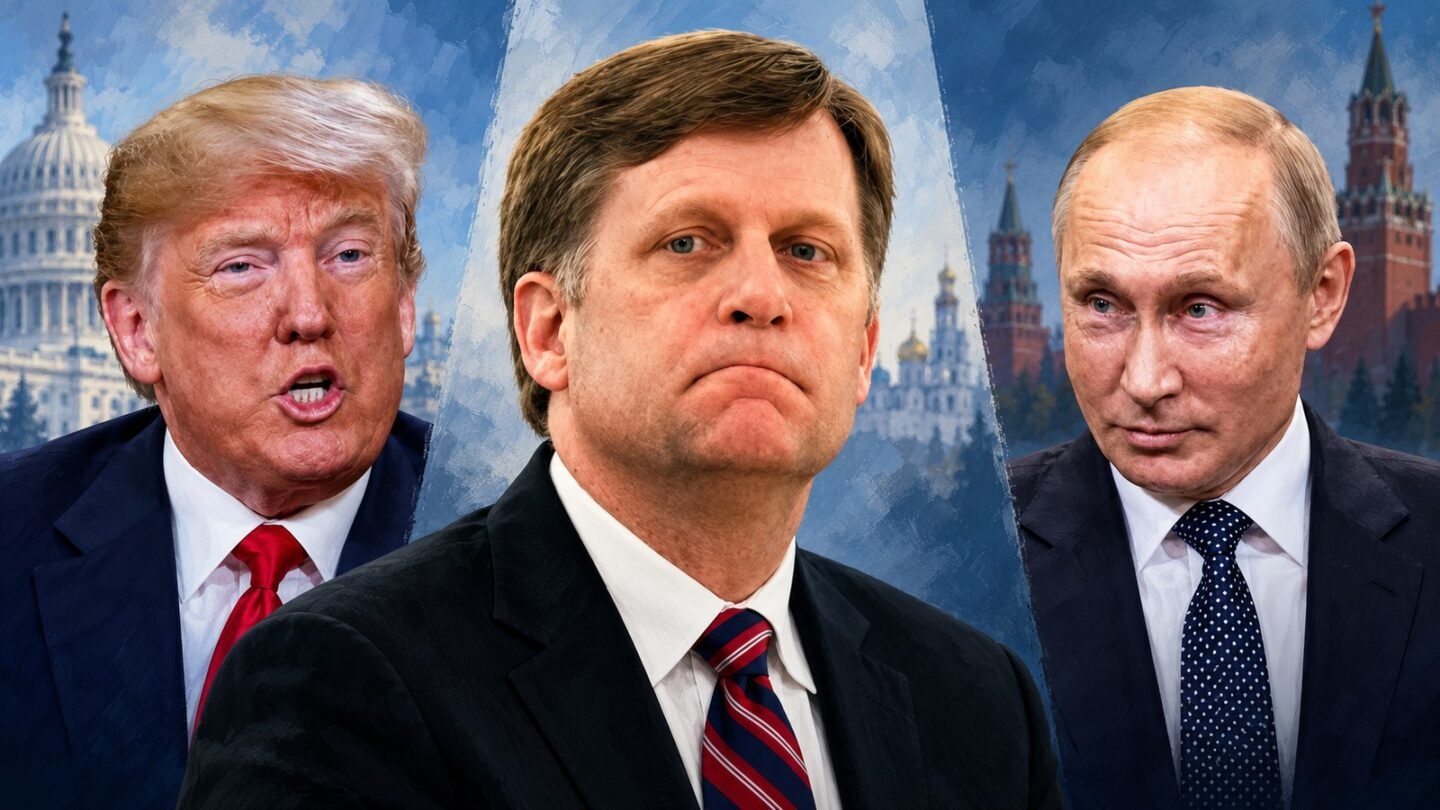
Michael McFaul has publicly criticized Donald Trump’s approach to Vladimir Putin, but the exact comparison attributed to him in a supplied political graphic could not be independently verified. The claim that no American president has supported Putin as strongly as Trump should therefore not be presented as an authenticated quotation.
That verification gap is separate from the current debate over Russian diesel. Official records confirm sanctions relief and bipartisan opposition to it, while the administration argues the arrangement can lower fuel costs and support diplomacy.
Calling Trump the worst president in American history is another, broader judgment. Neither an unverified quotation nor disagreement over one policy establishes an objective ranking of every presidency.
Who Michael McFaul is
McFaul’s Hoover Institution biography confirms that he served as U.S. ambassador to Russia from January 2012 to February 2014. Before that, he worked as a special assistant to the president and senior director for Russian and Eurasian affairs at the National Security Council.
The biography identifies him as a Stanford political science professor and Hoover fellow. His professional background helps explain his role in debates about Russia, but it does not authenticate every statement circulated under his name.
A quotation needs its own evidence: an original post, recording, transcript or authored text with the relevant wording and context. Matching a person’s general views is not enough to confirm an exact attribution.
His criticism is documented in his own writing
In an April 2, 2025 essay published by The New York Review of Books, Michael McFaul argued that Trump’s overtures to Putin could damage America’s long-term interests. He warned that moving toward authoritarian leaders could weaken relationships with democratic allies.
The essay also linked support for Ukraine to the credibility of U.S. commitments elsewhere. Those arguments establish McFaul’s publicly expressed position, with an identifiable publication date and source.
They do not establish that he made the precise historical comparison in the supplied graphic. The essay predates the October 2026 diesel agreement and should not be described as a response to that announcement.
In a separate March 10, 2025 post, McFaul challenged the view that Putin is primarily a transactional leader. That is another documented argument about Russian policy, rather than confirmation of the circulating wording.
What the diesel-policy record confirms
The Treasury Department’s Office of Foreign Assets Control issued General License 135 on October 9, 2026. It authorizes specified transactions involving Russian-origin diesel, including imports into the United States, through April 7, 2027.
On October 11, seven senators issued a joint statement opposing the decision. They argued that it conflicted with Congress’s restrictions on Russian energy imports and could provide Putin with a financial lifeline.
The group comprised Republicans Susan Collins, Lisa Murkowski, Thom Tillis and John Curtis, and Democrats Jeanne Shaheen, Richard Blumenthal and Ron Wyden. Their objections establish bipartisan criticism, not a court ruling on the agreement’s legality.
Hourly Times’ coverage of earlier diesel-supply negotiations with European governments provides background on the administration’s efforts to address fuel costs.
The administration gives a different policy explanation
ABC News reported October 12 that Trump stood by the Russian diesel decision and defended it as serving American interests. His stated argument centered on addressing high energy costs.
Reuters separately reported, citing people familiar with a Miami meeting, that U.S. envoys presented the arrangement to Ukrainian officials as an effort to bring Russia back to negotiations. That account describes the rationale relayed by sources, not a demonstrated diplomatic success.
Lower prices, concessions from Russia and a durable ceasefire are outcomes requiring evidence. An announced agreement does not establish that those benefits have occurred.
What remains unverified
Michael McFaul’s criticism of Trump’s relationship with Putin can be reported from authenticated writing. The exact comparison in the supplied graphic remains unverified in the sources reviewed, and its original date and setting have not been established.
The diesel authorization and senators’ objections are independently documented developments. They should inform discussion of the policy without being used to turn an unsupported attribution into a confirmed quotation or settle an all-time presidential ranking.