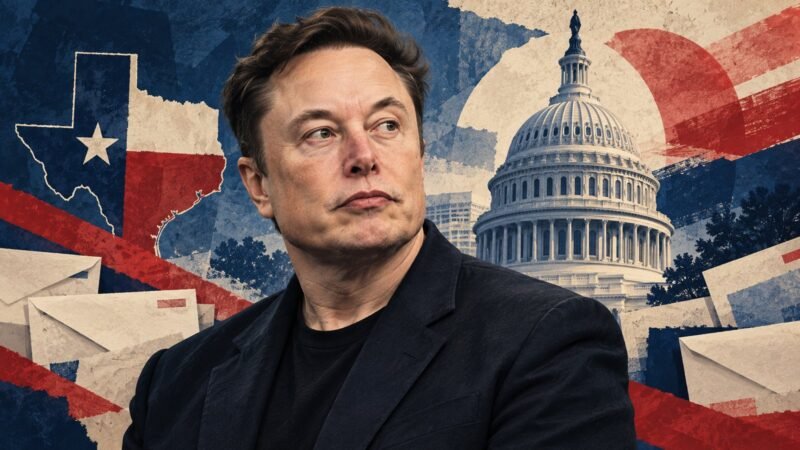
President Donald Trump returned to Texas on October 7 to campaign with Republican Senate nominee Ken Paxton, putting a closely contested race against Democrat James Talarico at the center of the Midterm Elections 2026. The San Antonio appearance was Trump’s third visit to the state in less than a month, Reuters reported.
A UMass Lowell/YouGov survey released October 8 adds a caution to claims that either candidate is clearly ahead: it showed a tie. For Democrats, that creates a potential opening in a Republican-held seat. For Republicans, it leaves a competitive contest to defend. Neither conclusion establishes who will win.
Trump makes the Texas contest a test of his own agenda
At the Freeman Coliseum rally, Trump praised Paxton’s performance and loyalty. The Factbase transcript records the president asking supporters to treat the congressional election as a referendum on his administration and to vote as though he were on the ballot.
Paxton thanked Trump for campaigning in Texas and expressed confidence that he would win. Their argument was clear: electing the Republican nominee would help preserve the president’s agenda, while Democratic victories would threaten it.
That makes Trump’s involvement relevant beyond an endorsement. By explicitly connecting the Senate vote to his presidency, he is asking voters to judge both the candidate and the administration. Democrats can challenge that combined record; Republicans can argue that continued party control is necessary to carry out their priorities.
For the Midterm Elections 2026, the accountability question is whether voters find those arguments persuasive. A presidential visit demonstrates campaign attention, but it cannot by itself establish a change in voter preferences or prove that a candidate is gaining ground.
What the Texas poll shows, and what it cannot tell us
The UMass Lowell/YouGov poll topline puts Paxton and Talarico at 45% each. Libertarian Ted Brown received 2%, another candidate 1%, undecided respondents 7%, and respondents saying they would not vote 1%. The displayed percentages total 101% because of rounding.
UMass Lowell sponsored the statewide survey, which YouGov conducted online among 850 likely Texas voters from September 18 through September 28. Its methodology describes a non-probability panel with sample matching and weighting, and reports an adjusted margin of error of plus or minus 4.5 percentage points.
The ballot question asked respondents which named Democratic, Republican or Libertarian candidate they would support if the Senate election were held then. These are stated preferences among a modeled electorate, rather than counted ballots or a guarantee about turnout.
That timing matters when assessing the Midterm Elections 2026. A newly published survey is not necessarily newly collected evidence. Different surveys should be compared using their interview dates, populations and methods before any movement is attributed to a campaign event.
A Democratic opening still requires a statewide victory
Texas’s official ballot certification lists Paxton as the Republican Senate candidate, Talarico as the Democratic candidate and Brown as the Libertarian candidate. The race concerns the seat held by Republican Sen. John Cornyn; Paxton is the nominee seeking it, not an incumbent U.S. senator.
The Senate’s published party division for the current Congress lists 53 Republicans, 45 Democrats and two independents. Replacing a Republican with a Democrat would therefore improve Democratic seat arithmetic, but Texas alone would not determine the chamber’s majority. Outcomes elsewhere and the seats each party retains also matter.
The Democratic opportunity in the Midterm Elections 2026 is consequently specific: turn a competitive Texas contest into a seat gain. The evidence supports examining that possibility, rather than announcing that the state has already changed its political alignment.
A Blue Wave is a possible election scenario, not a finding established by this poll. Likewise, Vote Blue No Matter Who is a Democratic campaign slogan, not evidence of candidate quality, voter agreement or an eventual result. A credible Democratic case should explain what Talarico would do and why voters should prefer it.
There is a concrete policy contrast to examine. The Texas Tribune reported September 26 that Talarico advocated temporarily suspending federal fuel taxes, while Paxton supported permanent repeal and said road funding should come from reducing waste. Voters should assess both proposals’ likely savings and funding tradeoffs; neither campaign’s promise establishes that Congress will enact it.
Debate access offers a concrete accountability question
Trump’s support also creates a practical question about scrutiny of his preferred candidate. AP reported October 8 that Trump called for a Talarico-Paxton debate and Talarico welcomed the demand. At that report’s publication, no debate had been scheduled and Paxton had not publicly answered the latest call.
AP also reported that Paxton’s campaign had previously expressed willingness to debate but objected to some proposed moderators. That response matters: an unresolved negotiation should not be presented as proof that a candidate will never participate.
The Washington Post reported October 9 that Talarico returned to public campaigning after illness.
Hourly Times’ earlier coverage explains the separate Texas debate invitations. A confirmed joint appearance would give voters a chance to compare answers directly. Until one is announced, an invitation and an acceptance from only one candidate remain different from an agreed event.
Midterm Elections 2026: voting dates set the next test
Texas’s official early voting guidance confirms that in-person early voting runs October 19 through October 30, ahead of Election Day on November 3. Registered voters can use an early voting location in their county of registration.
The next useful campaign updates are any confirmed debate agreement, additional polling with disclosed methods, and the candidates’ substantive proposals. Hourly Times’ analysis of Trump’s affordability challenge provides broader context, while keeping public opinion separate from demonstrated economic causation.
For Democrats, Texas warrants serious attention. For Republicans, Trump’s appeal offers a clear mobilization argument. The defensible conclusion for the Midterm Elections 2026 is a competitive Senate contest with national implications, whose outcome remains for voters to decide.