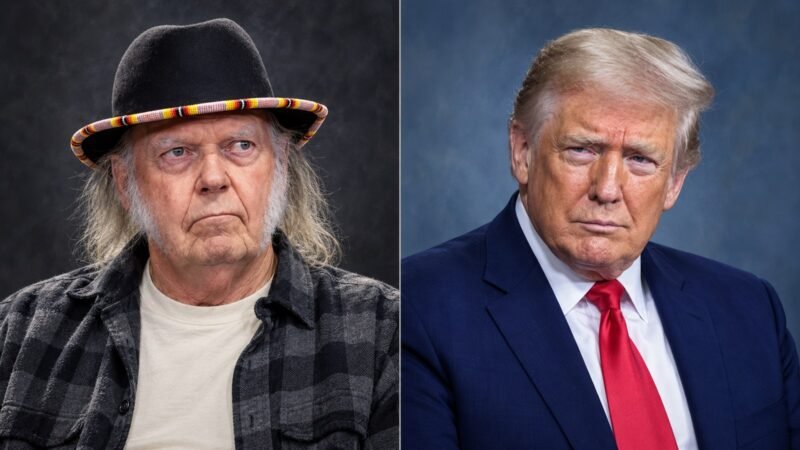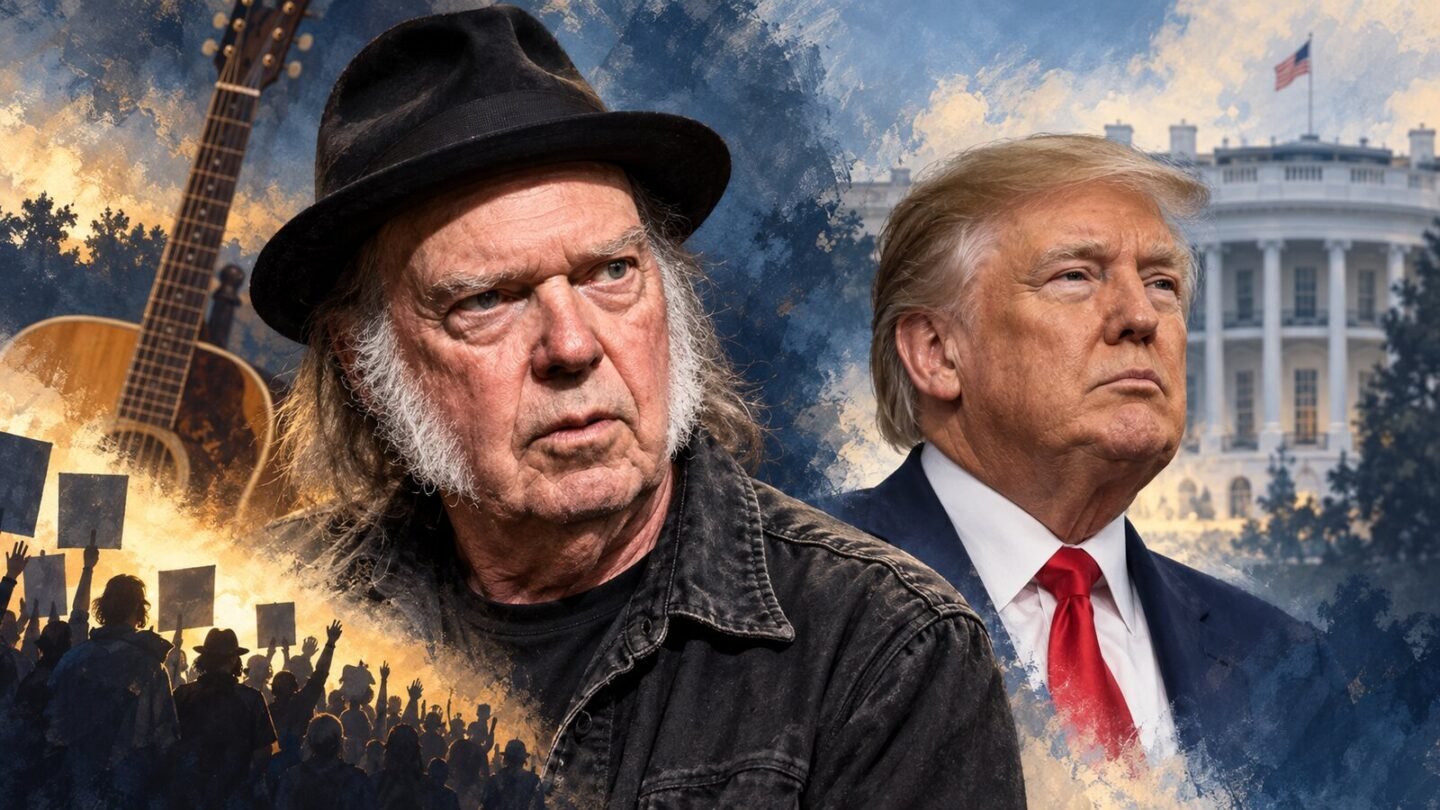
A Neil Young editorial published in January 2026 accused President Donald Trump of damaging the country and urged Americans who oppose his direction to protest peacefully. The musician’s criticism was reported at the time by Rolling Stone and Louder.
The central quotation is supported by those reports. However, it expresses Young’s political judgment rather than an objective measurement of the country’s condition. It also comes from January, rather than a newly verified October statement.
Rolling Stone reproduced the opening of his criticism:
“Donald Trump is destroying America bit by bit.”
The remark was part of a longer argument about the administration’s leadership, immigration enforcement and political division. Young’s language was sharply critical, but his appeal to opponents specifically called for a peaceful response.
What the Neil Young editorial argued
Young accused Trump of dividing Americans and criticized the qualifications and conduct of officials around him. These were the musician’s assessments of the administration, not findings from an investigation or a government report.
According to Louder’s January 9 coverage, the editorial appeared in the Times-Contrarian section of the Neil Young Archives. Rolling Stone’s Australian edition also reported the remarks in an article dated January 10.
Those publication dates establish that the statement was publicly reported early in 2026. They should not be confused with the date of a later graphic or social-media post repeating it.
The editorial also contained an update on Young’s archival music work. Rolling Stone reported that he discussed preparing another Archives collection, placing the political passage within a broader message to fans.
The Archives page linked by Rolling Stone did not expose the editorial text during this review. The wording and context here therefore rely on the contemporaneous reporting, rather than a claim that the original article was directly read.
A call for peaceful protest
Louder reproduced Young’s appeal for people to mobilize:
“Rise up. Peacefully in millions.”
That wording matters when assessing the Neil Young editorial. Removing the reference to peaceful action would leave out an important qualification in his message. The cited passage does not call for violence.
Louder placed the editorial after Young had separately criticized the January 7 killing of Renee Nicole Good by a U.S. immigration agent in Minneapolis. That chronology helps explain why immigration enforcement featured prominently in the musician’s writing.
Young also expressed fears about the direction of American politics and the concentration of power. His warnings about what Trump might do should be understood as his concerns, rather than proof of future events or verified presidential intentions.
Political opinion and a factual correction
The broad claim that a president is destroying a country is a value judgment. Readers can agree or disagree, but the phrase does not identify a defined measure that would settle the question by itself.
Some statements within a political editorial can still be checked against historical records. Rolling Stone reproduced Young’s assertion that ICE did not exist before Trump and noted that this was not literally true.
Immigration and Customs Enforcement was established in March 2003. A DHS statement preserved in a congressional hearing record confirms that history. The agency therefore existed well before Trump’s presidency.
That correction does not determine whether readers should accept Young’s broader criticism of immigration enforcement. It does show why an authentic quotation should not be treated as confirmation of every factual claim surrounding it.
Young’s earlier dispute with Trump’s campaign
The January comments followed a documented history of disagreement. In August 2020, Young sued Trump’s campaign over its alleged unauthorized use of his songs at political events.
Reuters reported that Young ended the lawsuit in December 2020. The case concerned Rockin’ in the Free World and Devil’s Sidewalk and was dismissed with prejudice. Reuters said it was not immediately clear whether a settlement had been reached.
The Neil Young editorial belongs to that longer record of opposition. Whether his January assessment was fair remains a matter of opinion; its peaceful-protest language, date and factual limitations should remain part of any account of what he wrote.