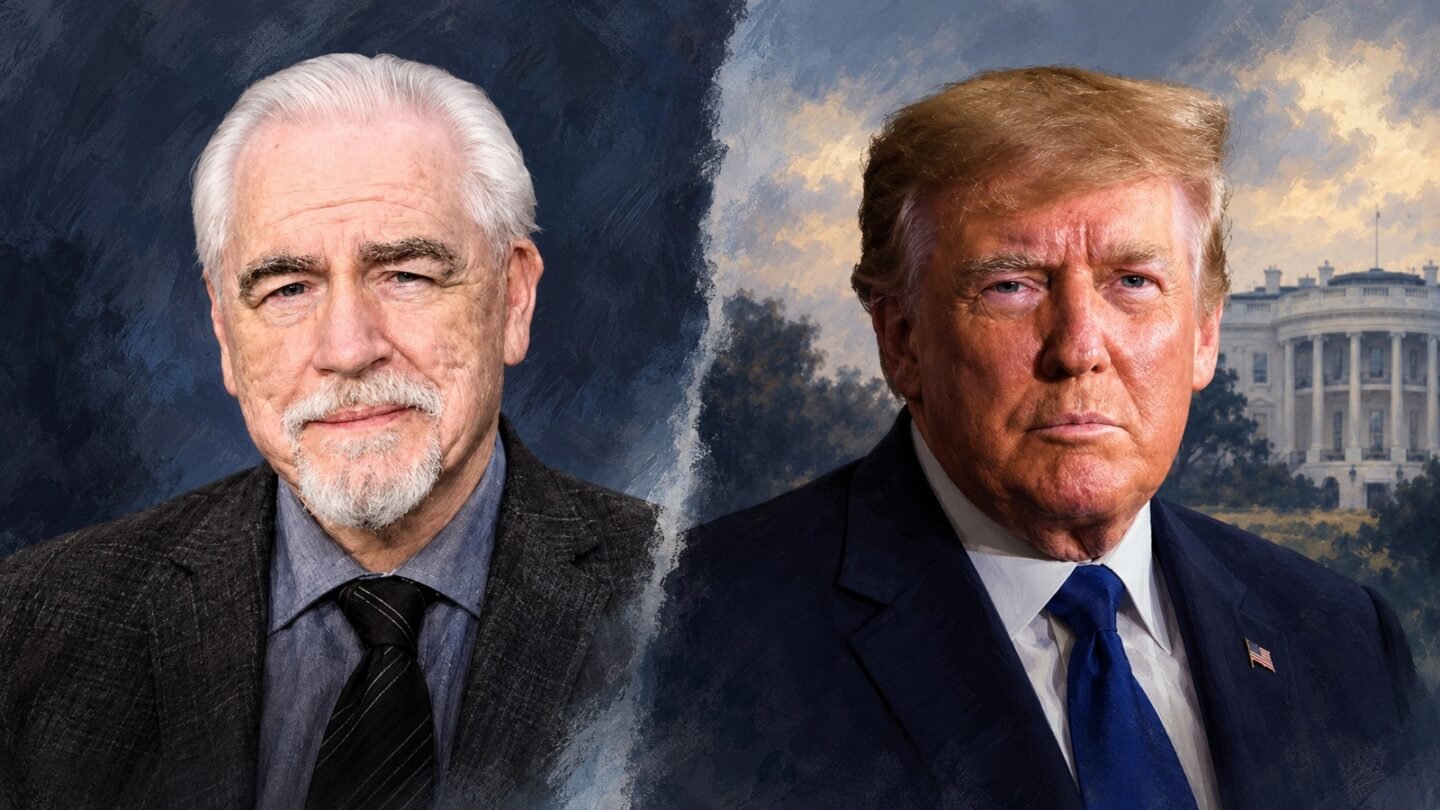
Brian Cox remarks about Donald Trump came during a January 20, 2025, appearance on ITV’s Good Morning Britain, before Trump’s second inauguration. The Succession actor criticized the incoming president while discussing women’s rights and political division in America. The interview predates the current debate and should not be presented as a new statement.
GB News reported that Cox described Trump as a “convicted criminal” and a “known liar.” Those phrases raise different questions: one concerns a documented criminal judgment, while the other expresses Cox’s broader assessment of Trump’s honesty.
The court record establishes that a New York jury convicted Trump of 34 felonies. It also establishes that the judge imposed an unconditional discharge, without imprisonment. Whether Trump deserved a different punishment is a judgment about sentencing, rather than a description of the sentence actually ordered.
Brian Cox Remarks Came Before Trump’s Inauguration
Contemporaneous reporting by the Press Association, published by The Standard, places the interview on January 20, 2025. Cox discussed his concern about women’s position in American politics, referring to abortion rights and the presidential election defeats of Hillary Clinton and Kamala Harris.
His argument was that those developments reflected a wider problem for women. That was his interpretation of American politics; it did not establish why individual voters supported Trump or what all American women believed.
The date changes how the Brian Cox remarks should be understood. Cox was speaking ahead of Trump’s return to office, rather than reacting to a newly announced court decision in October 2026.
What the New York Jury Decided
On May 30, 2024, a Manhattan jury found Trump guilty of 34 counts of falsifying business records in the first degree. The Manhattan district attorney’s office identified each count as a class E felony.
Prosecutors said the records disguised reimbursements to Michael Cohen connected to a $130,000 payment to adult-film actor Stormy Daniels before the 2016 presidential election. The charges concerned falsified business records, rather than a criminal conviction simply for making a nondisclosure payment.
According to prosecutors, the reimbursements were recorded as payments for legal services under a retainer agreement that did not exist. The 34 counts concerned separate false business-record entries associated with the arrangement.
Trump denied wrongdoing and denied Daniels’ account of a sexual encounter. He has argued that the prosecution was politically motivated and has sought to overturn the conviction.
Why the Conviction Did Not Mean Prison
Judge Juan Merchan sentenced Trump on January 10, 2025, to an unconditional discharge. That sentence left the conviction in place but imposed no jail time, fine or probation. It was not an acquittal or an order overturning the jury’s verdict.
A guilty verdict and the punishment imposed are separate parts of the case. Calling Trump convicted describes the judgment; saying he belongs in prison expresses a view about what punishment should have followed.
Hourly Times has separately explained why Trump’s felony conviction did not result in a prison sentence.
A Felony Conviction Does Not Automatically Bar the Presidency
The Congressional Research Service explained in a June 2024 legal briefing that the Constitution’s presidential qualifications do not address felony-conviction status. USAGov lists the basic requirements as natural-born citizenship, a minimum age of 35 and at least 14 years of U.S. residency.
The New York conviction therefore did not itself prevent Trump from serving as president. Whether a candidate meets legal requirements and whether voters consider that person suitable for office are separate questions.
What Comes Next in the Legal Challenge
On August 28, 2026, U.S. District Judge Alvin Hellerstein rejected Trump’s attempt to move the state case into federal court. His written ruling distinguished private conduct from official presidential responsibilities. Reuters reported that Trump’s lawyers filed notice they would appeal that decision.
The Brian Cox remarks do not resolve those legal challenges. They remain political criticism alongside a court record that includes guilty verdicts, an unconditional discharge and efforts to reverse the judgment.
On October 22, The New York Sun reported that oral arguments in Trump’s appeal were scheduled for November 5. That hearing date has not been independently confirmed here from an official court calendar; the report does not establish how the appeal will be decided.