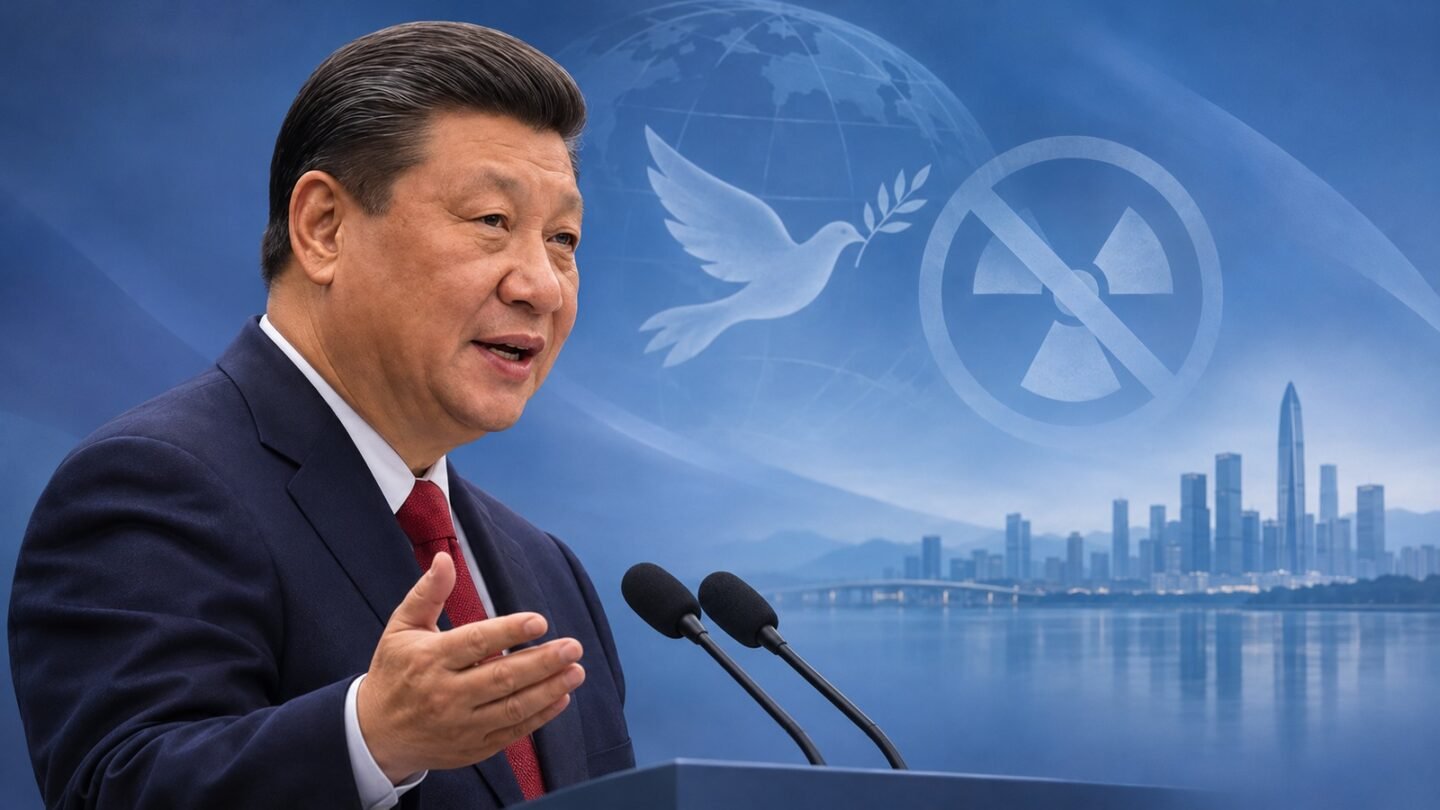
Chinese President Xi Jinping called for a nuclear weapons ban and the eventual destruction of all nuclear arms during talks with U.S. President Donald Trump and Russian President Vladimir Putin in Shenzhen on November 19, 2026.
The three leaders agreed to pursue dialogue on reducing nuclear risks and preventing proliferation. Their published declaration did not establish weapons reductions, inspection arrangements or a deadline for dismantling arsenals.
What Xi said about a nuclear weapons ban
According to Xinhua’s account of his remarks, Xi said nuclear weapons “should be completely prohibited and thoroughly destroyed over time to make the world free of nuclear weapons.”
The meeting took place alongside the Asia-Pacific Economic Cooperation gathering in southern China. Xi’s statement set out an eventual goal of eliminating nuclear weapons, rather than announcing that China would immediately begin destroying its own stockpile.
Xinhua also reported that Xi urged the three powers to maintain regular high-level contacts and establish crisis communication and prevention mechanisms. He argued that communication could help manage differences and prevent friction from escalating.
What the three-country declaration actually commits to
The published joint declaration reaffirmed the leaders’ position that nuclear war cannot be won and must never be fought. It said the countries would conduct dialogue on reducing nuclear risks and preventing the spread of nuclear weapons.
That wording is narrower than Xi’s nuclear weapons ban appeal. The document does not set a ceiling on warheads, identify weapons to be removed from service or provide a timetable for negotiations on a binding reduction agreement.
The declaration also addressed United Nations reform, refined petroleum supplies and the jurisdiction of international courts. It did not name Ukraine or Iran or publish terms for ending either conflict.
Hourly Times’ earlier report on the Shenzhen summit outcome explains those broader commitments and the absence of a new nuclear arms-control treaty.
China’s arsenal estimates provide a different backdrop
The Pentagon’s 2025 China Military Power Report assessed that Beijing’s nuclear warhead stockpile remained in the low 600s through 2024. It described slower production than in previous years while maintaining that China’s nuclear expansion continued.
The report projected that China remained on track to possess more than 1,000 warheads by 2030. That is a forecast, not a count of weapons China already has.
The dates matter. The low-600s figure describes the report’s assessment of 2024, while the 2030 figure describes a possible future stockpile. Neither should be presented as an exact inventory at the November 2026 summit.
What independent nuclear researchers estimate
The Federation of American Scientists’ 2026 world nuclear forces assessment estimates China’s military stockpile at approximately 620 warheads. Its corresponding estimates are 3,700 for the United States and 4,400 for Russia.
Those figures compare military stockpiles. They should not be mixed with total inventory figures, which can also include retired weapons awaiting dismantlement. FAS separates those categories in its published table.
In a January 2026 analysis of the Pentagon report, FAS noted that China would still have several thousand fewer warheads than either the United States or Russia even if its stockpile exceeded 1,000 by 2030.
The estimates show why the nuclear weapons ban discussion involves both China’s expansion and the much larger existing arsenals of the other two participants. They do not establish that any participant has agreed to specific cuts.
FAS cautions that future stockpile projections depend on uncertain factors, including missile deployments and fissile material production.
The existing treaty framework and the next practical test
Article VI of the Nuclear Non-Proliferation Treaty commits its parties to pursue good-faith negotiations on ending the nuclear arms race and achieving nuclear disarmament. The treaty also addresses preventing proliferation and cooperation on peaceful nuclear energy.
The Shenzhen declaration therefore sits alongside an existing international disarmament framework. Its text leaves practical questions unresolved, including the scale of any reductions, how compliance would be verified and when negotiations would take place.
For now, the announced common commitment is dialogue. Xi’s elimination proposal goes further than the specific measures the three governments jointly published.