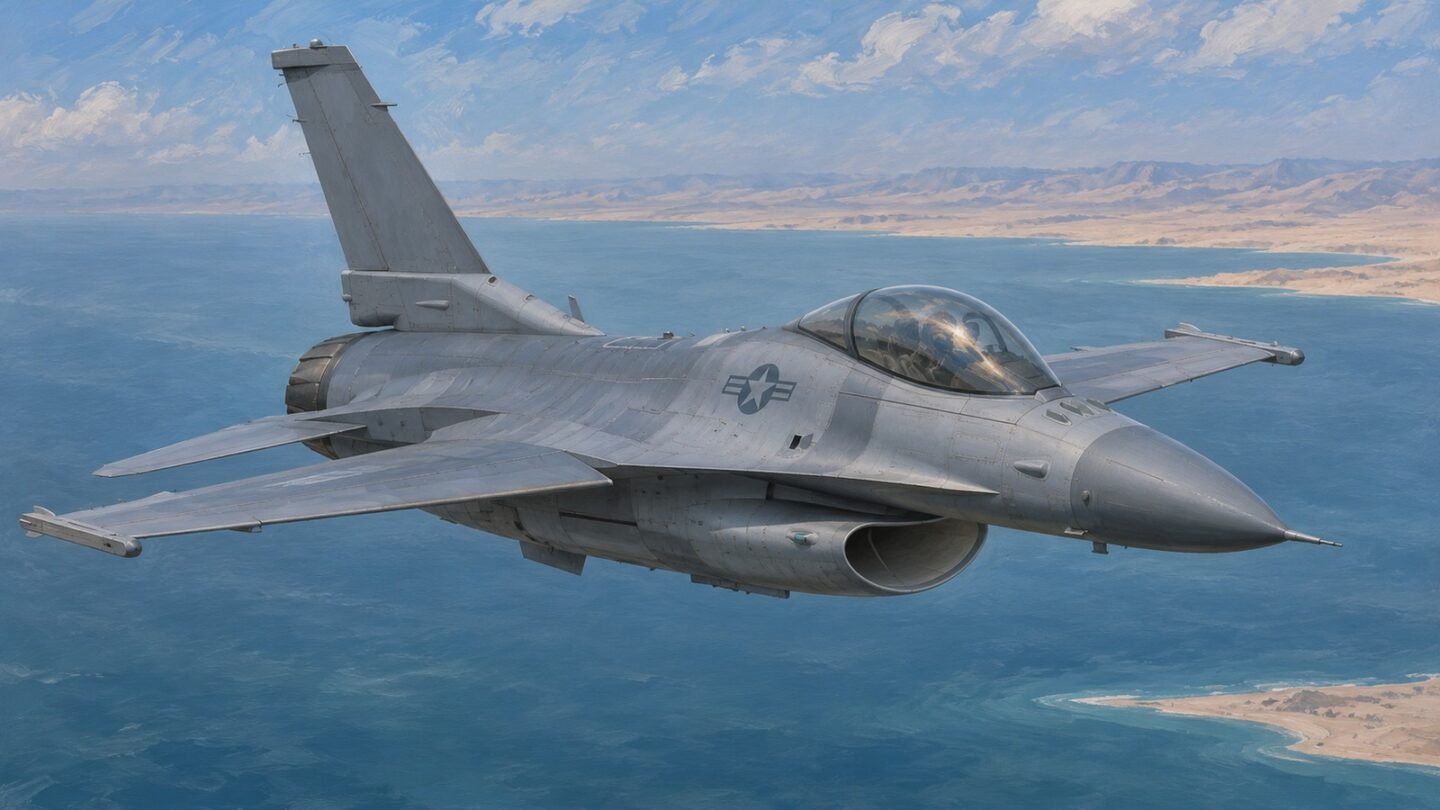
U.S. Central Command rejected Iran’s F-16 claim on November 21, denying that Iranian forces had attacked an American fighter aircraft over the Gulf the previous day. The command said all U.S. military fighter jets in the Middle East were safe and accounted for.
The denial followed an Iranian military account alleging that an air-defense missile damaged an F-16 on Friday evening and forced an emergency landing. The alleged attack occurred on November 20, while the competing statements were reported on November 21.
Neither damage to the fighter nor the emergency landing has been independently verified by Hourly Times. The two sides’ accounts differ on whether an attack occurred at all, making clear attribution essential.
What Iran alleged in its F-16 claim
In the Iranian army statement carried by Tasnim, the army’s public relations office said domestically developed air-defense systems detected and tracked an American F-16 over the Persian Gulf.
The statement alleged that a missile exploded near the fighter, damaged it and caused the pilot to abandon the mission. It claimed the aircraft subsequently landed at a nearby airport in the region.
Tasnim’s account did not identify the airport, aircraft tail number or pilot. Those omissions leave important parts of the alleged sequence unavailable for independent checking.
The statement described damage and an emergency landing. It did not establish that an aircraft was shot down, and the reported allegations should not be rewritten as a confirmed aircraft loss.
CENTCOM rejects the reported attack
Reuters reported that CENTCOM denied the Iranian account outright. Its response rejected the occurrence of an attack, rather than merely disputing the extent of damage.
Anadolu separately reported the same denial and the command’s assertion that American fighter aircraft in the region were accounted for. ABC also reported that CENTCOM characterized the allegation as false in a post on X.
There is a distinction in how the statements identify the Iranian source. Tasnim attributed the account to the regular army’s public relations office, while CENTCOM’s rebuttal referred to a claim by the Islamic Revolutionary Guard Corps.
That attribution difference does not independently resolve the underlying dispute. The verified development is the publication of Iran’s allegation and the U.S. military’s explicit rejection of it.
Aircraft capabilities do not verify an incident
The F-16 Fighting Falcon is a multirole combat aircraft designed for air-to-air and air-to-surface missions, according to an Air National Guard fact sheet. Its equipment includes navigation and landing systems, threat warnings and electronic countermeasures.
Those general capabilities explain the type of aircraft named in the allegation. They do not identify a particular aircraft, its mission or its condition on November 20, and they provide no independent confirmation of an interception.
Shipping incidents form a separate regional backdrop
The exchange came amid continuing maritime-security incidents around the Strait of Hormuz. In warning 216-26, UKMTO reported that an outbound tanker had been struck in its engine room by an unknown projectile east of Khasab, Oman, on November 21.
The warning reported no casualties at that stage and said the environmental impact was unconfirmed. It did not identify an attacker or establish a connection with the disputed aircraft account. The agency dated that report to 05:50 UTC and placed it 17 nautical miles from Khasab, with military authorities identified as its source.
Hourly Times previously covered Iran’s conditions for reopening the Strait of Hormuz. That report described Tehran’s negotiating position and warnings to shipping, rather than an agreement accepted by Washington.
Regional tensions provide context for the F-16 claim, but separate tanker reports cannot serve as evidence that a fighter was hit.
What remains unverified
Hourly Times cannot independently confirm the alleged missile damage or emergency landing. The sources reviewed do not supply independently authenticated maintenance records or an identified landing location establishing the Iranian account.
The next substantive development would be independently verifiable aircraft evidence or a further official statement addressing those missing details. Until then, the F-16 claim remains denied by CENTCOM rather than established as a confirmed incident.