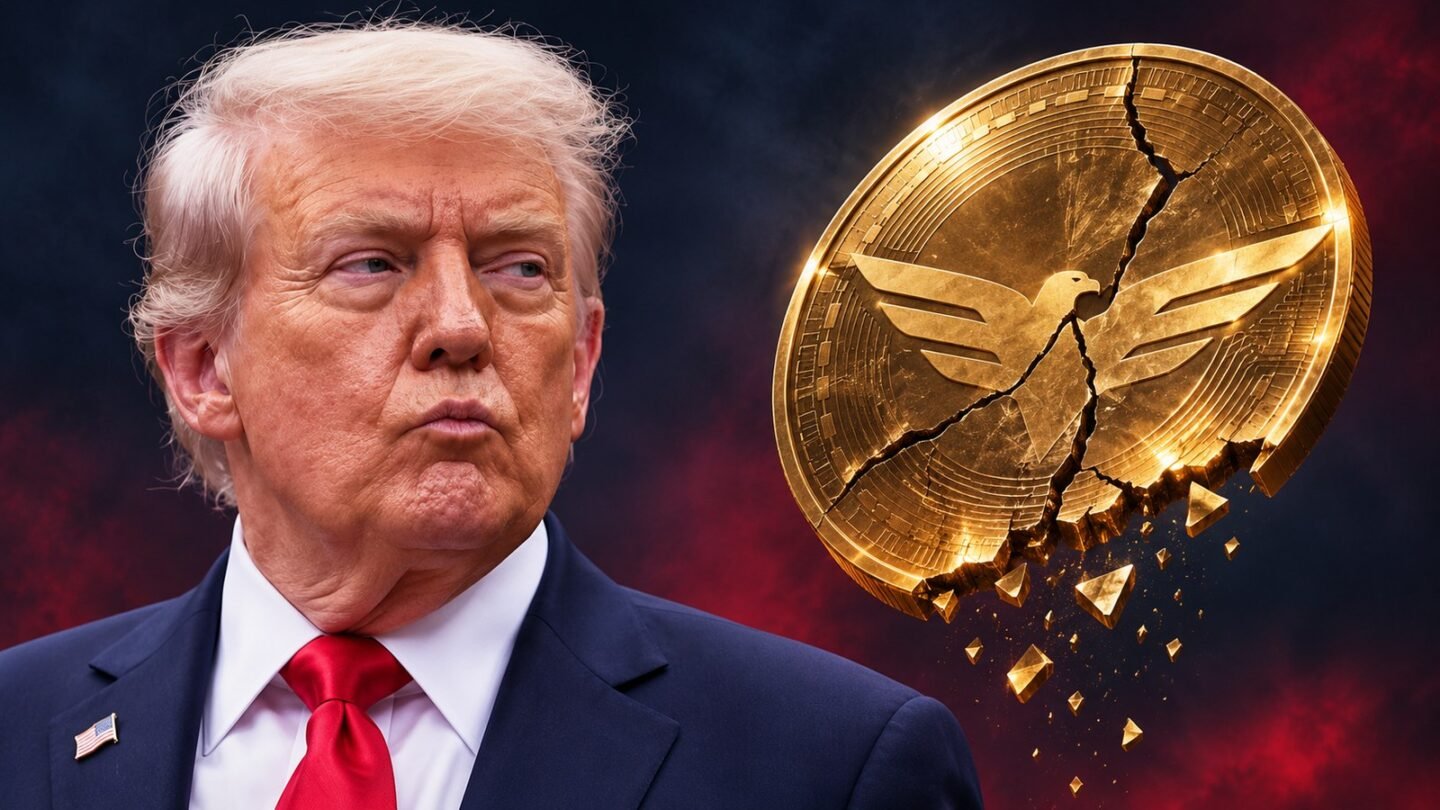
The WLFI token crash sent World Liberty Financial’s cryptocurrency down more than 50% overnight into November 28, as the Trump family-backed venture faced renewed accusations from early investor Justin Sun. The token hit a record low of $0.0158 on Binance, according to The Block.
Reuters reported a Saturday-morning price near $0.018, compared with $0.039 a day earlier. Prices varied across exchanges and reporting times, but the fall left the token roughly 95% below its September 2025 peak.
World Liberty said it had sold treasury assets to reduce borrowing and denied selling WLFI in that process. Sun alleged insider misconduct and urged exchanges to remove the project’s tokens. His allegations have not been established as findings of fraud.
What the WLFI token crash means
WLFI is World Liberty’s governance token, distinct from its USD1 stablecoin. A fall in WLFI’s market price measures the changing value of that token, rather than the entire company’s cash balance or Donald Trump’s personal wealth.
CoinGecko’s historical data reviewed for this report listed a $0.3313 all-time high and a $0.0158 low. The decline between those points is approximately 95.2%.
That does not mean every buyer lost the same percentage. Purchase price, sale timing and whether holdings remain unsold affect each investor’s outcome. Public Citizen’s earlier research noted that private-sale buyers paid different prices from investors buying after public trading began.
The reported $20 million sale involved ether
CoinDesk reported that blockchain analyst EmberCN identified a project-linked reserve wallet selling 12,121 ether for about $20.06 million in stablecoins. The analyst estimated a realized loss of about $19.26 million against the wallet’s acquisition cost.
Those figures describe a sale of ether, not proof that insiders sold $20 million of WLFI. The loss estimate also depends on the analyst’s reconstruction of the purchase cost.
In a Saturday-afternoon statement reported by The Block, World Liberty said it sold treasury-owned ETH and mETH, used proceeds to pay down debt and consolidated collateral. It said no WLFI tokens were sold through those treasury moves.
The Block reported that the project had borrowed against WLFI on Dolomite, a lending platform co-founded by World Liberty’s technology chief. Falling collateral prices can put such borrowing under pressure, but the precise cause of the sudden market selloff remains unclear.
Justin Sun’s allegations remain disputed
Sun accused World Liberty insiders of unauthorized selling, improper lending arrangements and investor fraud. CoinDesk reported that he called for exchanges and authorities to intervene, including by delisting WLFI and USD1.
The dispute predates this weekend. Sun sued World Liberty in April over his frozen holdings, while the company countersued in May and accused him of trying to drive down WLFI’s price, according to CoinDesk.
The Block reported that Sun provided no evidence for his latest claims. Its report also included World Liberty’s denial that its treasury transactions involved WLFI sales.
Separately, Binance said it was reviewing market activity and execution data after traders’ futures positions were automatically closed. That exchange review is not a published finding identifying who caused the collapse.
WLFI token crash and the Trump family’s exposure
Reuters reported in July that Trump’s companies received almost $800 million from World Liberty during 2025, including token-sale revenue and proceeds from selling business interests. That historical income is separate from the changing market value of remaining holdings.
Forbes reported in June 2025 that the Trump-linked entity’s ownership had fallen from an earlier 75% to 60%, then approximately 40%. Those earlier ownership changes do not establish that Trump or his sons sold tokens immediately before this crash.
The sources reviewed do not establish Trump’s personal loss from the overnight decline, nor demonstrate advance knowledge or insider trading by family members.
What the earlier investor-loss estimate included
Public Citizen’s earlier analysis of Trump-linked crypto losses estimated at least $1 billion in WLFI investor losses before this weekend. Much of that estimate reflected a corporate holder’s unrealized loss, alongside losses among retail wallets.
It should not be described simply as $1 billion already lost by ordinary retail investors. The group also acknowledged that centralized-exchange trading limited its ability to measure the full total.
Binance’s announced review and further disclosures about treasury transactions are the developments to watch. Neither had established the cause of the WLFI token crash or resolved Sun’s allegations in the reporting reviewed.