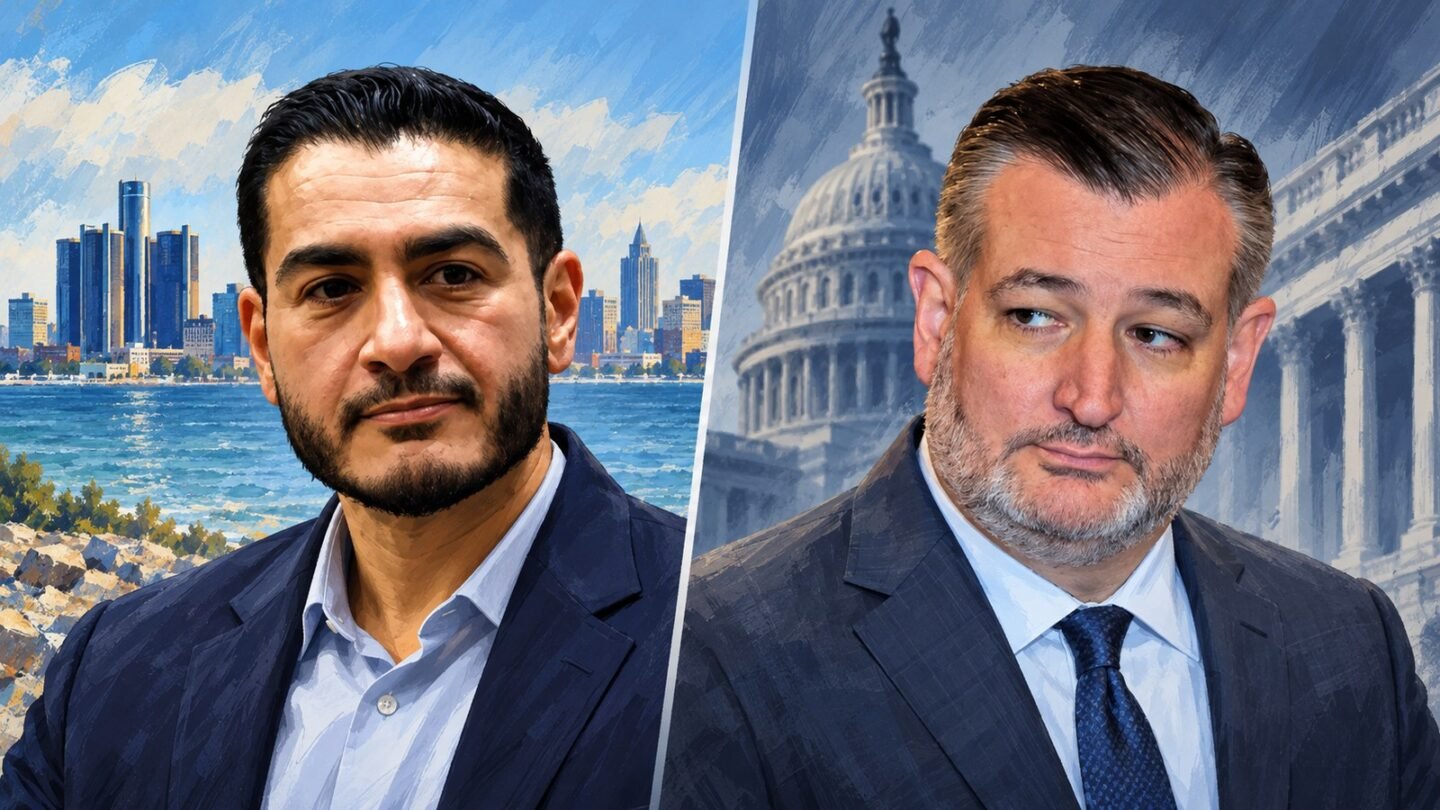
A Ted Cruz warning about Michigan Democratic Senate nominee Abdul El-Sayed centers on allegations of Muslim Brotherhood ties that El-Sayed denies. The Texas Republican raised the concern on his October 14 podcast and made similar accusations during an October 28 campaign appearance in Michigan.
Cruz argued that electing El-Sayed could endanger national security if the Democrat later gained access to sensitive intelligence through Senate committee work. His warning describes a possible future scenario, rather than an established intelligence leak or a publicly documented security breach involving the candidate.
El-Sayed has denied belonging to the Muslim Brotherhood and publicly disavowed the organization. Independent fact-checkers have also challenged claims that his past statements on Egyptian politics amount to a pledge of support for the group.
What the Ted Cruz warning actually said
On the October 14 episode of Verdict with Ted Cruz, Cruz and co-host Ben Ferguson discussed El-Sayed’s family background, writings and possible access to classified material if elected.
“If he wins, I believe that poses an unprecedented national security risk,” Cruz said.
Cruz suggested that a future assignment to the Senate Intelligence Committee or another committee handling classified information could put American personnel and intelligence sources at risk. That argument depends on his allegation that El-Sayed supports the Brotherhood, which the candidate disputes.
The podcast page dates the episode to October 14. The quotation circulating in the supplied graphic therefore predates the final week of the campaign; it should not be presented as a newly issued government security alert.
El-Sayed has denied membership and disavowed the group
At an October 17 town hall in Caro, Michigan, an attendee asked El-Sayed whether he would disavow the Muslim Brotherhood. He answered, “Sure, yeah, absolutely,” according to PolitiFact’s review of the exchange.
El-Sayed then challenged the premise of the question, arguing that his Muslim faith should not cause voters to assume he holds an allegiance separate from the U.S. Constitution. At another event the following day, he reiterated that he had condemned the organization.
Republican Senate nominee Mike Rogers subsequently said El-Sayed had not disavowed the group. PolitiFact rated that statement false, citing the town hall video and El-Sayed’s direct answer.
In a separate television interview, El-Sayed again denied ever being a member. A CNN transcript reproducing his exchange with Fox News anchor Bret Baier records that denial. His campaign has characterized the broader accusations as anti-Muslim attacks intended to distract voters from domestic issues.
What the family and political allegations establish
Republicans have cited old social media posts about El-Sayed’s relatives, his writing on Egypt’s 2011 revolution and a group letter he signed in 2012 supporting then-Egyptian President Mohamed Morsi. Morsi was associated with the Muslim Brotherhood.
Those are different categories of evidence. A relative’s reported political activity does not establish the candidate’s membership, and a position on a foreign government is not automatically an endorsement of every organization associated with that government.
Bridge Michigan reviewed claims that El-Sayed had pledged support to the Brotherhood and reported that the available evidence did not substantiate them. Its review distinguished his comments on Egyptian affairs from an explicit pledge to the organization.
PolitiFact likewise reported that the 2012 statement supported Egypt’s elected president, rather than pledging support to the Muslim Brotherhood as a whole. El-Sayed has said he was raised primarily by his father and stepmother and rejected suggestions that relatives’ reported views establish his own affiliations.
A campaign allegation ahead of Michigan’s vote
The Ted Cruz warning forms part of a wider dispute in the Michigan contest between El-Sayed and Rogers. Reuters reported that Rogers has portrayed El-Sayed as sympathetic to Islamist extremism, an accusation El-Sayed denies and his supporters describe as Islamophobic.
Cruz repeated his concerns during an October 28 appearance in Michigan. The new campaign remarks continued the argument made in his earlier podcast; they did not establish that El-Sayed had received classified material or disclosed any information.
The Ted Cruz warning remains a disputed political accusation. Michigan voters are scheduled to decide the Senate race in the November 3 general election.