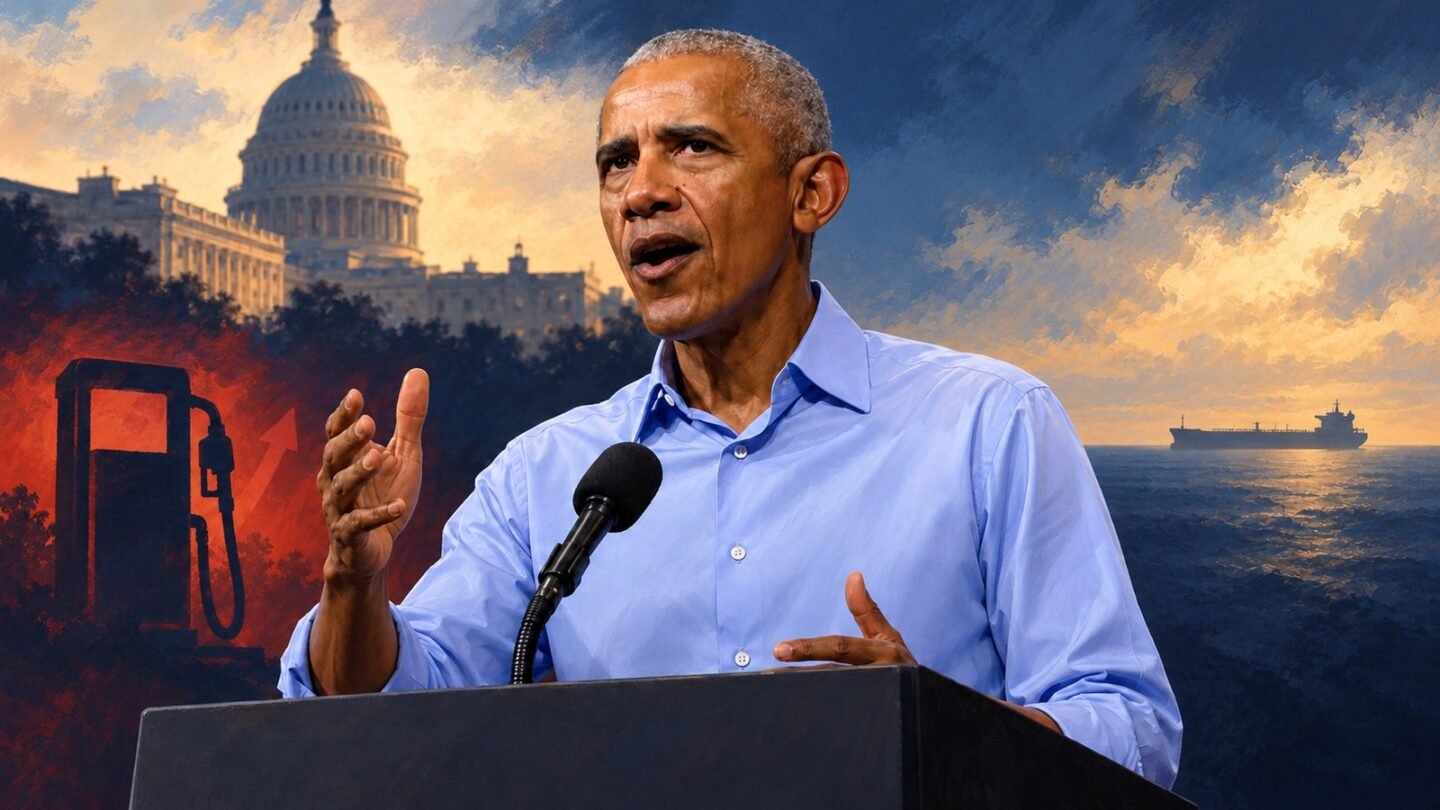
Former President Barack Obama criticized President Donald Trump over consumer costs and the war with Iran at an October 24 campaign rally in Cleveland, urging voters to use the midterm elections to hold the administration accountable.
Obama appeared in support of Democratic Senate candidate Sherrod Brown and gubernatorial candidate Amy Acton. He also campaigned in Detroit that day as both parties worked to mobilize voters before the November 3 election.
Barack Obama links household costs to Trump’s decisions
In remarks carried by Reuters, Obama acknowledged that presidents do not control the entire economy. He nevertheless argued that decisions by the current administration were directly responsible for higher costs.
He singled out the Iran conflict, calling it an “unnecessary war that nobody asked for and nobody voted for.” That description was Obama’s political judgment about the decision to fight.
Obama presented the election as an opportunity to impose greater accountability on the administration. His argument connected foreign policy with the expenses Americans face at home, rather than treating the war as a separate campaign issue.
Obama also acknowledged voters’ earlier frustration with Democrats over inflation after the pandemic. His argument was that dissatisfaction with the previous administration did not excuse decisions made by its successor.
He also criticized Trump’s attention to White House renovations, contrasting those projects with voters’ financial concerns. The comments formed part of a broader appeal for voters to support Democratic candidates.
The Iran nuclear agreement returns to the debate
Obama defended the diplomatic approach taken during his presidency. PolitiFact reported that he argued the 2015 nuclear agreement had prevented Iran from obtaining nuclear weapons without requiring military action.
The agreement involved the United States, Iran, China, Russia, France, Germany and the United Kingdom. It exchanged sanctions relief for restrictions on Iran’s nuclear activities and monitoring of its commitments.
Trump withdrew the United States from the agreement in 2018. An archived White House announcement from November 2018 documents his administration’s decision to restore sanctions lifted under the deal.
The two presidents continue to disagree about that approach. Obama portrayed diplomacy as a successful alternative to war. Reuters reported that Trump, responding on social media, defended his rejection of the agreement and accused it of giving Iran a route toward a nuclear weapon.
Those competing arguments concern the deal’s effectiveness and the choices that followed. Reporting what each president said does not establish that every claim in either account is correct.
How oil costs affect prices at the pump
There is an important economic connection behind the political dispute. The U.S. Energy Information Administration says crude oil is the largest component of the retail price of gasoline.
Its explanation of gasoline price components also identifies taxes, refining costs and profits, and distribution and marketing as factors in what drivers pay.
That means oil costs matter, but they are not the only influence on a local pump price. Regional requirements, seasonal conditions and the costs of operating individual fuel stations can also affect prices.
The EIA’s explanation provides general context. It does not calculate how much of a particular household’s current expenses resulted from a specific presidential decision or establish the full economic impact of the Iran war.
Trump offers a different economic message
In reporting published by AOL, Trump acknowledged high oil prices while campaigning in Perry, Georgia, but described them as temporary. He predicted that pump prices would fall and defended his administration’s economic record.
Trump also promoted his tariff policies. His message was that the country was becoming stronger, contrasting with Obama’s argument that the administration’s decisions had made life harder for consumers.
For Brown, Obama’s appearance followed an earlier endorsement. Hourly Times’ coverage of Obama’s support for Sherrod Brown explains the campaign relationship and the Ohio Senate contest.
The rallies put the competing public economic messages before voters. The November 3 election will decide congressional contests; neither a campaign speech nor an endorsement establishes their outcome.