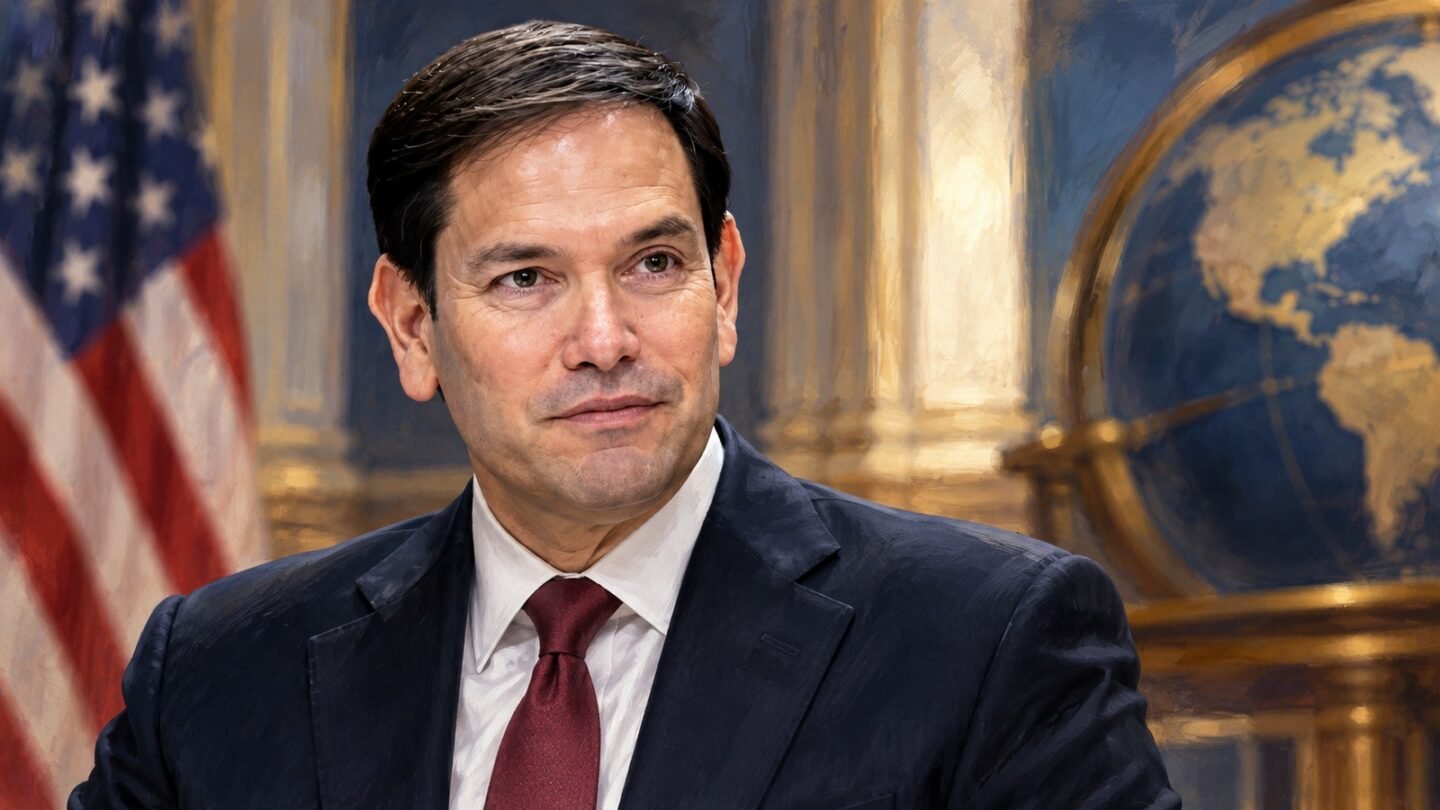
Rubio diplomacy is drawing scrutiny after Secretary of State Marco Rubio’s October trip to Uzbekistan and India, with critics questioning his priorities and the State Department defending his work. The dispute concerns how Washington balances immediate crises, long-term partnerships and changes to its diplomatic institutions.
Calling Rubio the worst secretary of state in American history goes beyond what these reports establish. It is an evaluative claim requiring defined criteria and comparison across administrations, rather than a fact demonstrated by one itinerary or an agency reorganization.
Rubio entered office on January 21, 2025, according to the State Department’s historical record. His performance must also be understood within the president’s authority over foreign policy and the secretary’s responsibility for carrying it out.
Why Rubio Diplomacy Faces Questions About Priorities
An October 18 Associated Press report examined criticism that Rubio was favoring less politically risky destinations over the most difficult international negotiations. Former U.S. ambassador to NATO Ivo Daalder argued that Rubio had avoided some of the capitals and crises central to the job.
The State Department rejected that assessment. It told AP that Rubio’s schedule served President Donald Trump’s foreign-policy and national-security priorities, and that important diplomatic work happens outside public view.
Rubio also defended strategic visits to countries where Washington wants stronger relationships, rather than traveling only when a crisis or conference demands it. Those positions identify a disagreement about priorities; they do not establish that an unpublicized negotiation was successful or that a quieter itinerary was necessarily ineffective.
What the Central Asia Visit Involved
The announced October 17–22 itinerary covered Samarkand in Uzbekistan and Mumbai and Jamnagar in India. Reuters reported that the India agenda included discussions about energy cooperation, while the Uzbekistan visit included business engagement and meetings with regional officials.
RFE/RL subsequently reported that Rubio met foreign ministers from all five Central Asian countries and Uzbek President Shavkat Mirziyoev. He departed Uzbekistan for India on October 20.
The visit included Uzbekistan’s signing of the Artemis Accords on peaceful space exploration. RFE/RL also reported an investment agreement that the parties said would total $12 billion when implemented. That figure describes an announced agreement, rather than proof that the full investment has already occurred.
Luke Coffey of the Hudson Institute told RFE/RL that the meetings largely maintained momentum from earlier agreements. His assessment placed more weight on eventual investment than on immediate announcements, providing a different test of the trip’s value.
Rubio Diplomacy and the State Department Overhaul
In an April 22, 2025, statement, Rubio announced a comprehensive reorganization. He argued that the department had become inefficient and that reform would better align its work with American interests.
The plan called for consolidating regional functions, removing redundant offices and ending certain programs that the administration considered misaligned with its priorities. Those descriptions reflect Rubio’s rationale, rather than an independent assessment of every affected office.
A May 21, 2026, Reuters investigation reported staffing losses and diplomatic vacancies, alongside concerns that foreign governments increasingly relied on informal channels. The administration disputed that this represented a breakdown and defended the changes as improving efficiency and decision-making.
That investigation provides evidence for examining institutional capacity. Its findings are a dated snapshot, however, and should not be presented as an updated October staffing count without further verification.
How the Secretary’s Responsibilities Shape the Debate
The State Department’s published description of the office identifies the secretary as the president’s principal foreign-policy adviser. Responsibilities include negotiations, diplomatic representation, protecting American interests abroad and managing the department and Foreign Service.
These responsibilities extend beyond public appearances. They also provide concrete areas for scrutiny: the conduct of negotiations, the resources available to diplomatic missions and the implementation of announced agreements.
Hourly Times has separately examined the debate over the administration’s Russian diesel agreement, another example of competing claims about American foreign-policy interests.
The Rubio diplomacy debate remains open. For the Central Asia agreements, implementation and actual investment remain the next developments to assess; the visit alone cannot establish a final historical ranking.