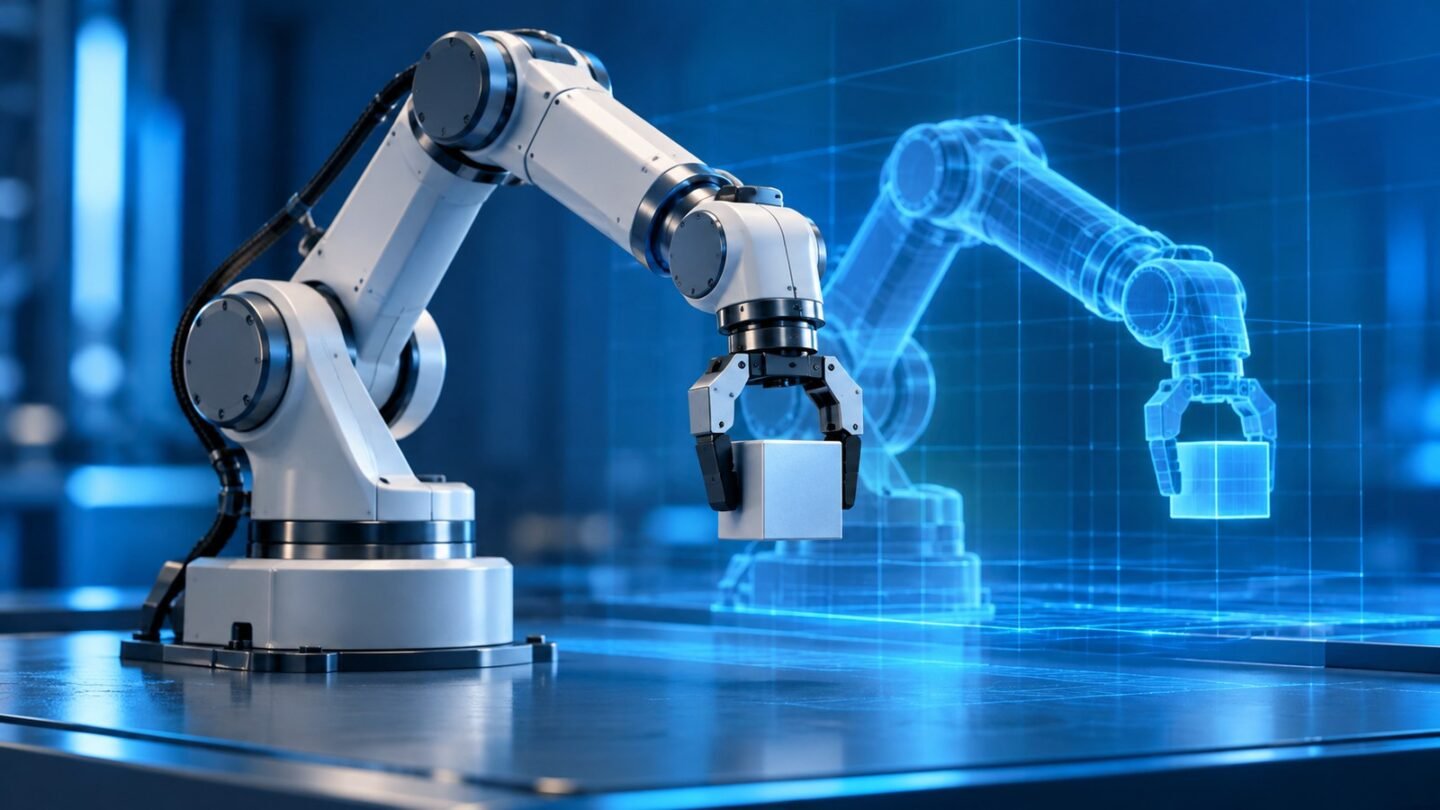
Gemini 4 Argon is moving into robotics development, with Google publishing demonstrations on October 13, 2026, that connect visual understanding, code generation and physical simulation. The company says its new model can help developers control robots, reconstruct simulated environments and improve how machines interpret physical tasks.
The announcement accompanies Argon’s broader developer rollout. Google describes the model as suited to complicated workflows requiring multiple steps, including software engineering and scientific research. Its robotics examples show how those capabilities can be applied to machines interacting with objects.
Google also reports an 87% score on the Embodied Reasoning Question Answer benchmark, or ERQA. That figure measures performance on a reasoning evaluation; it is not an 87% success rate across real-world robot tasks.
Gemini 4 Argon Connects Reasoning With Robot Control
In one demonstration, Google describes a Boston Dynamics Spot robot using a simulated foot-pedal trash bin to practice before disposing of cans. Another shows a robotic arm turning a mug upright and placing a napkin inside it.
These are company-presented demonstrations, rather than independently reproduced results. They illustrate the types of robotics workflows Google is targeting, without establishing that the model can operate every robot or complete unfamiliar physical tasks reliably.
The official model documentation lists support for text, images, video, audio and PDF inputs, with text output. It also lists code execution, function calling and structured outputs among the available capabilities.
That distinction helps explain the integration. The API produces text and can work with tools; the documentation does not describe a physical robot as part of the model itself. Robot demonstrations therefore involve the surrounding software and hardware used in those setups.
Building Simulations From Physical Scenes
Google’s robotics post also describes reconstructing simulation environments from robot footage, human video and sketches. These examples fall under Real2Sim: representing a physical scene in a simulation so developers can examine interactions and movement.
Several demonstrations use MuJoCo. Its official website describes it as a free, open-source physics engine for robotics and other fields that need fast, accurate simulation.
MuJoCo supports models with contacts, friction, joints and actuators. Its documented applications include testing control schemes before deploying them on physical robots, making it relevant to the simulation-based work highlighted in Google’s announcement.
The engine’s role is to calculate physical behavior within the modeled environment. In that setting, the AI-generated code and scene description still have to work with the simulator’s representation of objects, constraints and motion.
Google’s wider launch announcement provides another example: an internal cornhole test involving an Apptronik Apollo humanoid. The company says Argon analyzed human video, calculated movement and built simulation code before the robot made seven consecutive shots in a real-world trial.
Understanding Physical Tasks and the 87% Benchmark
Other examples in the robotics post focus on interpreting recorded activity, identifying manipulation errors and estimating progress. Google presents these as ways to analyze what happened during a task, alongside generating actions.
The ERQA benchmark repository provides a separate view of how embodied reasoning is evaluated. Its questions combine images and text and cover spatial reasoning and world knowledge relevant to robotics.
Answers are multiple-choice selections, recorded as a single letter. The repository says the full benchmark contains 400 examples and includes an evaluation harness for querying multimodal models.
This format is important context for Gemini 4 Argon’s reported 87% result. A system answering questions about a physical scene is being tested differently from a robot completing a sequence of movements on actual hardware.
Google’s score should therefore be read as its reported benchmark result. The repository explains the evaluation format, but does not independently verify the company’s latest Argon score or establish performance across every deployment.
Research, Improvement and Developer Access
Google also outlines research workflows involving simulation-generated training data and repeated attempts to improve physical actions. Its developer post groups these with robot control, simulation reconstruction and physical understanding.
The broader launch announcement describes safeguards including monitoring agent behavior and defenses against malicious instructions. Google presents these measures as part of its model deployment; they are not a certification of safety for any particular robot installation.
Gemini 4 Argon is available through the paid Gemini API tier, according to Google’s developer announcement. Google AI Ultra subscribers can also use the model in AI Studio and Google Antigravity.
The API documentation identifies the model as gemini-4-argon and lists a unified input-and-output limit of 1,048,576 tokens. Standard synchronous output is capped at 65,536 tokens, with longer output available through its long-decode mechanism.
Google points developers to its API guidance and development platforms to begin building. The published examples provide a starting point for evaluating the model’s role in robotics, while their reported outcomes remain specific to the setups described by the company.