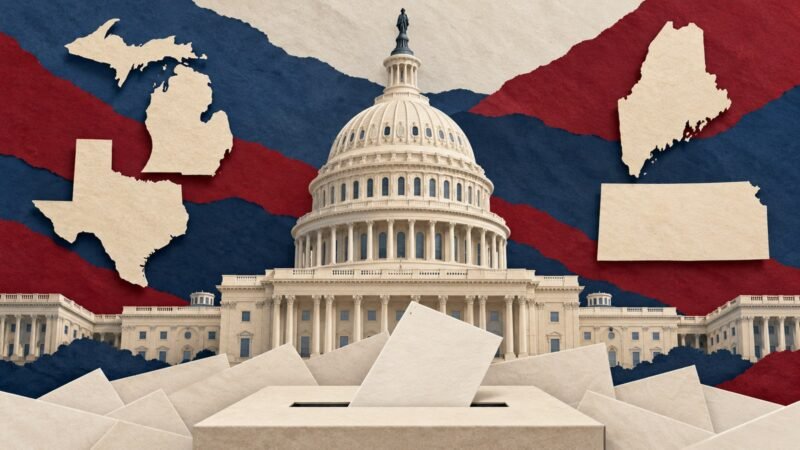
A federal judge’s October 9 ruling has given Democrats a concrete accountability issue before the Midterm Elections 2026: the Trump administration pursued an unlawful voter-records policy that put eligible citizens’ registrations at risk. That finding warrants scrutiny, but it does not prove President Donald Trump has a plan to sabotage November’s elections.
U.S. District Judge Sparkle L. Sooknanan vacated the Justice Department’s challenged policy in Common Cause v. U.S. Department of Justice. The department said it was reviewing the decision. The distinction between an unlawful policy and a proven electoral conspiracy should guide how candidates, journalists and voters discuss the ruling.
What the court ruled on voter records
The 78-page memorandum opinion concerns federal demands for state voter-registration lists, comparisons with citizenship-status records and pressure on states to remove people the department considered ineligible. The court concluded that the department lacked the claimed statutory authority and that the policy violated federal administrative, privacy and paperwork requirements.
Sooknanan also found that the policy was arbitrary and capricious. Her opinion describes a federal effort that had removed U.S. citizens from their home states’ rolls and risked disenfranchising others.
The decision preserves lawful federal assistance and states’ ability to maintain accurate lists. It does not authorize ineligible people to vote. Protecting eligible voters and enforcing valid eligibility rules remain compatible obligations.
The Republican accountability question is specific: why did the administration pursue this method, and how will it prevent eligible citizens from being wrongly removed? Calling a program election security does not answer whether its authority, safeguards and implementation satisfy the law.
Why database errors matter before Midterm Elections 2026
The dispute involves the Systematic Alien Verification for Entitlements system, known as SAVE. Citizenship information can be outdated, creating a risk that someone who became a naturalized U.S. citizen will still be identified as a noncitizen.
Courthouse News reported the experience of Anthony Nel, a Denton County, Texas, resident and plaintiff. After a SAVE check identified him as a noncitizen in October 2025, officials gave him 30 days to provide citizenship proof. His passport renewal took longer, and his registration was canceled before being reinstated.
That account illustrates the practical difference between identifying a possible discrepancy and establishing ineligibility. A notice, document request or cancellation can impose time and expense even when the person ultimately resolves the problem.
It does not establish how many voters nationwide experienced the same situation or how any affected person would vote. The materials reviewed do not support a national estimate of wrongful removals attributable to this policy.
For the Midterm Elections 2026, the useful questions concern prevention and correction: what information generated a flag, who reviewed it, what notice reached the voter and how quickly could an error be fixed? Those questions apply regardless of party registration.
The administration’s case and the limits of this ruling
The Justice Department defended its authority to conduct the challenged program. Its broader position is that citizenship verification helps states prevent noncitizens from voting. After the October 9 decision, its immediate response was that it was reviewing the ruling.
A separate case complicates claims that every federal use of SAVE has been rejected. On September 25, the Supreme Court paused an earlier order restricting the expanded database, allowing that system to operate while litigation continued. That action concerned a different challenge; it was not a final resolution of the October 9 case.
The National Voter Registration Act also generally requires systematic removal programs to be completed at least 90 days before a federal election, subject to statutory exceptions. That rule does not mean every individual correction or removal is prohibited during the period.
These distinctions matter when evaluating the Midterm Elections 2026. A legal victory against one policy does not settle every dispute about voter data, and a temporary Supreme Court order does not establish that every related government action is lawful.
Further appeals or orders could change the practical effect of the October 9 ruling. Coverage should identify the policy and procedural stage each time, rather than treating every court decision as an interchangeable verdict on election integrity.
Scrutiny of federal election actions is justified
Reuters’ October 2 investigation, updated October 3, described a federal search for evidence supporting claims that voting machines had altered the 2020 election. It reported election officials’ concerns about possible demands for equipment or ballots during the midterms. The White House told Reuters the investigation sought vulnerabilities, rather than revisiting 2020.
Those concerns are attributable warnings, not proof that a seizure will occur. The investigation and the voter-records ruling address different actions and should be assessed on their own evidence.
For Democrats, the strongest argument is about accountable government: election policies should have lawful authority, reliable evidence and protections against wrongful exclusion. That argument becomes weaker when a documented legal violation is inflated into a claim about an unproven secret plan.
Republicans defending the administration can make a case for accurate rolls while explaining how their preferred methods protect citizens who are incorrectly flagged. A credible defense should address the court’s findings directly, rather than assuming that criticism of a method amounts to opposition to election security.
What voters can take from Midterm Elections 2026 coverage
The claim that Republicans fear defeat because of their governing record needs separate evidence. Hourly Times’ coverage of affordability dissatisfaction examines political pressure over living costs. Dissatisfaction can help explain campaign stakes; it cannot establish the motive behind a particular election policy.
A possible Blue Wave remains an electoral scenario. Vote Blue No Matter Who is a Democratic campaign slogan, not evidence of future results or a substitute for evaluating individual candidates and election rules.
Voters can consult official voting guidance and their state or local election office for registration questions, identification requirements and ballot deadlines. Anyone receiving an eligibility notice should seek the applicable instructions promptly rather than assuming a national court ruling resolves their individual record.
The November 3 elections will determine congressional contests through voters’ choices. The defensible conclusion for the Midterm Elections 2026 is that this administration’s voter-records policy suffered a serious legal setback deserving sustained scrutiny. Evidence establishes that setback; it does not establish the sabotage allegation.