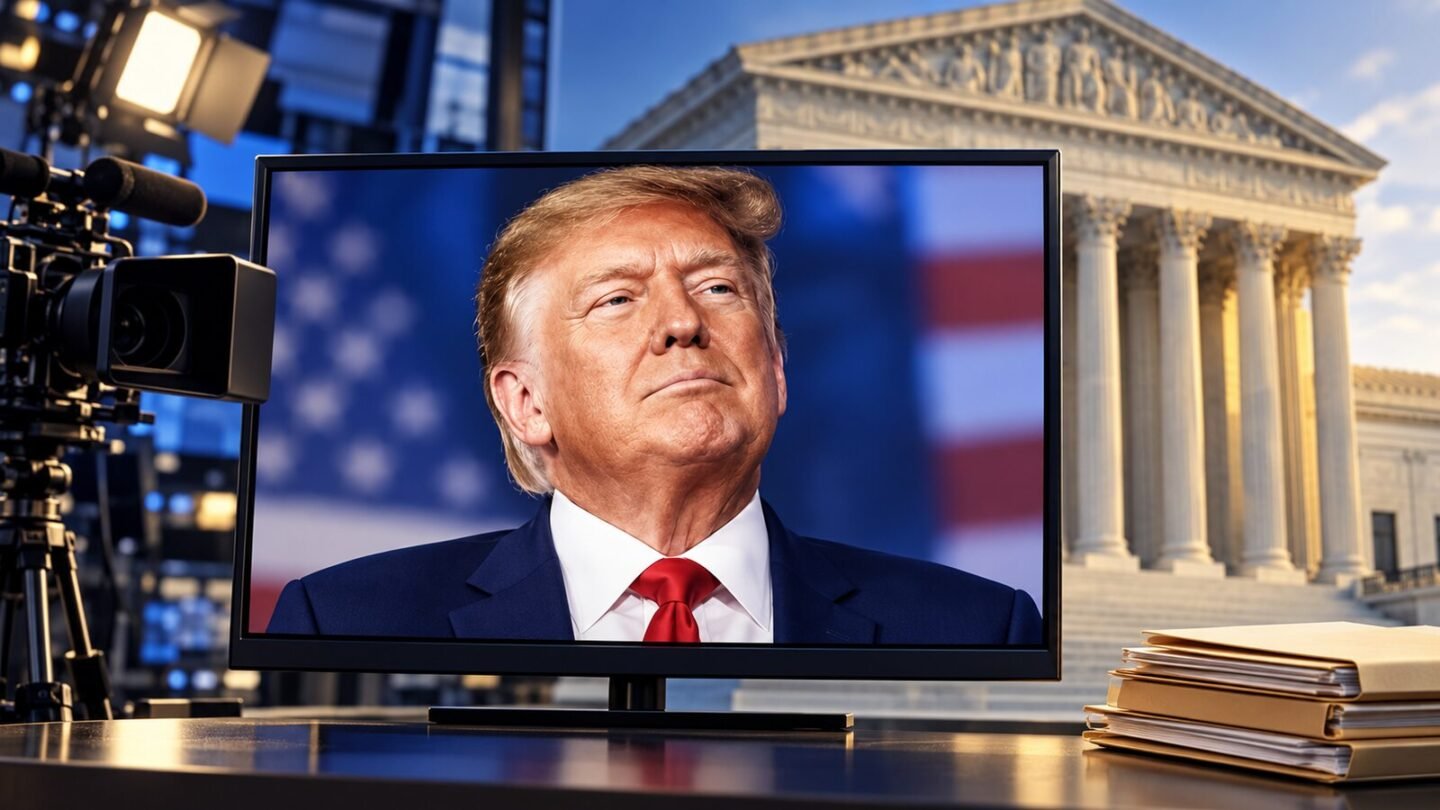
The DNC ads lawsuit asks a federal court to stop taxpayer funding for television commercials featuring President Donald Trump ahead of the midterm elections. Filed October 7 in Washington, the case alleges that government spending crossed the line between public information and partisan promotion.
The Democratic National Committee wants a declaration that the spending was unlawful and an injunction against further publicly financed advertising. The administration defends the commercials as legitimate government messaging. Those competing positions must be distinguished from a court finding that the ads violated federal law.
What the DNC ads lawsuit challenges
The DNC’s federal complaint names Trump in his official capacity, the White House Office, the Office of Management and Budget and the Department of Homeland Security. It challenges both the development and broadcast of the advertisements.
The party alleges that the commercials promote Trump and benefit Republicans during the election campaign, while giving Democrats no comparable access to publicly financed advertising. Its argument concerns the purpose, content and financing of the spots, rather than simply the appearance of a president on television.
The filing invokes restrictions on using congressional appropriations for unauthorized publicity or propaganda. It also challenges agency actions under administrative law and argues that officials exceeded their authority.
What the $12 million and $20 million figures mean
The Associated Press reported that more than $12 million worth of the advertising had aired, citing estimates from advertising-tracking company AdImpact. The commercials began running in September under a $20 million DHS contract.
Those numbers describe different measures. The reported value of advertising already broadcast is not the same as the total contract amount, and neither should be presented as a complete, independently audited accounting of every government payment.
The DNC says the money came from funding Congress provided for Customs and Border Protection purposes. In an October 7 statement, the party argued that funds intended for border-related commemorative activities were redirected to political advertising.
That claim makes the funding authority part of the dispute. Establishing where money originated, who approved its use and which expenses were incurred requires records beyond the commercials themselves.
The White House calls the ads public-service messaging
Gray DC reported that the administration defended the advertisements as public-service announcements, pointing to presidential messaging under previous Republican and Democratic administrations. A White House official also emphasized that Trump is not on the ballot and that the ads do not explicitly ask viewers to vote Republican.
Democrats dispute that explanation, arguing that the overall presentation resembles election advertising. AP reported that one commercial closely resembled an advertisement from Trump’s 2024 campaign.
The DNC ads lawsuit therefore presents a disagreement over how these particular commercials should be classified. The administration’s comparison with earlier presidential announcements is its defense; the party’s description of partisan propaganda is its allegation.
Future political funding does not settle earlier spending
On October 5, Trump announced a change in funding for future commercials. The White House said his allied political organization would pay. Hourly Times previously examined Trump’s funding announcement and the unresolved taxpayer questions.
Reuters subsequently reported on October 7 that the White House said Trump’s political action committee would not reimburse taxpayers for ads already aired. That addresses past spending separately from the promise about future funding.
The DNC alleges that publicly funded advertisements continued after Trump announced the change. A funding announcement alone does not establish when an existing advertising purchase ended or resolve the legality of earlier expenditures.
A separate challenge seeks similar scrutiny
The DNC ads lawsuit is not the only challenge. Campaign Legal Center says it and partner organizations filed a separate lawsuit October 7 on behalf of Common Cause, union-related plaintiffs and Alabama state House candidate Robert Hunter. Its case page listed that challenge as active on October 8.
The separate action likewise contests government-funded presidential advertising. It does not substitute for a decision in the DNC case, and the existence of multiple complaints does not establish that either set of plaintiffs has proved its allegations.
For readers evaluating the controversy, the central distinction remains between documented spending, the administration’s public-service explanation and the legal conclusions the challengers seek. The requested court orders would determine whether the challenged use of public funds can continue; the filings themselves do not supply that answer.