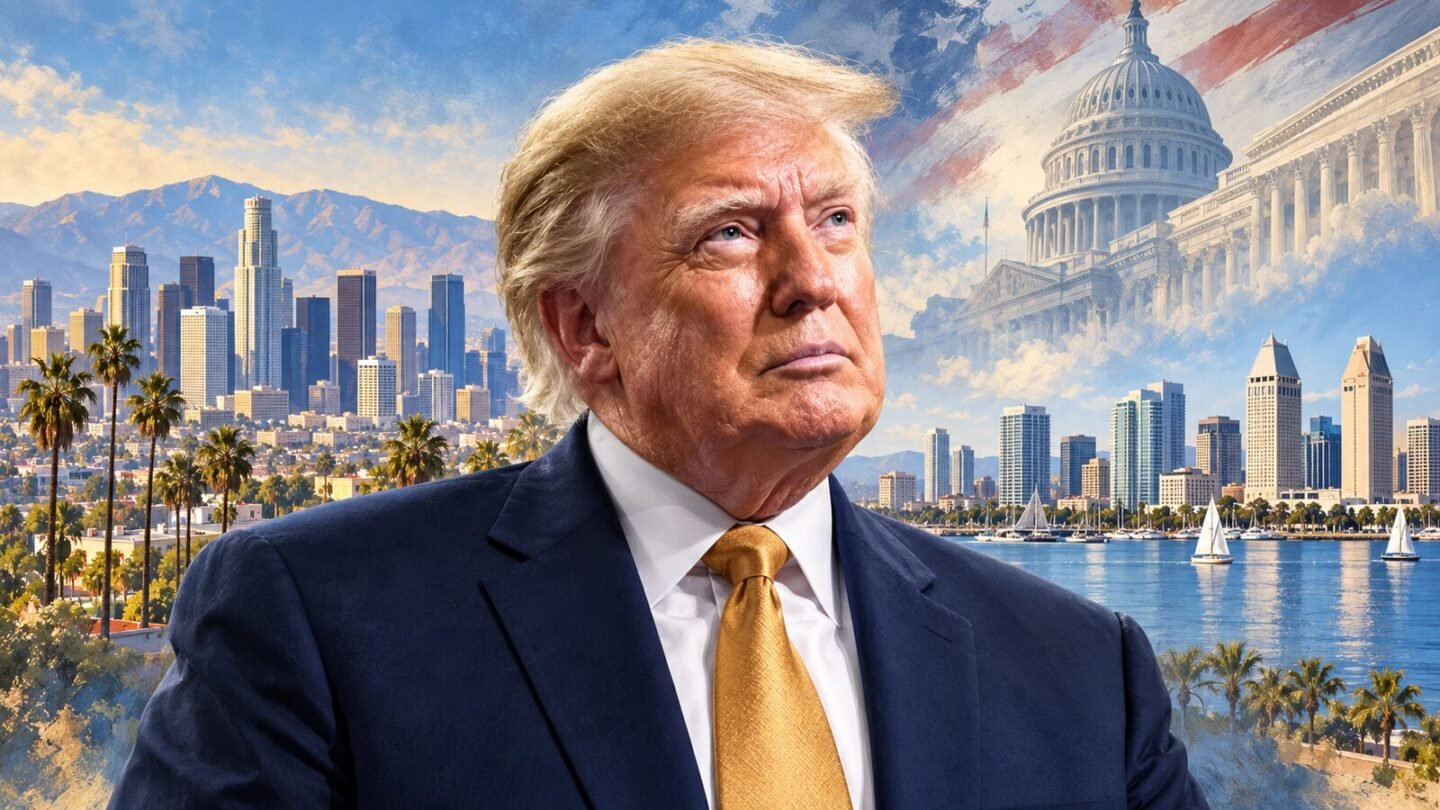
Trump rally remarks about Los Angeles and San Diego have drawn criticism from California officials after President Donald Trump discussed possible attacks on the cities during an October 5, 2026, campaign event in Grand Island, Nebraska. The White House disputes claims that he was inviting Iran to attack, saying he was explaining why the administration considered the war necessary.
The controversy has also prompted accusations of treason. Those accusations require a separate legal assessment: the Constitution defines the offense narrowly, and a political demand for imprisonment does not establish criminal liability.
Trump rally remarks and their surrounding context
During the rally, Trump defended the war with Iran while discussing its economic costs. Immediately before naming the California cities, he described a higher cost as a relatively small sacrifice for protecting the United States and the world.
He then said: “Let them take out Los Angeles. Let them take out San Diego.” He followed those words by describing a very small price to pay and predicting that the conflict would end soon.
The full rally transcript also records him returning to gasoline and other costs after the disputed passage. Earlier in the speech, he had portrayed action against Iran as necessary to prevent a nuclear threat.
That surrounding discussion matters because the dispute concerns both the words themselves and what Trump intended them to describe. His predictions about the war ending and prices falling were his claims, rather than established outcomes.
The White House disputes the criticism
White House spokesperson Steven Cheung responded on October 6 by saying Trump was describing a threat American cities would have faced if a nuclear Iran had not been stopped.
PolitiFact reported that the White House directed it to Cheung’s explanation. Its review placed the passage within Trump’s broader argument that the economic consequences of war were justified by preventing a greater danger.
The administration’s defense is therefore that Trump was describing a scenario it sought to prevent, rather than granting permission for an attack. California officials interpreted the wording very differently, arguing that a president should never speak of American cities as acceptable losses.
California officials reject the language
Gov. Gavin Newsom accused Trump of suggesting that foreign enemies should be allowed to attack the cities. Los Angeles Mayor Karen Bass said the language endangered Americans and conflicted with a president’s responsibility to protect the country.
San Diego Mayor Todd Gloria said his city was “not expendable.” He objected to treating residents as collateral damage or an acceptable cost of war.
Criticism also came from Republican San Diego County Supervisor Jim Desmond, a congressional candidate. He said he strongly disagreed with the comments and argued that defending Americans must remain the commander in chief’s first responsibility.
The reactions show that the Trump rally remarks raised concerns beyond a dispute over energy prices. Officials focused on the consequences of presidential language for the people living in the cities he named.
Treason, impeachment and criminal punishment are distinct
The Constitution’s treason provision, in Article III, Section 3, covers levying war against the United States or adhering to its enemies by giving them aid and comfort. It requires two witnesses to the same overt act, or a confession in open court, for conviction.
That narrow definition does not make every reckless or offensive statement treason. The quoted passage alone does not establish that the constitutional requirements have been met. Disagreement over its meaning is also different from a judicial determination of guilt.
Impeachment is a separate constitutional process. It can result in removal from office and disqualification, but it does not itself impose a prison sentence. Criminal punishment requires a lawful prosecution, conviction and sentence; public outrage cannot substitute for evidence and due process.
Meanwhile, the safety assessment reported locally was more specific than the political debate. Rep. Sara Jacobs, a San Diego Democrat, said on October 6 that she had spoken with the local FBI office and military leaders and that there was no increased threat to San Diego. KPBS’s October 7 update included that assessment and Cheung’s response to the Trump rally remarks.