President Donald Trump’s administration has begun sending $500 health insurance refunds to approximately 950,000 people, bringing a tangible benefit into the debate over Midterm Elections 2026. The payments offer immediate relief to eligible recipients, while leaving a larger question unanswered: how will Washington make recurring insurance bills more affordable?
ABC News reported October 1 that an administration official said mailing began September 30. The White House announced the program September 10, describing the payments as a return of surplus federal marketplace user fees. Delivery dates for individual recipients remain unclear.
The distinction between a refund and continuing premium assistance matters in Midterm Elections 2026. A payment can improve a household’s finances without changing the price of its insurance next month. That gives Democrats a substantive policy contrast to develop, even as Republicans can point to money actually being distributed.
Who qualifies for the $500 health insurance refunds?
The White House’s published eligibility description limits the program to people receiving no premium assistance in 30 states using the federal marketplace platform. Living in an included state does not, by itself, establish eligibility.
Administration officials told ABC News that most recipients have incomes above 400% of the federal poverty level, but some people below that threshold who received no subsidies are included. Income alone therefore should not be presented as a complete qualification test.
People receiving premium assistance are outside the announced group. Residents of states operating their own exchanges are also excluded under the administration’s description. The White House says the program concerns fees collected through the federal exchange, rather than a nationwide health insurance payment.
Those limits create practical questions about the selection process. Investopedia reported that the White House had not clarified whether the qualifying period was 2025 or 2026. Readers should avoid treating broad eligibility descriptions as confirmation that their particular household will receive a payment.
Why the geography matters for Midterm Elections 2026
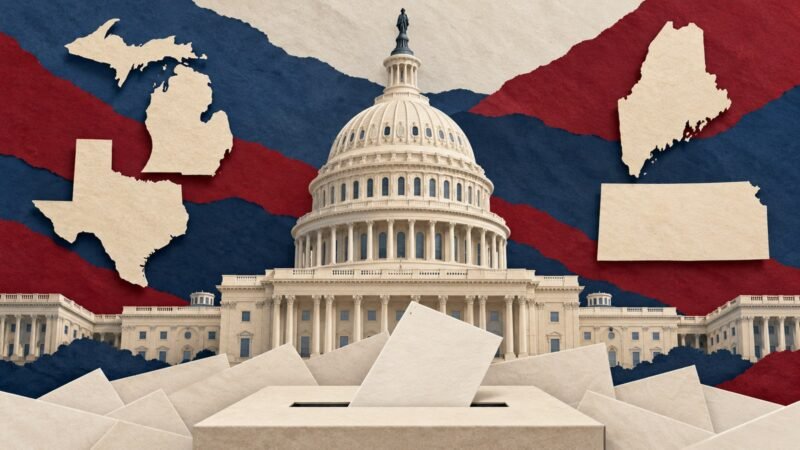
Reuters’ October 1 analysis found that 71% of the payments, approximately $339 million, would go to residents of 13 states hosting competitive statewide races. That concentration connects the refunds directly to the November 3 election.
However, a map of payments is not proof of electoral intent. The program’s federal-exchange restriction provides an administrative explanation for its boundaries. Establishing why officials selected a particular design or launch date would require additional evidence.
There is a separate, documented political element: the payments arrive with a presidential letter promoting Trump’s healthcare record, according to The Washington Post. Recipients encounter both financial assistance and a message assigning the president credit for it.
For Midterm Elections 2026, these two issues deserve separate scrutiny. One concerns whether the refund policy is justified and fairly administered. The other concerns how an incumbent uses a government benefit to communicate with voters shortly before an election.
The money may be welcome regardless of a recipient’s politics. Accepting a payment does not establish support for Trump, and payment totals cannot be converted into votes. No evidence reviewed for this article measures how recipients’ voting intentions changed after receiving the refunds.
A one-time payment meets recurring premium increases
KFF’s May analysis found average monthly premium payments rose from $113 in 2025 to $178 in 2026, a 58% increase across marketplace consumers. The $65 monthly difference equals $780 over a year, a calculation that illustrates why continuing costs deserve attention.
That average is not the bill facing every refund recipient. Some consumers switched plans, and others left coverage. KFF explained that those changes helped make the observed increase smaller than its earlier estimate of a 114% increase for subsidized enrollees keeping the same plan.
Its analysis of premiums and deductibles also found average deductibles increased by $1,027 to $3,786. Lower monthly payments can come with greater financial exposure when someone needs care, making premiums alone an incomplete affordability measure.
A hypothetical household facing a $100 monthly increase would incur $1,200 in additional annual premiums; a $500 payment would offset about 42%. This is an illustration, not an estimate of the typical recipient’s costs. The relevant comparison is each household’s actual annual expense.
The wider issue fits Hourly Times’ coverage of Trump’s affordability test. For Midterm Elections 2026, voters can reasonably ask whether a benefit changes a continuing expense or merely helps absorb it once.
Funding claims deserve evidence from both sides
The administration says surplus user fees fund the refunds and blames the Biden administration for collecting excessive amounts. The Washington Post reported that administration officials identified exchange operating fees as the funding source. That explanation does not independently establish mismanagement by Biden.
AP reported in September that KFF’s Cynthia Cox disputed the certainty of that blame, noting that unused fees could have originated during Trump’s first term. The reviewed materials do not provide an audited allocation tracing each refunded dollar to a particular administration.
The Democratic-aligned Center for American Progress argues that continuing premium assistance would address a broader affordability problem. Its September analysis also questioned why the announced recipient count was smaller than the population of unsubsidized enrollees in the included states.
That is a legitimate accountability question for Republicans defending the program. It is also an argument requiring careful comparison: restoring broader assistance entails recurring federal spending, whereas returning a defined fee surplus has a different stated purpose. Democrats should explain the financing and reach of their alternative.
Campaign messaging and what voters should watch next
The strongest Democratic argument is that a welcome refund can coexist with inadequate long-term relief. The strongest administration response is that returning excess fees offers a direct benefit to people who paid full premiums. Evaluating either position requires evidence about costs, eligibility and funding.
In campaign messaging, “Vote Blue No Matter Who” is a Democratic slogan. A “Blue Wave” remains a possible electoral scenario, rather than a result established by these payments. Neither phrase answers a household’s insurance questions.
Before Midterm Elections 2026, officials should clarify the qualifying coverage period, explain how recipients were selected and document the surplus being distributed. Candidates should specify whether their proposals lower future premiums, provide temporary payments or change coverage protections. Those details will matter after the checks are spent.