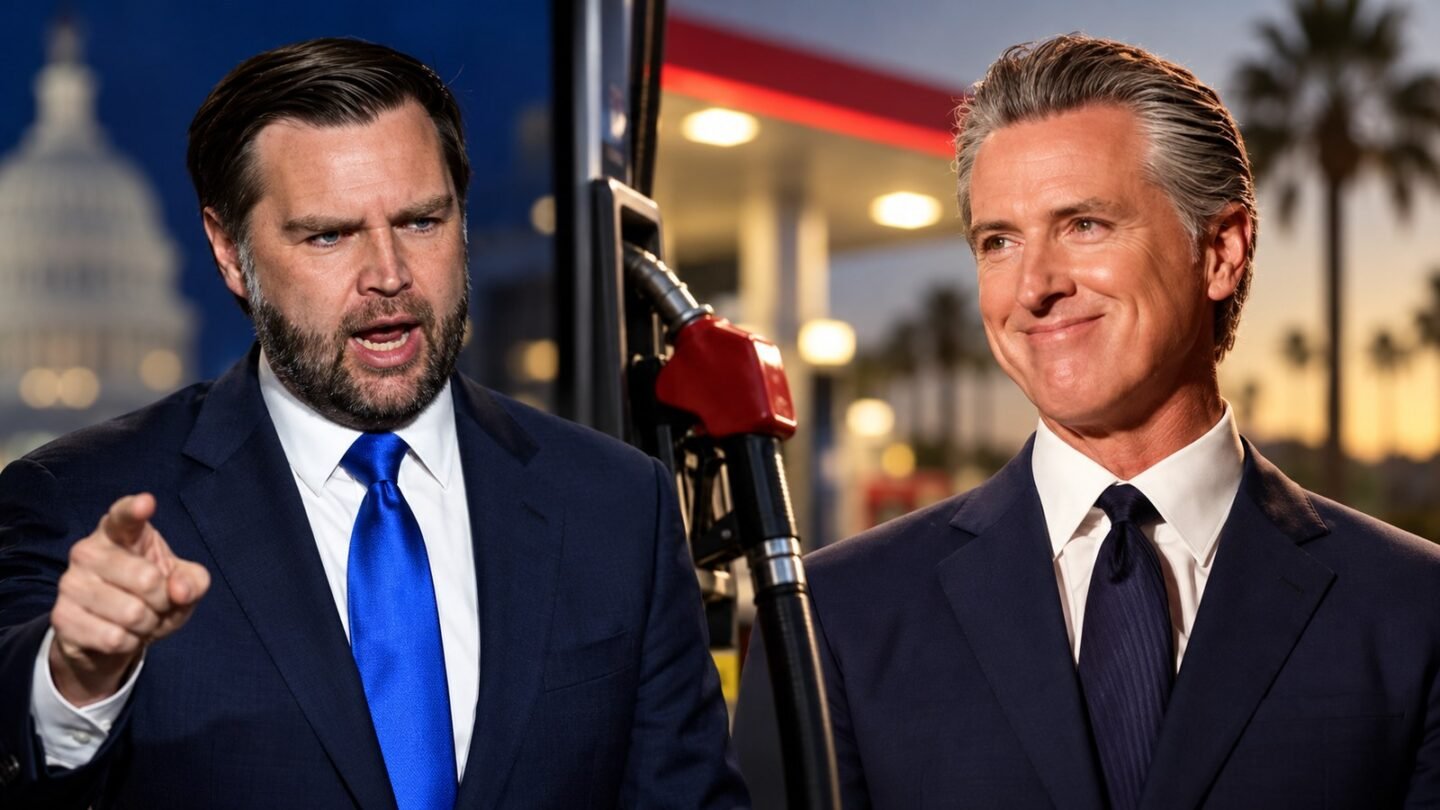
California Governor Gavin Newsom’s press office mocked Vice President JD Vance over gas prices after Vance blamed sharp fuel-cost increases on foreign dictators. The office’s October 26 post on X turned his argument into a sarcastic reference to President Donald Trump.
The response came from the Governor Newsom Press Office account, rather than Newsom’s personal account. It followed Vance’s remarks at a Republican campaign rally in Belgrade, Montana, ahead of the November 3 midterm elections.
What Vance said about gas prices
Vance acknowledged that voters remained concerned about fuel costs and inflation. He then pointed to earlier episodes of rising prices, including the period after Russia invaded Ukraine in 2022.
He argued that the 2022 increase had taken prices higher than their current level and also cited 1979, 2001 and 2007. Those comparisons were part of his campaign argument; listing the years does not establish a common cause for every price movement.
“They skyrocket every time some tin-pot dictator decides to throw a tantrum.”
Vance also advocated expanding domestic production, building refineries and developing additional energy facilities. He criticized Democrats’ approach to energy, presenting increased American output as the administration’s answer to overseas disruptions.
That policy argument provides context for the excerpt circulating online. His remarks defended the administration’s approach; the Trump comparison was supplied by his critics.
Newsom’s press office turns the remark toward Trump
The @GovPressOffice account responded on October 26 with a short message:
“Can’t believe he’d talk about Trump like that”
The joke treated Vance’s description as if it applied to his own president. It was political sarcasm, rather than evidence that Vance had actually called Trump a dictator.
Reports about the exchange connected that criticism to the administration’s war with Iran and the debate over fuel costs. The distinction matters: reporting the press office’s response does not make its implied characterization an established factual finding.
Nor should the post be presented as a new statement personally delivered by Newsom. The identifiable source of the response is his press office’s account, which is also referenced in material published on the governor’s official website.
What actually affects gas prices
The U.S. Energy Information Administration identifies several components of pump prices: crude oil, refining costs and profits, taxes, and distribution and marketing. Crude oil is the largest component, although its share changes over time and across regions.
Its explanation of gasoline-price factors also describes differences in fuel formulations, local competition and operating costs. These help explain why drivers can encounter different prices even within the same broader market.
Supply disruptions can matter, too. EIA explains that interruptions to crude supplies, refinery operations or pipeline deliveries can push prices higher. Seasonal demand and changes in gasoline specifications can affect costs even when crude prices are stable.
Gas prices can also respond to wholesale-market changes with a delay. EIA’s methodology notes that retail prices may take time to catch up when wholesale costs rise. That timing can change the apparent share of refining and retail margins from one month to another.
In a September 4 analysis, EIA identified disrupted refining activity in Russia, China and the Middle East as a reason global gasoline supplies were tight. It said that tighter supplies increased the cost of imports and demand for U.S. exports.
That analysis provides a documented supply-chain explanation. It does not reduce every change at the pump to one leader’s behavior or establish that every historical episode Vance listed had the same explanation.
An affordability dispute before the midterms
The exchange fits a broader contest over responsibility for household costs. Hourly Times’ reporting on voter trust in the parties on affordability explains why dissatisfaction with prices and confidence in a party’s solutions are separate questions.
For readers assessing this dispute, the central facts are the rally remarks and the press office’s response. The political taunt should remain clearly attributed, while claims about the causes and scale of fuel-price increases require economic evidence.