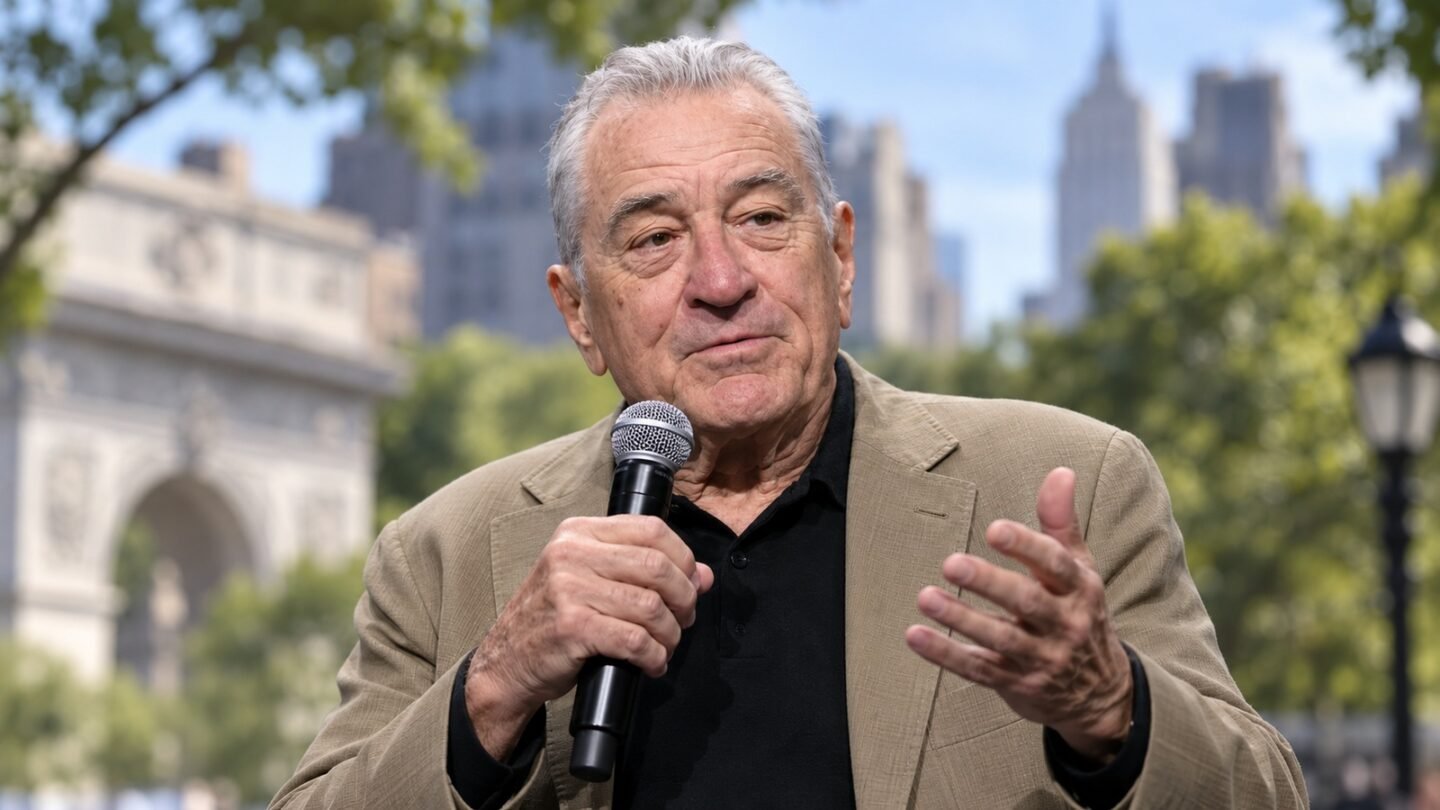
De Niro criticism of President Donald Trump at an Epstein-records event in New York included accusations of cruelty, corruption and disregard for human life. The remarks were political condemnations delivered at a public gathering, rather than medical findings or a judicial determination of wrongdoing.
The event took place in Washington Square Park on October 5, 2026. Local reporting published the following day placed Robert De Niro alongside Rosie O’Donnell and survivors of Jeffrey Epstein’s abuse in a call for greater disclosure and accountability.
De Niro criticism included a broader attack on Trump
Published transcripts of speech footage carry the phrases “unspeakable cruelty,” “unprecedented corruption,” “blatant disregard for human life and humanity” and “malignant narcissism.” They appear within a longer passage attacking Trump’s conduct and the administration’s handling of Epstein-related records.
The language matters because the supplied social post rearranges those phrases into a compact accusation. The underlying criticism is supported by the published speech material, but the post’s wording should not be presented as one uninterrupted verbatim sentence.
De Niro went on to accuse Trump of obstructing further releases and questioned what information remained undisclosed. Those were the actor’s allegations. The fact that he made them does not independently establish why a particular document was withheld or whether a specific official acted unlawfully.
He also praised survivors for speaking publicly and described their demands in terms of accountability and closure. That part of the address connected his political criticism with the people whose experiences were central to the gathering.
The gathering focused on survivors and access to records
AmNewYork’s October 6 report described a touring bookmobile carrying printed Epstein-related material that stopped at the Manhattan park. It reported that participants called for additional unredacted records and encouraged voters to support greater accountability.
The report included survivors describing the continuing impact of abuse and the difficulty of speaking publicly. Their participation gave the event a purpose beyond a celebrity’s dispute with a president.
A recording page published by writer Ellie Leonard also identifies Washington Square Park as the location and lists De Niro, O’Donnell, Katie Phang, Norman Eisen and Rosanna Arquette among the speakers. That account corroborates the setting and participants, while reflecting coverage from someone involved in documenting the event.
The distinction between event date and publication date is important. October 6 coverage describes the gathering held on October 5. The supplied post does not establish a separate, newly delivered speech later in the month.
Public records require context as well as transparency
The Justice Department’s Epstein Library provides an official source for released materials and information about their handling. The department says the site houses records responsive to the Epstein Files Transparency Act and will be updated if additional documents are identified for release.
The library also explains that personal information about victims and other private individuals has been redacted. It warns that the volume of material means sensitive information may nevertheless have been inadvertently included and provides a way to report such disclosures.
Its search notice adds another limitation: handwritten material and certain document formats may not be electronically searchable or may produce unreliable results. Search totals therefore need an explanation of the method used before they can support broader numerical claims.
These notices explain aspects of the department’s stated process. They do not resolve every dispute over completeness, justify every individual redaction or independently disprove the allegations raised at the event.
Political accusations remain different from established findings
The De Niro criticism uses moral and psychological language to express opposition to Trump. A speech containing such language does not establish a clinical diagnosis, and reporting an accusation of corruption is different from proving a particular offense.
No direct response to this specific speech was identified in the reviewed sources. A general description of what Trump supporters might believe would not substitute for an attributable response.
The verified story is that De Niro delivered strong criticism at a survivors’ transparency event. Readers can evaluate his arguments, but the De Niro criticism should remain attributed, with claims about criminal conduct, withheld records and medical conditions assessed through their own evidence.