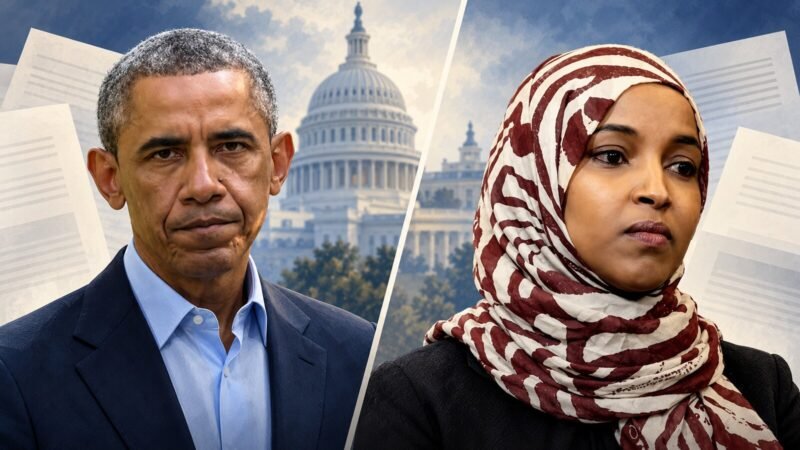
The federal search of Rep. Ilhan Omar’s Washington home has raised questions about the treatment of naturalized citizens, government power and election-season investigations. Homeland Security Investigations searched the Minnesota Democrat’s residence on October 12, 2026, under a judicially authorized warrant, the Justice Department said.
On October 14, The Associated Press reported, citing a person briefed on the investigation, that authorities had seized Omar’s phone and issued more than a dozen grand jury subpoenas, including to relatives. Those investigative steps do not establish guilt or revoke citizenship.
What investigators have publicly confirmed
The Justice Department described the search as part of an ongoing federal criminal investigation. ABC News reported, citing sources, that the inquiry concerned Omar’s immigration paperwork. Other reporting linked part of the investigation to documents completed during her childhood.
Omar has denied wrongdoing and described the search as political intimidation. Her statement accused the administration of using federal law enforcement against political enemies.
The government’s confirmation of judicial authorization and Omar’s allegation of political targeting address different questions. A warrant authorizes a specified investigative action; it is not a conviction or a final ruling on the underlying allegations.
The reviewed public reporting does not establish that Omar fraudulently obtained citizenship. Her legal history and the government’s evidence must be assessed through the relevant proceedings, rather than inferred from agents’ presence at her home.
Why naturalized citizens are part of the debate
The social media comparison with Melania Trump concerns consistency in government treatment. Her official White House biography says she was born in Slovenia, moved to New York in 1996 and became an American citizen ten years later, in 2006.
That biography establishes her immigrant background and citizenship timeline. It does not establish misconduct, justify a search of her home or show that investigators have opened a case against her.
There is also no verified statement in the supplied material establishing how Melania feels about Omar’s situation. Whether she should be concerned is an opinion question, not a report of her response.
The broader principle is that naturalized citizens should receive legal safeguards without investigations being assigned on the basis of partisan comparisons. Sharing an immigrant background does not establish that two people have the same legal circumstances or evidence against them.
Search powers and citizenship loss are distinct
The Fourth Amendment protects against unreasonable searches and seizures. It requires warrants to rest on probable cause and to describe the place to be searched and the people or things to be seized.
Those protections constrain government searches. They do not provide immunity from a properly supported investigation, and a lawful investigation does not settle the ultimate question of criminal liability.
Citizenship revocation involves a separate legal framework. Federal law allows court proceedings to revoke naturalization on specified grounds, including illegal procurement or concealment of a material fact or willful misrepresentation.
The statute also provides notice and an opportunity to answer the government’s petition. Cases involving citizenship acquired through a parent can raise additional statutory issues, making the actual records and applicable law essential.
Consequently, a search warrant, a criminal charge and a judgment affecting citizenship are different legal events. None should be described as another merely because a case involves old immigration documents.
Election timing adds another accountability question
The search occurred shortly before the November 3 midterm elections. Omar’s criticism has therefore included concern about the political use of investigative authority, rather than only the documents being examined.
The Justice Department’s published election-sensitivity policy prohibits selecting investigative timing to affect an election or advantage or disadvantage a candidate or party. It also requires consultation when an action is likely to raise an issue, or the perception of one, under that rule.
The timing alone does not establish a violation. Assessing that allegation requires evidence about the decision, its purpose and the procedures officials followed.
For naturalized citizens, the central distinction remains equal safeguards rather than identical investigations. Omar’s case must be evaluated on its evidence, while Melania’s citizenship cannot reasonably be treated as evidence against her.