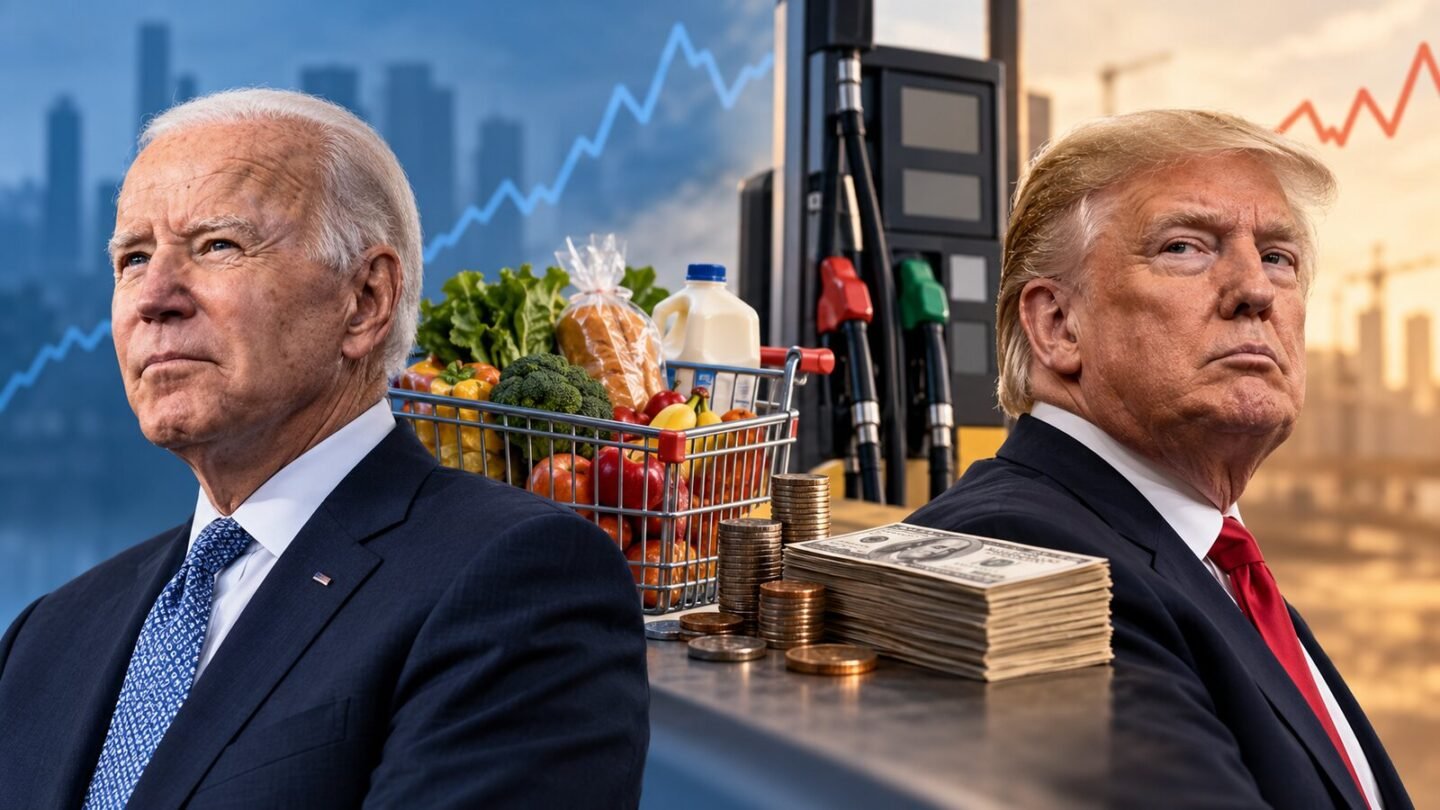
Trump economy approval has fallen to a new low as Americans remain worried about prices, gasoline, jobs and household finances. That does not automatically prove the economy was better under Joe Biden, but it shows that many voters are dissatisfied with Donald Trump’s economic record as the 2026 midterm elections approach.
Why Trump Economy Approval Has Fallen
An AP-NORC poll released October 1 found that only 26% of U.S. adults approved of Trump’s handling of the economy. Approval of his handling of the cost of living was even lower, at 17%.
The poll was conducted from September 24 through September 28 among 2,140 adults. Its overall margin of sampling error was plus or minus 2.9 percentage points.
The same survey found that 65% of adults believed Trump’s policies were responsible for higher-than-usual prices. More than half said the national economy and their local economy had become worse since Trump returned to office. Those findings measure public opinion, not economic performance by themselves, but they show a serious political problem for the White House.
The fall in Trump economy approval is also consistent with other measures of public anxiety. The Conference Board reported that its Consumer Confidence Index dropped 6.7 points in September to 81.9. Its measure of expectations for income, business conditions and the labor market declined for a third consecutive month.
An Economist/YouGov poll conducted in September found that 41% of Americans thought Democrats did a better job handling the economy, while 37% chose Republicans. That question compared the parties rather than the Biden and Trump presidencies directly.
What the Latest Economic Data Show
Official data present a more complicated picture than the polling.
The Bureau of Labor Statistics reported that consumer prices were 3.4% higher in August 2026 than one year earlier. Core inflation, which excludes food and energy, was 2.4%. Energy prices were 16.3% higher than a year earlier, driven partly by a 27.4% increase in gasoline prices.
The labor market remained relatively stable. Employers added 162,000 jobs in August, while the unemployment rate held at 4.1%. The Bureau of Economic Analysis estimated that real gross domestic product grew at a 2.2% annual rate in the second quarter of 2026.
Those numbers do not describe a recession. They show an economy that is still growing and adding jobs, but where price increases—especially energy costs—are creating pressure for households. That combination helps explain why Trump economy approval can weaken even while economic output continues to grow.
Was the Economy Better Under Biden?
The answer depends on which period and measure a voter considers most important.
Inflation reached a four-decade high during Biden’s presidency, causing a significant increase in the price level. By December 2024, however, annual inflation had slowed to 2.9%. The unemployment rate was 4.1%, and employers added 256,000 jobs that month.
In August 2026, the unemployment rate was also 4.1%, but annual inflation was 3.4%. This simple comparison favors Biden’s final month on inflation and December job growth, but one month cannot represent an entire presidency.
Prices also usually do not return to their earlier levels when inflation slows. Lower inflation means prices are increasing more slowly; it does not mean previous increases disappear. That helps explain why voters may remain unhappy even when GDP and employment data look reasonably strong.
A September Harvard CAPS/Harris poll reported that 53% of voters believed the economy was worse than when Biden was president. A July survey from the same organization had found 50% saying the economy was better. The change shows that public assessments can move quickly with gasoline prices, headlines and personal financial experiences.
What Trump Economy Approval Can and Cannot Show
Presidents can influence economic conditions through taxes, tariffs, spending, regulation, immigration and energy policy. Congress, the Federal Reserve, businesses, global conflicts and international commodity markets also shape the results.
Trump and his supporters argue that tax, trade, energy and regulatory changes will deliver stronger long-term growth. Critics argue that tariffs, higher energy costs and policy uncertainty are making life more expensive and reducing confidence.
Both arguments should be tested against complete data over time. Polls show how people feel, but they cannot prove that one president alone caused every change in prices, wages or employment.
The latest Trump economy approval numbers are clearly negative and politically important. Available data also show growth and continued job creation, preventing a simple claim that the economy is failing in every respect.
Voters can reasonably prefer Biden’s final economic conditions, particularly on inflation. Others may prioritize growth, taxes, regulation or future expectations and reach another conclusion. Debate over Trump economy approval will continue, but the fairest answer is that many Americans currently feel worse while the broader comparison remains mixed and depends on the measures being used.