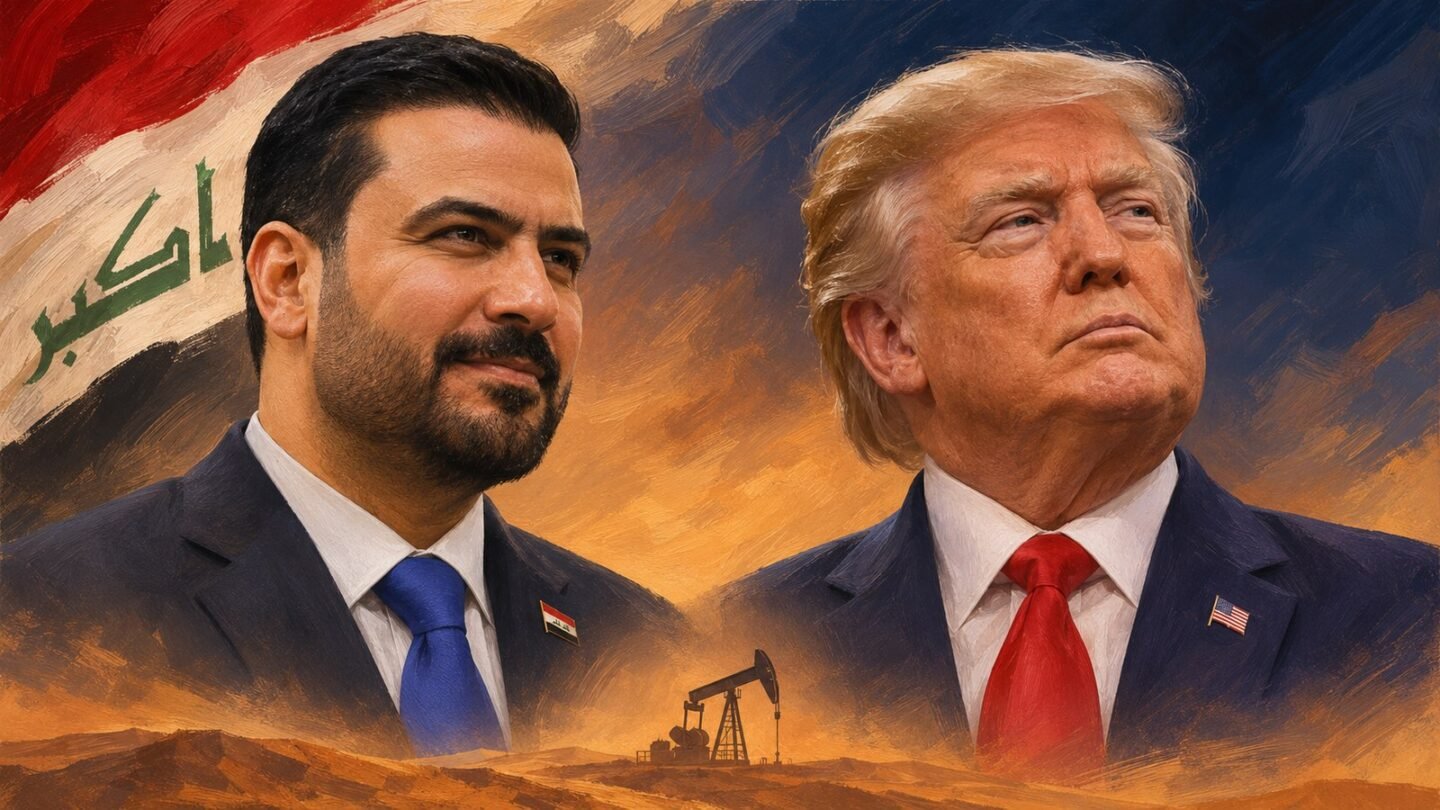
President Donald Trump backed Iraq oil control efforts on November 27, endorsing Prime Minister Ali al-Zaidi’s campaign against smuggling and his demand that weapons remain under state authority. The statement came as Baghdad faced opposition from Kurdish leaders over oilfields and border crossings, alongside a separate confrontation with an Iran-backed armed group.
Trump’s Truth Social post supported a stronger Iraqi state and efforts to combat corruption. It did not name the Kurdistan Region or explicitly endorse each of the orders at the center of the dispute, Iraqi outlet 964media reported.
The distinction matters because Washington’s political support does not, by itself, establish that Baghdad has completed the takeover of disputed facilities or secured the disarmament of armed factions.
What Trump said about Iraq oil control
Trump said he supported al-Zaidi’s efforts to “stop the smuggling of Iraqi oil, end corruption, and bring all weapons under the exclusive control of the state.” His endorsement linked the government’s energy campaign with its broader attempt to strengthen public institutions.
The Iraqi prime minister had already issued his principal orders on November 24. Trump’s November 27 statement therefore followed the announcement of the measures, a court interpretation of federal powers and public protests in the Kurdish region.
Al-Zaidi’s office has rejected suggestions that foreign governments direct its decisions. In a November 25 statement reported by 964media, it said the government acted according to Iraq’s constitutional responsibilities and national interests.
Oilfields and border crossings are disputed
Rudaw reported that the November 24 directives instructed federal agencies to take over the Kurdistan Region’s border crossings. They also called for federal management of Oil Ministry fields under Kurdish security control in Kirkuk, Nineveh, Diyala and Salahaddin provinces.
The orders barred the regional government from approving crude oil and petroleum-product exports without the federal Oil Ministry. They followed an inquiry into suspected smuggling involving the state-owned North Oil Company.
The campaign also included monitoring wells and pipelines and investigating contracts and the movement of petroleum products. These are government directives and investigative steps; they do not establish criminal responsibility for every person or company under examination.
Reuters reported that two crossings, one with Syria and another with Iran, were closed on November 26. Separately, government spokesman Haider al-Aboudi said exports bypassing state oil marketer SOMO would be treated as smuggling because proceeds did not reach the treasury.
Kurdish authorities reject Baghdad’s approach
The Kurdistan Regional Government called the measures unconstitutional and objected to the military language surrounding them. It also said it would continue cooperating against corruption and oil smuggling, according to 964media.
Kurdish leader Masoud Barzani likewise opposed decisions he considered unconstitutional while supporting action against smuggling through legal means. The dispute therefore concerns the division of powers as well as the government’s stated anti-smuggling objective.
Associated Press reported that thousands demonstrated in Erbil on November 26. Iraq’s Federal Supreme Court had ruled the previous day that federal authorities could deploy forces to secure international borders, including those within the Kurdish region.
The National reported on November 26 that al-Aboudi denied reports of army units moving toward the Kurdistan Region, despite the dispute over federal powers.
Armed groups face a separate challenge
The push for Iraq oil control overlaps with al-Zaidi’s campaign in Jurf al-Sakhar, south of Baghdad, a stronghold of Kataib Hezbollah. Rudaw reported that Iraqi forces entered the area following allegations of oil theft, which the Iran-backed group denies.
That operation explains why Trump’s reference to state control of weapons has significance beyond the Kurdish dispute. However, political backing for disarmament should not be confused with evidence that the faction has surrendered its arsenal.
Revenue claims and the next talks
Al-Aboudi estimated losses of $100 billion from oil smuggling through the Kurdish region between 2008 and 2025. Reuters said the method behind that government estimate was unclear. It should therefore be understood as an attributed claim, rather than an independently established total.
The next announced step in the Iraq oil control dispute is political dialogue. The National reported that Iraqi leaders approved a national dialogue for December 1 under the sponsorship of Supreme Judicial Council head Faiq Zaidan, aimed at finding constitutional solutions to the Baghdad-Erbil dispute.