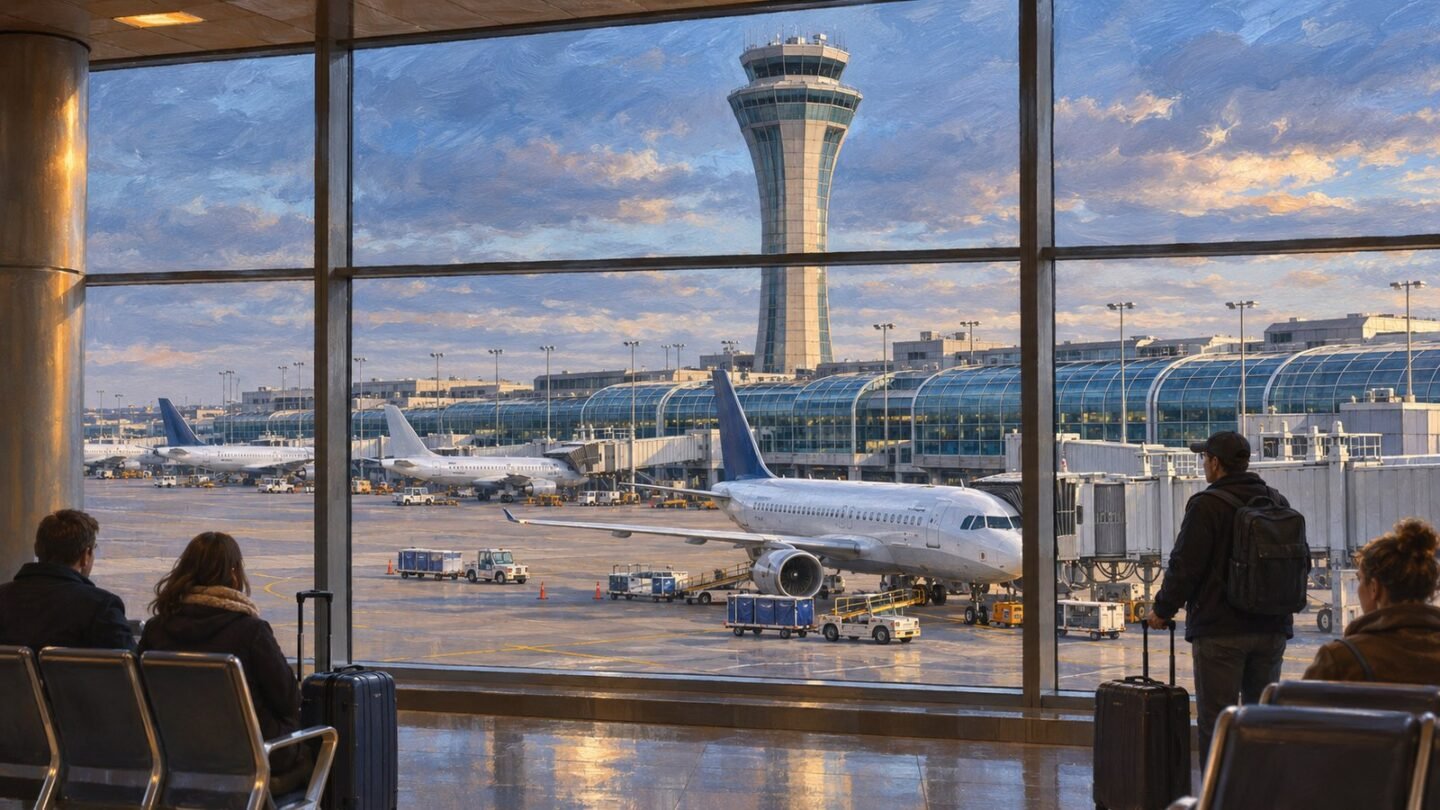
The O’Hare ground stop issued during the Thanksgiving travel rush had given way to a ground delay program by late afternoon on November 24, according to the Federal Aviation Administration. An equipment outage continued to restrict arrivals at Chicago’s major airport.
At 4:38 p.m. Central, the FAA’s public system listed average assigned delays of 47 minutes and no active ground stop at O’Hare. The update means the earlier alert should not be read as an ongoing halt to all airport operations.
The disruption followed a separate staffing-related pause on November 23. The two events occurred on consecutive days but were attributed to different problems.
O’Hare ground stop transitions to managed delays
The FAA’s November 24 advisory identified an equipment outage and listed a ground delay program covering arrivals through 11:59 p.m. Central. That was the scheduled program window, rather than a promise that every delayed flight would recover by that time.
The program covered flights departing the contiguous United States and selected Canadian airports. Its published figures described delays assigned under the traffic-management program, rather than a guaranteed wait for every passenger.
The FAA’s live airspace status summary is updated regularly. The 47-minute figure reflects the late-afternoon update and can change as conditions develop.
Equipment problem involves airport surface radar
Reuters reported that the FAA identified a problem with a ground radar system and said technicians were working to repair air traffic equipment. The system helps controllers monitor aircraft and vehicles on runways and taxiways.
The agency’s advisory referred to an Airport Surface Detection Equipment outage. That identifies the equipment involved without establishing that every radar or communications system serving Chicago had failed.
The current advisory does not identify a cyberattack or establish a connection to another recent aviation outage. Those explanations should not be inferred from the equipment-outage description alone.
Monday’s interruption involved controller staffing
The previous day’s O’Hare ground stop was attributed to staffing constraints at Chicago Terminal Radar Approach Control, according to the FAA’s statement reported by local media and Anadolu.
That pause affected flights arriving at O’Hare and was subsequently lifted. Tuesday’s equipment issue is a separate operational event, even though both disrupted travel during the same holiday week.
What a ground stop means for passengers
The FAA explains that a ground stop holds affected flights at their departure airports. Passengers waiting outside Chicago can therefore experience a delay caused by conditions at O’Hare.
A ground delay program works differently. It assigns departure times to regulate the rate at which aircraft reach a destination whose available capacity cannot accommodate the expected demand.
Ending a ground stop consequently does not mean all flights immediately return to their original schedules. The subsequent delay program can continue to hold affected departures while arrivals are managed.
Neither term, by itself, means every departure from O’Hare has been canceled. Travelers need their airline’s flight-specific information to determine whether their own itinerary has changed.
Disruption coincides with peak Thanksgiving flight demand
The FAA’s November 24 holiday forecast projected more than 417,000 flights over a nine-day period. It expected Tuesday to be the busiest day, with more than 52,000 flights, describing the overall holiday skies as the busiest in 16 years.
Those figures are forecasts of flight activity, not counts of passengers or cancellations. They provide context for the demand facing the aviation system during the disruption.
Hourly Times previously reported on the interagency effort to prevent further FAA outages before Thanksgiving. That initiative concerns broader system reliability and does not establish the cause of this particular equipment failure.
What travelers should check next
The FAA advises passengers to allow extra time to reach the airport, check with their airline for updates and consult its airport-status information. Airport-wide averages cannot determine an individual flight’s departure or connection time.
For this O’Hare ground stop and the delays that followed, the key distinction is between the earlier arrival pause and the later traffic-management program. The late-afternoon FAA update showed managed delays continuing, rather than an active ground stop.