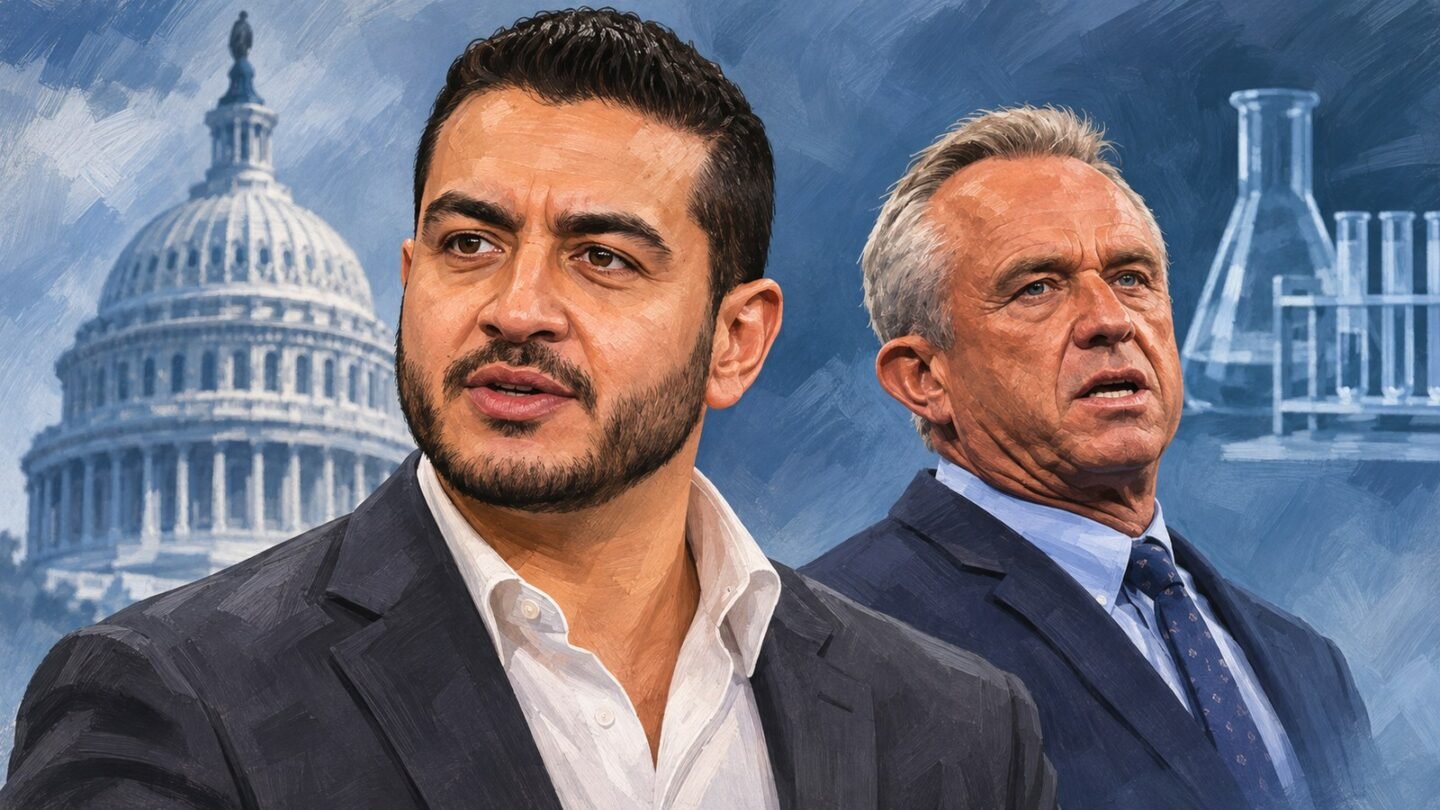
Michigan Sen.-elect Abdul El-Sayed wants to investigate staffing decisions at federal health agencies under Health and Human Services Secretary Robert F. Kennedy Jr. The proposed El-Sayed investigation would examine decisions affecting food safety and disease surveillance, he said in a November 5 CNN interview.
El-Sayed, an epidemiologist and former Detroit health director, argued that cuts weakened the Food and Drug Administration and the Centers for Disease Control and Prevention. He pointed to Michigan’s severe summer Cyclospora season as a reason to examine what happened.
His comments describe intended congressional oversight, rather than an investigation already opened by the Senate. Kennedy has disputed claims that changes to federal surveillance undermined the outbreak response.
What the El-Sayed investigation would examine
Reporting on El-Sayed’s interview with CNN’s Kate Bolduan records him describing parts of the FDA and CDC as “DOGE-ed out,” a reference to the administration’s Department of Government Efficiency initiative.
He said he wanted to understand “the decision-making that’s gone on” and identify changes that could prevent future problems. He framed the proposed inquiry as accountability and problem-solving, rather than retaliation.
That is his argument about the effect of agency decisions. Establishing whether particular cuts delayed detection or worsened the outbreak would require evidence connecting those decisions to specific failures; the case totals alone do not establish that connection.
Michigan’s seasonal total is broader than the lettuce outbreak
The Michigan Department of Health and Human Services’ 2026 season summary lists 15,472 provisional cyclosporiasis cases with symptom onset or laboratory collection dates from May 1 through August 31. It also records 379 hospitalizations and two associated deaths.
The state explicitly says that total includes cases associated with the multistate outbreak and cases not linked to it. It should therefore not be described as 15,472 Michigan infections all traced to one lettuce supplier.
CDC’s separate September 11 final outbreak update reported 12,883 illnesses across 21 states linked to iceberg lettuce from Taylor Farms de Mexico. Epidemiologic and traceback evidence identified the lettuce as the source of that outbreak.
CDC declared the outbreak over on September 11. Michigan’s summary says FDA closed its investigation on October 2. These are retrospective questions about the summer response, rather than evidence of an ongoing lettuce outbreak.
What changed in FoodNet, and what Kennedy said
CDC’s FoodNet explanation says reporting for data collected from July 1, 2025, became optional for pathogens other than Salmonella and Shiga toxin-producing E. coli. Cyclospora was among those affected.
FoodNet is a particular surveillance collaboration, not the entirety of federal disease tracking. CDC identifies another system, the National Notifiable Diseases Surveillance System, as continuing to monitor Cyclospora.
CDC also says FoodNet’s active surveillance was not designed to detect outbreaks and that the changes did not alter the systems used by federal, state and local partners to detect and investigate them. That agency position is relevant to evaluating El-Sayed’s allegations.
On July 21, Kennedy rejected criticism of the response and characterized FoodNet reductions as removing “redundant surveillance,” ABC News reported. He said surveillance and outbreak tracing continued. Those statements dispute El-Sayed’s interpretation without resolving every question about staffing and response capacity.
The competence criticism came in an earlier interview
The dispute also includes campaign rhetoric. STAT’s October 28 profile, and its publicly accessible October 29 newsletter, report that El-Sayed called Kennedy the “most incompetent HHS secretary ever.” That was his assessment, made before the election, rather than an official finding.
It followed Kennedy’s October 26 appearance in Grand Rapids supporting Republican Senate candidate Mike Rogers. Kennedy claimed that Arabs “don’t produce science.” The broad claim is contradicted by documented scientific achievements: Egyptian-born Ahmed Zewail received the 1999 Nobel Prize in Chemistry.
The El-Sayed investigation proposal concerns agency decisions and public health performance. The campaign exchange provides background to the relationship between the two men, rather than proof that particular cuts caused infections.
The El-Sayed investigation would add to the broader scrutiny of Kennedy’s health policies. El-Sayed is preparing to take office in January; a formal oversight request, committee action or hearing announcement would establish how his stated plan will proceed.