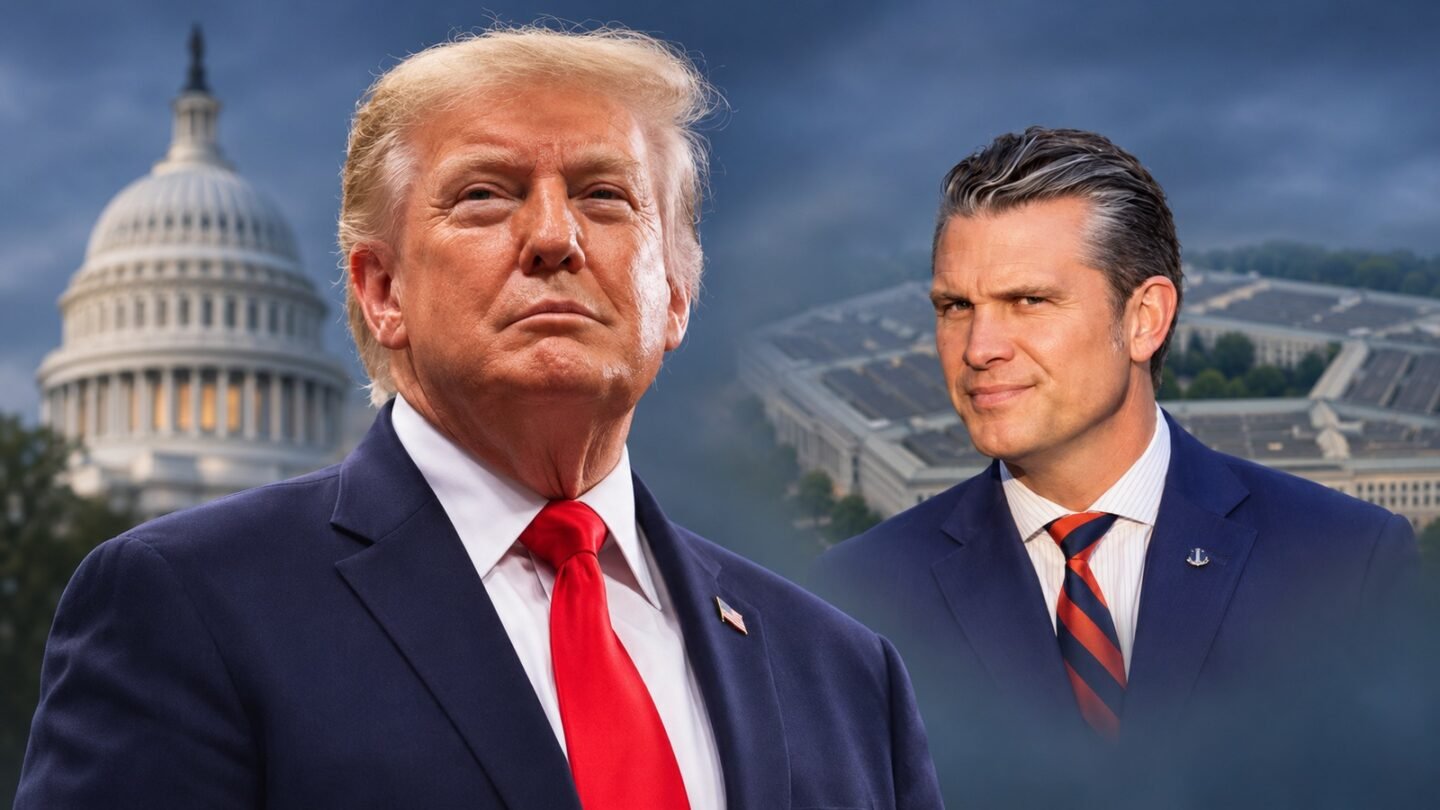
President Donald Trump urged lawmakers to oppose the Hegseth impeachment effort in a November 9 Truth Social post, saying Defense Secretary Pete Hegseth deserved praise rather than impeachment. The appeal followed Republican Rep. Thomas Massie’s presentation of eight articles accusing the Pentagon chief of misconduct involving Iran and other military operations.
Trump asked Congress to support Hegseth while citing military recruitment and what he described as victories in Venezuela and Iran. Those were the president’s assessments of the secretary’s record, rather than findings resolving the allegations before lawmakers.
The message was published Monday night, before Hegseth’s November 10 Pentagon briefing. That timing distinguishes Trump’s initial appeal from his separate statement praising the secretary’s performance after Tuesday’s news conference.
Trump asks Congress to support Hegseth
An archived copy of the November 9 post records Trump’s direct appeal to lawmakers:
“Pete Hegseth should be praised, not Impeached. Congress, stand up for Pete!!!”
The post also attacked Massie and portrayed Hegseth as a successful military leader. It emphasized the president’s confidence in the secretary without addressing each of the eight impeachment articles individually.
Trump’s recruitment claim did not include supporting figures or specify a service branch, reporting period or comparison measure. His description of the military campaigns as victories likewise expressed his position on their outcomes. This report does not independently confirm those broader assessments.
The president’s backing establishes his public position on Hegseth’s future. It does not establish how individual representatives will vote or whether the resolution has enough support to advance.
What the Hegseth impeachment resolution alleges
Massie, a Kentucky Republican, renewed his effort on November 9. His office’s summary of the eight impeachment articles identifies three allegations involving the War Powers Resolution of 1973 and the Iran conflict.
Those articles challenge the authority to begin hostilities, the continuation of operations despite congressional direction to withdraw, and compliance with statutory deadlines for ending unauthorized military action.
The remaining articles allege failures to follow civilian protection laws, unlawful lethal operations against suspected drug traffickers, retaliation against Sen. Mark Kelly over protected speech, an unauthorized seizure of Nicolás Maduro and Cilia Flores in Venezuela, and unlawful military action in Yemen.
Massie’s statement also urged Trump to replace Hegseth while Republicans could still confirm a successor in the Senate. He argued that the incoming Democratic congressional majorities would pursue further hearings and proceedings.
Those are the sponsor’s allegations and predictions, not findings of guilt or guarantees about future congressional action. Trump and Hegseth reject the case against the secretary.
Hegseth rejects the charges at Pentagon briefing
On November 10, Hegseth described the impeachment campaign as politically motivated and defended the military operations as lawful actions ordered by Trump. He argued that policy disagreements should be addressed through legislation, debate and elections.
The White House published excerpts supporting that response. Hegseth also warned that proceedings against him would undermine military personnel, presenting his defense as support for the service members who carried out the administration’s orders.
After the briefing, Trump issued another supportive message. Reuters reported that the president praised Hegseth’s defense and again attacked Massie, extending his public backing into the day of expected House procedural action.
Hourly Times has separately explained Massie’s renewed push for House consideration, including the distinction between a procedural vote and a decision to approve impeachment articles.
What comes next in the Hegseth impeachment effort
The Hegseth impeachment effort requires action by lawmakers regardless of the president’s endorsement. Reporting reviewed for this article described a November 10 procedural vote that could block the resolution, send it to committee or permit further consideration.
A House vote approving impeachment articles would bring formal charges without automatically removing Hegseth. Under the Senate’s explanation of the process, conviction requires two-thirds of senators present and carries removal from office.
The next scheduled development is the House’s handling of Massie’s resolution. Whether lawmakers proceed toward a vote on the allegations depends on that procedural decision, rather than on Trump’s appeal alone.