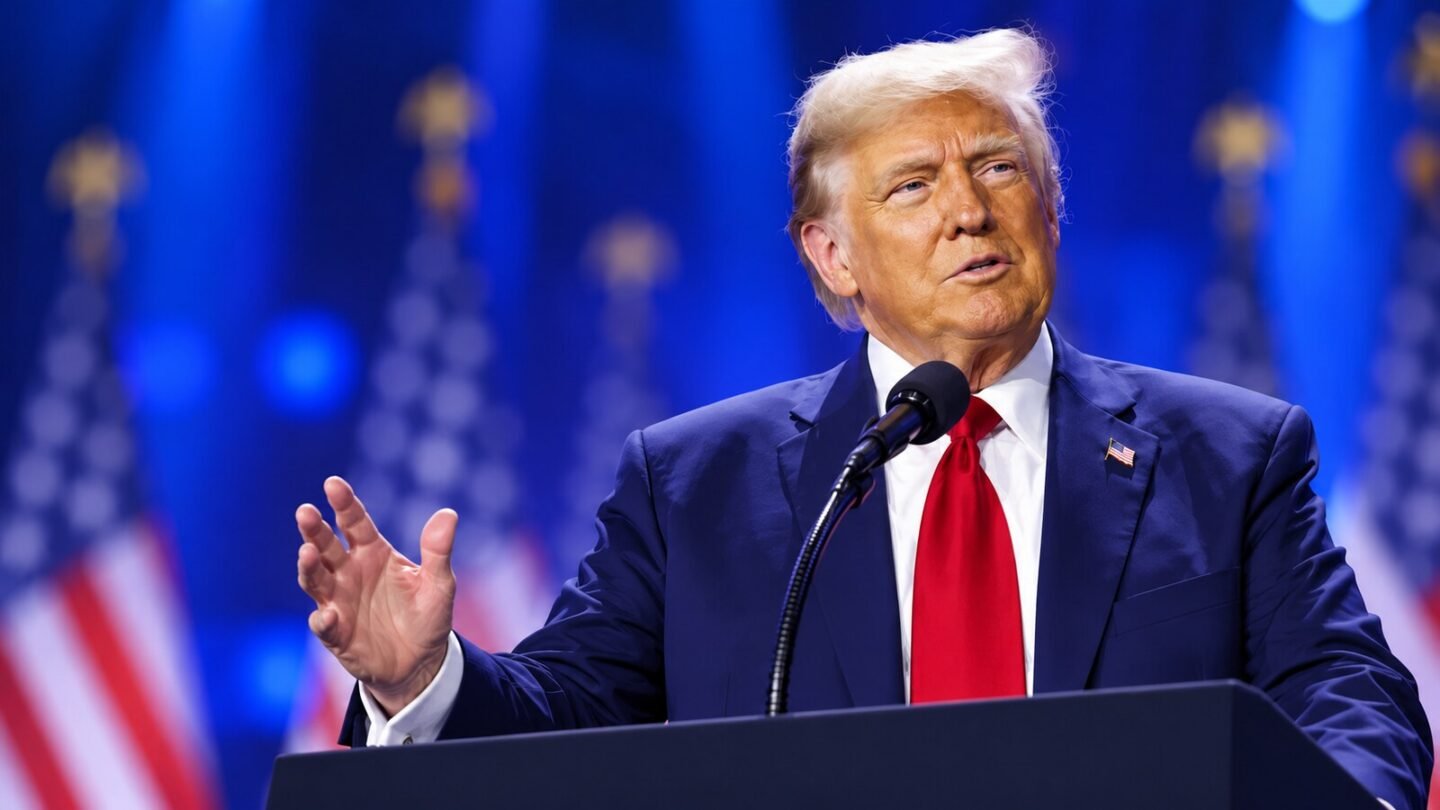
President Donald Trump used his Rock Hill rally on October 29 to urge Republicans to vote and warn that a Democratic midterm victory would threaten his administration’s agenda. The South Carolina appearance supported Republican Sen. Darline Graham, who faces Democratic challenger Annie Andrews ahead of the November 3 election.
The event took place at the Rock Hill Sports & Event Center. The Republican event listing advertised remarks at 12:30 p.m., placing the appearance in the final week of campaigning before voters decide control of Congress.
Trump’s message at the Rock Hill rally
Trump presented the election as a choice between continuing his economic policies and allowing Democrats to reverse them. Roll Call reported that he praised the economy before telling supporters: “But if the Democrats win the midterms, they will burn it all down.”
That was a campaign warning about his opponents, rather than evidence that a specific reversal had already occurred. Trump urged Republicans to turn out for Graham and tied support for her to maintaining the direction of his presidency.
His opening remarks also reached beyond South Carolina. Trump promoted Republican Michael Whatley in neighboring North Carolina’s Senate contest against Democrat Roy Cooper. Rock Hill’s location within the Charlotte television market gave the appearance an audience extending across the state line.
South Carolina’s Senate contest draws national attention
Graham was appointed by Gov. Henry McMaster to complete the term of her late brother, Sen. Lindsey Graham. Andrews, a pediatrician, is seeking to defeat her in a contest that has brought repeated presidential visits to South Carolina.
South Carolina Public Radio’s advance reporting identified the Rock Hill stop as Trump’s second visit to the state for a rally in October and his third of 2026. His October 21 appearance in Pendleton had also centered on Graham.
The campaign has exposed divisions among Republicans. Graham defeated Rep. Ralph Norman in the party’s August runoff, but some of his supporters remained reluctant to unite behind her. Andrews, meanwhile, announced support from former Republican Gov. David Beasley and former Democratic Gov. Jim Hodges.
Those endorsements show that the candidates’ coalitions do not follow party lines perfectly. They do not establish how voters will ultimately divide their ballots.
Supporters gather early, with Trump at the center
South Carolina Public Radio reported that supporters lined up before sunrise outside the venue. Vendors sold Trump hats, pins and commemorative buttons, while the atmosphere around the complex was celebratory.
The station’s interviews suggested that Trump himself was a major attraction. Michael Curcio, who traveled from Florence, said he would probably vote for Republicans as a way of supporting candidates the president favored. Another attendee, Terry Pennington, lived in North Carolina and could not vote in South Carolina’s contest.
These accounts describe individual attendees’ motivations. A rally audience is not a representative sample of the electorate, and enthusiasm outside the venue cannot by itself predict the Senate result.
Harsh rhetoric also features in Michigan
The South Carolina appearance followed Trump’s October 25 rally in Port Huron, Michigan, supporting Republican Senate candidate Mike Rogers. Reuters reported that Trump invoked the September 11 attacks while portraying Democratic nominee Abdul El-Sayed as an extremist.
El-Sayed rejected the allegations. Such accusations should not be treated as established facts. Former President Barack Obama had campaigned for Democrats in Michigan the previous day, highlighting the competing national appeals surrounding that Senate seat.
The rival appearances form part of the wider Michigan Senate campaign, alongside disagreements over healthcare, housing and economic policy.
What the circulating graphic establishes
A graphic attributes the phrase “radical left jihadists” to Trump while describing his administration’s first two years. Matching wording appears in a third-party, AI-generated transcript labeled as coverage of the October 29 South Carolina rally.
That transcript provides a lead to the purported passage, but the exact wording has not been independently authenticated against the original recording for this report. The firmly documented message from Rock Hill is Trump’s appeal to preserve Republican power and prevent Democrats from undoing his agenda as Election Day approaches.