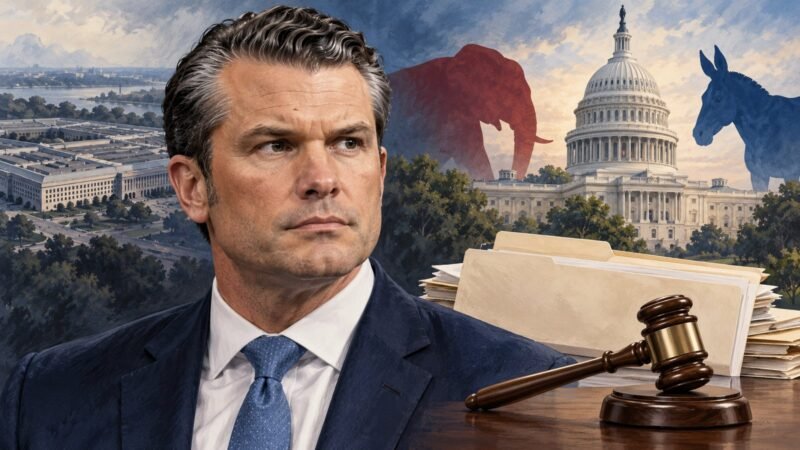
House Speaker Mike Johnson warned about “mini Mamdanis” emerging across the country at a June 24, 2026, Republican leadership news conference, following primary victories by candidates backed by New York City Mayor Zohran Mamdani.
The remarks are documented in a transcript published by Johnson’s office that day. The date matters: the quotation in the supplied graphic comes from June, rather than a newly verified October statement.
“It is a dangerous thing. This is not a joke,” Johnson said. “We are in a fight right now to save the republic, and every American needs to take this seriously.”
Those descriptions expressed the Republican speaker’s political assessment of progressive candidates. They did not establish that the candidates posed a proven threat to the country’s constitutional system.
What Mike Johnson said in June
The transcript released by Johnson’s office places the warning within a broader attack on Democrats after the New York primaries. He argued that Mamdani, Rep. Alexandria Ocasio-Cortez and Sen. Bernie Sanders had gained control of the party.
Mike Johnson described the candidates as part of a shift toward Marxism and framed the midterms as a choice about the nation’s direction. His office published the remarks as a partisan statement from House Republican leadership.
The transcript confirms the core warning shown in the graphic. However, the graphic’s photograph should not be treated as a verified image of that particular news conference.
The primary victories behind the warning
Three Mamdani-backed candidates won New York congressional primaries on June 23: Brad Lander, Darializa Avila Chevalier and Claire Valdez.
ABC7 New York reported that Lander defeated Rep. Dan Goldman in the 10th District, while Avila Chevalier defeated Rep. Adriano Espaillat in the 13th. Valdez won the Democratic nomination in the 7th District, defeating Antonio Reynoso and Julie Won.
The June races also involved disagreements within the Democratic Party. Mamdani’s preferred candidates competed against established Democratic figures, making Johnson’s criticism a response to intraparty contests rather than Republican general-election losses.
Those results demonstrated Mamdani’s influence in the city’s Democratic contests. They were nominations for the general election, rather than votes installing the candidates in Congress.
The distinction also limits what the results establish nationally. Victories in particular New York districts do not, by themselves, measure support for the same candidates or policies among voters across the United States.
Mamdani later rejected the label
Mike Johnson continued using similar language after Michigan’s August primaries. At an August 5 news conference, Mamdani responded to a separate Johnson post warning about the spread of candidates resembling him, amNewYork reported.
Mamdani congratulated Michigan Democratic Senate nominee Abdul El-Sayed and argued that his campaign had focused on healthcare, living costs and reducing money’s influence in politics. He said Republican attacks showed a disconnect from working-class concerns.
The mayor also rejected treating El-Sayed as a miniature version of himself, praising the physician’s public-health work. That response concerned Johnson’s later messaging; it should not be presented as an immediate reply to the June 24 statement.
Republicans differed over the campaign approach
Reuters reported on August 5 that Republican campaigns were divided over how heavily to emphasize socialism and communism in competitive congressional races.
Of advisers to 11 Republican House campaigns interviewed by Reuters, five campaigns favored emphasizing the theme. Six were skeptical or considered it secondary to other issues.
Some advisers argued that grocery bills, fuel prices and other living costs would matter more to swing voters than ideological labels. That reporting described campaign strategy discussions, not a representative survey of Republican voters.
In Michigan’s 7th District, Republican Rep. Tom Barrett’s campaign preferred highlighting his record over spending campaign money discussing Democratic opponent William Lawrence’s socialism, Reuters reported.
The November 3 midterms will decide House races across the country. As Hourly Times explains in its coverage of how a new House majority could affect Johnson’s speakership, the incoming House chooses its own Speaker. A change in party control would still require that separate leadership vote.